
 Austria Castérède, Wagner, Berio, Spohr, J. Strauss II: Nora Gubisch (mezzo-soprano), Orchesterakademie der Wiener Philharmoniker / Alain Altinoglu (conductor), Brahms-Saal, Musikverein, Vienna, 24.10.2025. (LJ)
Jacques Castérède – Concertino for Trumpet, Trombone, and Piano
Wagner – Siegfried Idyll, WWV 103
Berio – Folk Songs (transcribed for mezzosoprano and orchestra)
Spohr – Nonet in F major, Op.31
Johann Strauss II – Where the Lemon Trees Bloom Waltz, Op.364 (arr. Wolfgang Dörner)
In Vienna, the city of music, it is easy to chance upon a recital at any number of concert halls, churches, palaces, museums, or parks. It is the only place I have visited where music is not simply played, but it is also worn, eaten, drunk, and memorialised. From Mozartkugeln to t-shirts printed with composers’ likenesses, music is wonderfully inescapable. Some of this, I admit, can be a little kitschy, but, for serious music lovers there is plenty of high-quality musicianship to be found across the city. For the musicians themselves, this musical saturation generates a high level of competition, to which any young instrumentalist honing their craft in the city’s many music schools would surely admit. So, for the members of the prestigious Orchesterakademie der Wiener Philharmoniker (Academy Orchestra of the Vienna Philharmonic), the pressure is on eventually to earn a coveted place in one of the city’s highly regarded music consorts. Last Friday’s concert, titled ‘Chamber Music in the Brahms-Saal’, afforded these budding musicians an opportunity to demonstrate their potential in this regard.
A high level of professionalism was evident throughout the concert. These young musicians played their instruments competently at the Musikverein’s Brahms-Saal, where excellent acoustics amplify every sound (welcome or unwelcome, as was the case when mobile phones could be heard on two occasions). Happily, the Academy musicians were equally undeterred by those interruptions and by the presence of Alexander Van der Bellen, Austria’s Bundespräsident.
For the most part, the pieces were selected to test and showcase the Academy’s young musicians. Wagner’s Siegfried Idyll (composed as a birthday present to Cosima, Wagner’s wife, first performed on Christmas morning 1870) and Louis Spohr’s Nonet in F Major, Op.31 (written in 1813, the twilight of the Vienna Classical era and dawn of the Romantic) provided a wide range of musicians with the chance to shine; an opportunity taken up enthusiastically by Melin Acikel (bassoon) and Katarina Zvonar (flute).
The concert began with a performance of the first movement (Allegro energico) of Jacques Castérède’s Concerto for Trumpet, Trombone, and Piano (1958), providing these performers with a moment in the spotlight. Tobias Achleitner (trombone) rose to the occasion by demonstrating a good understanding of the piece’s witty character whilst playing some technically challenging (and fast) phrases. Castérède was influenced by jazz rhythms in creating the dialogue and flow between the two brass instruments. Fittingly, Achleitner was attentive to the need for articulation and accenting. Overall, it was lovely to see these young musicians play their instruments with genuine enjoyment.
Whilst I am a fan of Luciano Berio’s Folk Songs (composed in 1964 as a tribute to American mezzo-soprano, Cathy Berberian), I was surprised to see their inclusion in this concert. This song cycle requires musicians to have the confidence to play with abandon whilst maintaining impeccable timing and phrasing. This alone is no small task. In addition, due to the cultural and stylistic range of these songs, musicians need to draw on experience both in life and in music.
When listening to Berio’s song cycle, I thought that these eclectic pieces would be much more suited to Jordi Savall’s work with Hespèrion XX than that of the Vienna Philharmonic. Savall’s recordings, like Berio’s folk songs, draw on Sephardic, Spanish, and Islamic traditions. They are performed with immediacy and spontaneity stemming from Savall’s proclivity towards improvisation. This approach to music-making would, in my opinion, suit Berio’s folk songs more than the precise and gilded sound associated with the Viennese tradition. It was hardly surprising, therefore, to feel a sense of incongruity at the core of the young musicians’ musical mode, which, according to their leader, Michael Bladerer, is being shaped in line with the tradition, sound, and style of the Vienna Philharmonic.
Sadly, this part of the recital came across as a moment to demonstrate the vocal talent of guest musician, Nora Gubisch, who happens to be married to Alain Altinoglu (who conducted Siegfried Idyll and these folk songs). Gubisch sung with gusto and expressivity, performing songs three (‘Loosin yelav’ [Armenian]), four (‘Rossignolet du bois’ [French]), eight (‘Motettu de tristura’ [Sardinian]), ten (‘Lo fiolaire’ [Auvergne]), and eleven (‘Aserbaidschanisches Liebeslied’) stirringly. Whilst she could draw on the depth and expressivity of her voice and experience, she lacked clarity and diction in the opening two songs: ‘Black is the Color’ (USA) and ‘I wonder as I wander’ (USA). From the perspective of the Academy musicians, they missed out on an opportunity to appreciate the importance of curating an ideologically coherent programme.
I imagine that the inclusion of guest musicians like Gubisch, Altinoglu, and members from the Vienna Philharmonic would have been inspiring for the students of the Academy. At times, the polished performance by Anneleen Lenaerts (harpist at the Vienna Philharmonic) made it clear how close some of these students are to belonging to a renowned orchestra, but, as in any comparison, the opposite can equally be true. During the Berio song cycle in particular, the inclusion of professional guest musicians highlighted that the road to success can be long and winding.
Viennese tradition returned for the second half of the concert, with performances of Spohr’s Nonet and Johann Strauss II’s Where the Lemon Trees Bloom Waltz, Op.364 (arranged for orchestra by Wolfgang Dörner). At this point, it became clear that the lead violinist rotated for the works by Wagner (Mei Kaneko), Spohr (Katharina Auer), and Strauss (Constanze Koblitz). This provided three violinists with experience in leading their fellow musicians. All three led well, with Kaneko standing out for her lovely vibrato and tone, Auer for her technical skill (even if she did begin the opening movement of Spohr’s Nonet rather quickly), and Koblitz for her handle on both rhythm and dynamics.
Interestingly, Koblitz had her musicians stand to perform the Strauss waltz. This tends to add a sense of vitality and youthfulness to the sound of any ensemble, and, pleasingly, it did so here. Koblitz led confidently, never showing the audience how daunting it must have felt to lead a performance of a piece by ‘the Waltz King’ at the Musikverein! The encore, a polka by Strauss, was played with an air of celebration and the ease that comes with familiarity – a perfect way to celebrate his 200th birthday. This made it a fitting end to what was, for the most part, a Viennese showcase befitting of this city of music.
Lucy Jeffery
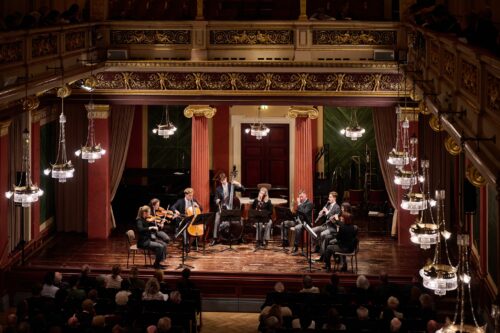
Featured Image: Guest musicians and members of the Orchesterakademie der Wiener Philharmoniker © Barbara Wirl
Members of Orchesterakademie der Wiener Philharmoniker: Katharina Auer (violin), Mei Kaneko, Constance Koblitz (violins), Antonia Ohnimus (viola), Endre Steiger (cello), Benedict Huber (double bass), Katrina Zvonar (flute), Isabella Schwartz (oboe), Valentin Lemberg (clarinet), Melin Acikel (bassoon), Markus Bauer (horn), Mathis Rullière (trumpet), Tobias Achleitner (trombone)
Guest musicians: Nora Gubisch (mezzo-soprano), Alain Altinoglu (conductor), Anneleen Lenaerts (harp), Thomas Steinbrenner (horn), Yu-Tung Pan (piano], Miha Koželj (clarinet), Felix Karner, Moritz Wiedenmann (percussion).
Sounds delightful. Excellent review.