 United States Various: Lorna McGhee (flute), Seong-Jin Cho (piano), Tanglewood Festival Chorus (guest conductor: Jean-Sébastien Vallée), Boston Symphony Orchestra / Andris Nelsons (conductor). Symphony Hall, Boston, 15.1.2026. (LV)
Allison Loggins-Hull – Rhapsody on a Theme by Joni
Bernstein – Chichester Psalms
Tchaikovsky – Piano Concerto No.1 in B-flat minor, Op.23
Arriving from Los Angeles and guest-reviewing in Boston for the first time, I was struck less by differences of orchestral caliber – both cities command excellence – than by differences of atmosphere, presentation and civic engagement. The Boston Symphony Orchestra’s ‘E Pluribus Unum: From Many, One’ is a month-long festival, now well underway. It reflects a curatorial approach that feels newly intentional and, perhaps not coincidentally, aligned with CEO Chad Smith’s arrival from the LA Phil in 2023: thematic programming, contextual framing and a clear desire to connect repertoire to a broader cultural conversation.
As Smith writes, the festival explores ‘those ideas that continue to shape America through the kaleidoscope of voices and viewpoints at play in our music and art’. No single style, he argues, defines American music. Rather, it is the coexistence of distinct voices – heard and valued individually – that leads to solidarity. ‘Empathy begins with understanding’ is a distinctly West Coast-inflected philosophy, but one that here has been absorbed into an institution with deep roots and a strong sense of communal identity.
That sense of framing was evident even before the music began in a series of short video introductions by Andris Nelsons, soprano Jennifer Holloway (who starred in the BSO’s recent Vanessa) and principal flutist Lorna McGhee. The tone was polished, bordering on corporate – Hollywood has long perfected this style – but Nelsons’s remarks from the stage proved far more effective: personal, warm and grounded in lived experience rather than institutional messaging.
Equally striking was the atmosphere inside Symphony Hall. Unlike downtown Los Angeles, where post-concert energy often revolves around escaping parking structures and navigating freeways, Boston’s urban setting fosters a palpable sense of shared occasion. That sense extended beyond the hall: stopping for post-concert snacks at a nearby tavern, one found it packed with audience members still animated by the performance and musicians from the orchestra and chorus as well – lingering, talking and clearly in no hurry to let the evening end. Even the winter weather – brisk and unapologetic – felt folded into the ritual, easily offset earlier by a pre-concert hot chocolate with an espresso chaser at a nearby Caffè Nero.
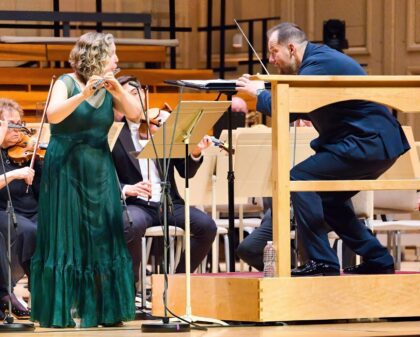
The program opened with Allison Loggins-Hull’s Rhapsody on a Theme by Joni, co-commissioned by the BSO and featuring McGhee in her BSO solo debut. Loggins-Hull, herself a flutist, spoke engagingly about reimagining her source of inspiration – Joni Mitchell’s ‘My Old Man’ – into what she modestly described as ‘a short flute concerto of sorts’. In reality, this is an ambitious, 14-minute concerto that makes formidable technical and expressive demands on its soloist.
Having access to the digital score (an invaluable courtesy to critics) clarified Loggins-Hull’s structural thinking. A helter-skelter opening in the strings, angularly lyrical or lyrically angular, establishes nervous momentum into which the flute bursts with dizzying passagework, alternating with long-limbed lyrical lines that show the instrument’s capacity to spin melody out of pure energy. Her writing for flute and woodwinds is consistently the most vivid; the strings, aside from the recurring frenetic motif, largely serve as texture and propulsion.
A central episode, delicately cued by triangle, leads to an extended solo cadenza in which McGhee explored flutter-tonguing and coloristic effects before reassembling the work’s angular DNA into a jaunty, slightly mischievous theme. Tension mounts as the lyrical material returns against renewed agitation, horn calls reappear and the piece concludes not with rhetorical grandeur but with a simple harmonic resolution that fades away, curiously unresolved. The audience response, however, was anything but ambiguous – closer to hometown fervor than polite new-music appreciation.
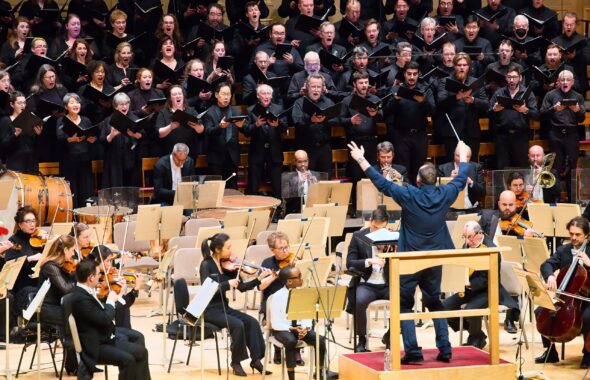
Leonard Bernstein’s Chichester Psalms followed, prefaced by Nelsons’s reflections on living in politically unsettled times and the need for positivity and hope: ‘Even the longest tunnels have a light at the end’. Introducing the soloist, he added, ‘This young gentleman is our present and future’. That ‘gentleman’ was boy soprano Edward Njuguna, whose pure, unforced tone drew the audience into an intimate sound world perfectly suited to Symphony Hall.
The orchestra reveled in Bernstein’s instrumental exuberance, from the bristling opening chorus to rhythms that recall West Side Story. The stillness before ‘Why do the nations rage?’ was exquisitely judged; percussion punctuation was crisp without aggression. Concertmaster Nathan Cole’s nanosecond-early down bows in the string interlude added urgency without fuss. The cello quartet towards the end of the final movement was sublime, capped by a stand-partner’s exchanged nod of shared satisfaction. The Tanglewood Festival Chorus sang with passion and unanimity, and although the final plea for unity is not quite peaceful, the message landed clearly. The audience rose as one.
After intermission came Tchaikovsky’s Piano Concerto No.1 with Seong-Jin Cho as soloist – seemingly an outlier in a festival devoted largely to American music. Yet its inclusion was anything but arbitrary. The concerto received its first successful performance in Boston in 1875, played by Hans von Bülow, after being dismissed in Russia as ‘worthless and unplayable’. Heard through that lens, the piece becomes part of the American story: a reminder that openness to new voices and second chances has long been central to the country’s cultural identity.
Cho and the BSO delivered the concerto with patrician power and audiophile clarity, the piano occupying a commanding central space while remaining fully integrated. His phrasing showed remarkable dynamic range and long-arched continuity, and fast passagework flowed effortlessly. The monumental first-movement cadenza unfolded in a finely graded palette of half-tones, releasing its accumulated energy into a thrilling, if slightly perfunctory, close.
The second movement breathed with gentle internal pulses that kept the line alive, Cho’s final statement calm and inward. The finale, Classical in profile at its opening rather than in temperament – its initial gesture recalling Beethoven’s Op.37 more than late-Romantic excess – was played with striking clarity and poise. If some transitions felt less fully integrated, the forward momentum and cumulative energy still carried orchestra and audience alike to an enthusiastic conclusion.
As an encore, Cho offered Chopin’s Waltz in C-sharp minor, Op.64 No.2, beautifully poised, its poetry carried by the unaffected simplicity of his phrasing.
Laurence Vittes
Featured Image: Andris Nelsons conducting the Boston Symphony and Tanglewood Festival Chorus in Chichester Psalms © Hilary Scott