 United Kingdom Verdi, La traviata: Soloists, Chorus and Orchestra of the Royal Opera House / Antonello Manacorda (conductor). Broadcast live (directed by Ian Russell) from the Royal Opera House, Covent Garden, to Cineworld Basildon, Essex, 14.1.2026. (JPr)

La traviata is the near-perfect vehicle for three singing ‘stars’ and if it gets them audiences will come time and again to hear it – even in an aging production: this is something The Royal Opera has realised with the very frequent revivals of Sir Richard Eyre’s 1994 production. However, it is increasingly something of a concern that the ‘stars’ it requires are something of an endangered species or, at the very least, cannot always be persuaded to appear in London. Nevertheless, there are three different casts of principal singers during this current run of performances.
Verdi wrote his best operas in two periods of his life – the middle years produced Rigoletto, Il trovatore and La traviata, and the latter years produced Aida, Otello and Falstaff. He was at the height of his powers when he composed La traviata for Venice’s Teatro La Fenice in 1853 and the dramatic structure of the opera is almost perfect with few of the longueurs of some of his subsequent works. The first act recounts the attraction of Violetta, a consumptive courtesan, for a penniless aristocrat Alfredo Germont; in Act II there is the confrontation between Violetta and Alfredo’s father who demands she abandons her scandalous liaison with his son; and this is followed by Alfredo denouncing Violetta at her friend Flora’s party – which admittedly is initially held up by some gypsies and bullfighting nonsense – before a final act showing their reconciliation cut short by Violetta’s dramatic death from TB.
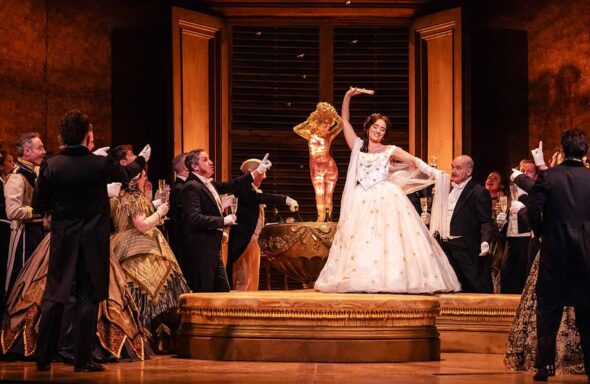
Eyre’s staging – it was his very first opera – is now efficiently recreated by Simon Iorio: it is over three decades old, and I was there in 1994 when it was first on and Sir Georg Solti conducted Angela Gheorghiu, Frank Lopardo and Leo Nucci in the leading roles. I have returned to the production several times since across the intervening years, possibly when ‘stars’ genuinely were ‘stars’. Apparently, Solti’s singular demand of designer Bob Crowley was ‘I want big frocks’ and his monumental sets and sumptuous costumes – apparently there are over 2000 for the current revival – help to provide an atmospheric, straightforward, uncontroversial framing for the unfolding tragedy.
Everything is solidly three-dimensional – and possibly rather unwieldy – meaning it is all longer than it need be with its two prolonged intervals. Violetta’s Act I salon is very opulent with an ice sculpture centrepiece and all the gold glitter, yet it has always seemed rather overpopulated with all the party guests on the stage. In comparison, Violetta’s country house with paintings propped up against the wall and ready to be sold clearly illustrates her financial plight. Later, a sparsely furnished bedroom in Act III with large, shuttered windows and a huge, dilapidated mirror (in which Violetta cannot bear to see herself yet sees visions of past events) ‘mirrors’ her decline perfectly. Only Act II Scene 2 with the guests partying around an over-sized green baize gambling table complete with huge overhead light and semi-circular ‘bullring’ for the gypsy entertainers, is rather incongruous. This rather diminishes the intensity of the Violetta/Alfredo confrontation, even if it is a spectacular setting for the showstopping mock- matadors, bulls and gypsies.
Ermonela Jaho first sang Violetta at Covent Garden in 2008, stepping in at the last moment for Anna Netrebko and apparently has sung the role over 300 times in her career so far. With respect, time has appeared to have taken its toll and it was significantly clear that – as she admitted herself in a filmed interview – she finds singing Violetta ‘challenging’ now she is more experienced (her term for ‘old’). From the start everything indeed seemed a ‘challenge’ for Jaho, and it was as if she did not entirely trust her technique, high notes were a little shouty and during ‘È strano! … Ah, fors’ è lui’ and ‘Sempra libera’ she was cupping her ear for help with pitching her notes and singing into the scenery perhaps to help her sound carry through to the audience. It was impossible to feel much sympathy for Jaho’s ailing Violetta who appeared fatally doomed from the start, and her acting became increasingly histrionic across the three acts (as seen in Ian Russell’s frequent close-ups for the screen) perhaps to compensate for some vocal unease.
It should have been a wonderful evening and what went wrong is not easy to explain. Certainly, there is no blame attaching to conductor Antonello Manacorda who once passed the shimmering violins of the prelude (inspired surely by Wagner’s Lohengrin?) eschewed bathos, conducting with complete understanding of dramatic pacing and encouraging his excellent orchestra to bring the opera to real emotional life. Only very occasionally did I suspect Manacorda was unwilling to give Jaho the tempo she wanted.
Her Alfredo was young Italian tenor Giovanni Sala who was making his Covent Garden debut. His voice was lyrical and bright, yet there is much Mozart in his repertoire and Sala sounded more a Mozart tenor than a Verdi one. La traviata may not be a full-blown verismo opera but it does have some moments when a more dramatic sound is useful – especially in Act II with ‘De’ miei bollenti spiriti’ and ‘O mio rimorso!’ – and here Sala was, for me, rather underwhelming. Sala is tallish and gangly and there was little of the sexual chemistry a great Violetta and Alfredo pairing might display.
Should Germont père be anything other than a rather one-dimensional character, I think so. Some have definitely brought more depth and motivation than Aleksei Isaev – an undoubtedly Russian-sounding baritone – brought to the character here. It might as well have been a concert performance when Isaev sang his Act II ‘Pura siccome un angelo’ and ‘Di Provenza il mar, il suol’ with a certain sangfroid and standing mostly stock still.
Current Jette Parker Artists made up much of the remaining cast who did well with what little Verdi gives them: Ellen Pearson, sang Flora and Sam Hird (Baron Douphol), Giorgi Guliashvili (Gaston) and Ossian Huskinson (Marquis d’Obigny) were all solidly sung vignettes; as were Barnaby Rea as Doctor Grenvil and Veena Akama-Makia (a former Jette Parker Artist) as Annina. Despite some undoubtably reliable performances – and not forgetting the always dependable chorus – overall this La traviata revival lacked a compelling frisson which could have elevated it from just an okay one to something more memorable.
Jim Pritchard
Featured Image: Sir Richard Eyre’s La traviata Act I – Ermonela Jaho (centre, Violetta) © Pamela Raith
Cast:
Violetta Valéry – Ermonela Jaho
Alfredo Germont – Giovanni Sala
Giorgio Germont – Aleksei Isaev
Annina – Veena Akama-Makia
Doctor Grenvil – Barnaby Rea
Flora Bervoix – Ellen Pearson
Baron Douphol – Sam Hird
Gastone de Letorières – Giorgi Guliashvili
Marquis D’Obigny – Ossian Huskinson
Giuseppe – Andrew Macnair
Messenger – Thomas Barnard
Servant – Eugene Dillon-Hooper
Flowergirl – Saskia Cheetham
Production
Director – Sir Richard Eyre
Revival Director – Simon Iorio
Set designs – Bob Crowley
Lighting design – Jean Kalman
Director of movement – Jane Gibson
Chorus director – William Spaulding
I cannot agree with this critic. We saw the performance at the cinema this week and thought it was wonderful. Ermonela Jaho displayed an amazing insight into the character of Violetta. The last act was particularly emotional. Her movement on her deathbed. The delicate way she approached her last aria. We were in tears as we were so deep inside the story, and she brought it to life. I did think her runs in ‘Ah, fors’è lui’ were lacking flexibility. But everything else she did in her performance made up for it.
Alfredo also drew emotion from her and I liked the feeling he was slightly younger than her, which gave credence to their relationship.
JP for S&H: Am really delighted that you found this La traviata more affecting than I did, but regarding EJ’s emoting, for me less still would have been more.
I agree!
About two or three years ago I attended an interview and CD launch given by Ermonela Jaho. The audience in the hundred or so capacity venue consisted mostly of Jaho fans, familiar with her work. I was new to her name, voice and work.
During the interview Jaho described her approach to her roles, focusing on what she believed the public wanted. The word ‘public’ was her most often used word., she prioritised the public at the expense of the composers, librettists and characters of her roles.
My response to Ermonela Jaho’s frank interview was not to spend any time on her work.
Then you have missed out on some fantastic performances. I am sorry for you.
I think the reviewer is being generous here. Jaho’s voice was not right for the role. Bluntly I think she’s too old. There was a certain ‘heaviness’ to her not very attractive voice. And she looked too old, too. The cinema is unforgiving in this regard.
I have to agree that her singing was not 100% at times but her acting made up for it …the final act was very moving but she looked totally exhausted. Maybe it should be the end of her Violetta on stage and she could move to new roles. It’s always sad not to know when to say No. Nevertheless we enjoyed this performance. Thank you to the whole team.
Thoroughly enjoyed the cinema performance today thought Ermonela’s voice beautiful. Delighted to get the opportunity to see such great performances.
I totally disagree with the critic and others. The performance was superb. Ermonela is not old! Violetta is ill and was portrayed perfectly.
I fear the critics criticise for the sake of it! Shame on you.
Jim for S&H: Please note I did not attach the word ‘old’ to EJ in any way apart from reporting what she said herself in her interview. Sometimes time catches up with singers, sometimes it doesn’t for quite a while. I am free thankfully with S&H to give an honest opinion based on decades observing singers, am I right … maybe not always … but it is my honest opinion.
I watched this in a cinema in Glasgow…I was surprised…this is Covent Garden after all…they chose to transmit this to the world…the soprano has sung more than 300 Violetta…they all seemed slim…youngish…and good looking…what about the quality of their sounds???…is it not possible to find singers whose voices don’t disappear from mid to lower range…and use language as if they understand the words?…you English critics often have the cheek to criticise Italian opera and great Italian opera singers…yet you choose to ignore what is obviously third-rate singing…I did not stay to the end…I had no interest in listening to Violetta crooning her way through the last act of Verdi’s masterpiece with half a voice…I looked around the cinema…probably less than 20 people in the entire place…how come???
No voices…that’s how come…opera isn’t about sophisticated mystifications, esoteric convoluted degree-educated mirage nonsense!!! opera is about emotions…it’s about the shiver generating power of the human voice…the voices need to be of remarkable power and colour…so that the vast number of the public might actually be interested in making the effort to go and enjoy the peculiar experience of hearing a great voice in a great building able to scale a full orchestra in full flood of passionate torrid sound…then you will get bums on seats…and how!!!
I’ve seen La traviata many times. Ermonela performance is spellbinding; sung with a depth of feeling out passing anything I’ve seen before. She gave everything she had and more. A truly memorable experience.
I’m flabbergasted by some of the comments here. I was at the ROH when the performance was filmed, and I was spellbound. I’ve seen this production at least 15 times. I know it (I was there in 1994), I love it, I take every opportunity to see it. But this was something else. Ermonela may not be in the first flush of youth, but her emotional engagement is unequalled – and her singing more than meets the technical demands of the role.
I was so enthralled by the live performance that I went back for a cinema encore. I don’t know what the sound engineers did, but the powerful effect of her pianissimos was all but lost. Watching her live, I have never seen anyone so embody the role of Violetta and, in the opera house, her pianissimos were simply heart-breaking.
To be fair to the reviewer who gave Ermonela a starry review for her breakthrough Violetta in ROH 18 years ago, I can understand his disappointment. The coloratura which earned her his plaudits then is no longer executed as cleanly in this performance. Ermonela’s now 50. Her voice has now changed. It’s no longer as light and agile as it once was. Predictable since she’s now moved on to heavier lyric soprano roles like Butterfly which has become a second calling-card role for her. It’s just unfortunate that the coloratura part which shows her to least advantage is what opens the opera. I admit it’s only her reputation alone that made me persist to the later two acts in the opera. The coloratura numbers were frankly acceptable only.
Ermonela more than redeemed herself from the second act onward. Today, we’re spoiled for choice with the number of good sopranos singing Violetta but there are few who are able to sing Violetta with as wide a range of colors as Ermonela displayed, even at this advanced stage of her career, where one would normally expect a singer’s timbre to fade. Perhaps it’s because I was hearing through the speakers at home, I’m amazed she could still deliver such heart-rending pianissimos which floated and melted in the ear, one after the other. I recently studied the opera with Maria Callas’s classic ROH recording 50 years before Ermonela’s breakthrough. It’s a pleasant surprise that Ermonela measures up well to Callas’s benchmark in the later two acts. I was very satisfied when I heard her performance, even when Callas’s haunting performance was still ringing in my ears.
To the reviewer who commented about the cast’s understanding of the language, Ermonela studied in Italy for several years so she does know the language. To the reviewer who commented about her interview, I think English may be Ermonela’s third language or fourth even, so she may not be as able to express herself spontaneously in an interview on the spot. If she put the public topmost, I don’t think Opera Rara will have invited her to record Donizetti’s recently discovered songs with them. That should do her some credit as an interpreter.
I have never been able to appreciate opera in the past, only having seen La bohème which I didn’t enjoy and The Pearl Fishers which I did a while back.
However I was offered a spare ticket to see this filmed production which much to my surprise, I did enjoy, not so much the first act but but I found Ermonela’s subsequent singing and acting very poignant, so much so, that in her final scenes, I was moved to tears which I did not expect.
Decepcionante. Creo que la opera no es teatro y este caso se ha teatralizado, especialmente en el tercer acto, convirtiéndolo en una escenificación angustiosa, insufrible y narcisista de Ermonela, quizás para intentar encubrir una interpretación algo más digna.
Translation: Disappointing. I believe opera is not theatre, and this production has been theatricalised, especially in the third act, turning it into an anguished, unbearable, and narcissistic portrayal of Ermonela’s, perhaps to try to mask a somewhat more dignified performance.