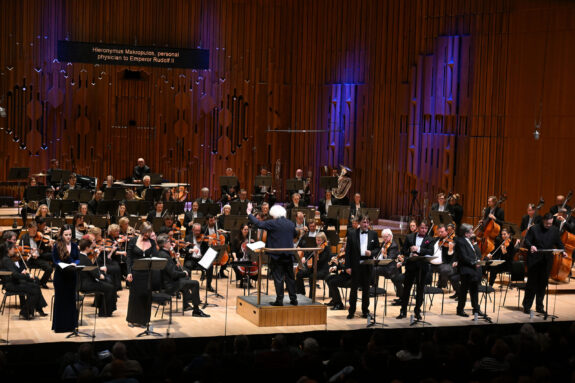
 United Kingdom Janáček, The Makropulos Affair: Soloists, London Symphony Orchestra / Sir Simon Rattle (conductor). Barbican Hall, London, 13.1.2026. (JR)

Cast:
Marlis Petersen – Emilia Marty
Aleš Briscein – Albert Gregor
Jan Martiník – Dr Kolenatý / Strojnik / Machinist
Peter Hoare – Vitek
Doubravka Novotná – Krista
Svatopluk Sem – Baron Jaroslav Prus
Vit Nosek – Janek
Lucie Hilscherová – Cleaning Lady / Chambermaid
Alan Oke – Count Hauk-Šendorf
Sir Simon Rattle and the London Symphony Orchestra continue their unmissable Janáček opera cycle. Having performed splendid concert performances of Jenůfa, Káťa Kabanová, The Cunning Little Vixen and the Excursions of Mr Brouček, Rattle now turned his attention to perhaps the most modern and least sentimental of Janáček’s operas, The Makropulos Affair (also known as The Makropulos Case). And a truly marvellous affair it was.
I saw Dmitri Tcherniakov’s production of The Makropulos Affair at Zurich Opera in 2019 (review here) conducted by Jakub Hrůša, and with Evelyn Herlitzius in the title role. May I refer you to that review for the convoluted and in all senses incredible plot and the history of the opera. Put simply, the opera centres around a law case, contentious probate, which has continued for thirty years, the sort of case lawyers salivate about. Clearly that is why Dr Kolenatý does not want the case going into another lawyer’s hands; to continue to receive fees, he is even willing to commit burglary. The other plot element is a magic potion or elixir ensuring extreme longevity (there are dozens of opera plots involving potions and elixirs): I am never entirely convinced, though, by Marty’s assertion that we should be considered lucky in ‘only’ living, usually, into our eighties or nineties, and living beyond 100 is a misfortune.
I was somewhat underwhelmed by the Zurich production (apart from the realistic set of the lawyer’s office), where – oddly – none of the singers were actually Czech: I did not then feel the opera deserved more frequent outings. Rattle, however, makes no mistakes in that regard and finds splendid Czech nationals for most of the roles. Janáček’s attention to matching the words to the notes is almost unique and the sound of the Czech language, with its consonant clusters, adds to the flavour and quality of the performance, when the language is pronounced accurately with its Slavic timbre.
This opera also lends itself very well to concert performance. There are no choruses, and very little action, barring a few entrances and exits into the lawyer’s office (Act I), opera house dressing room (Act II) and hotel room (Act III). No set or props are really needed. It is set entirely indoors. This performance was almost semi-staged with all the singers acting their parts (Peter Hoare and Alan Oke were stand-outs): this added much to the whole.
German soprano Marlis Petersen made an ideal Emilia Marty, glamorous of appearance and glorious of voice, with harsh vocal attacks where called for. All the male voices, right across the board, were of the very highest order, Janáček calling mostly for a declamatory and conversational style throughout. On one occasion Svatopluk Sem’s volume as Baron Jaroslav Prus had to be reined in by Rattle. At the opera’s première, Janáček was concerned the orchestra might drown out the soloists but there was no such risk here. The singers were all placed at the front of the stage and filled the hall with ease. Rattle kept a firm hand on the dynamics of his orchestral forces.
There were apparently nine (!) rehearsals for this performance (which was to be repeated in three days), and it showed. The orchestra were on top of the score, which fizzed with vim and brio from beginning to end. The first violins were strongly led, audibly and visually: by both Roman Simovic and Benjamin Marquise Gilmore on the front desk. Rattle drew wondrous sounds from all sections of the orchestra and has made the strongest of cases that this opera, infrequent as performances are, should be included along with the composer’s finest operatic works. Whilst it is still not a mainstay of the operatic repertoire, that may now be changing.
So, what next for this cycle? The House of the Dead seems the obvious, though perhaps less enticing choice. We will have to wait and see. I look forward to the release of this Makropulos Affair on LSO Live; it will be a fine addition to any CD library.
John Rhodes
Featured Image: Sir Simon Rattle and the London Symphony Orchestra’s The Makropulos Affair © LSO/Mark Allan