 United States The Met: Live in HD – Bellini, I puritani: Soloists, Chorus and Orchestra of the Metropolitan Opera / Marco Armiliato (conductor). Broadcast live (directed by Habib Azar) from the Metropolitan Opera, New York, on 10.1.2026 and seen at Everyman Chelmsford on 13.1.2026. (JPr)

I puritani was Bellini’s final opera and premiered in January 1835 whilst the composer died – at only 33 – later in September that year. As I have reflected before, I puritani is an opera where not a lot happens whilst taking a long time doing the little there is. It is set in the 1640s during the English Civil War – but do not expect a Roundheads and Cavaliers history lesson – though we do begin in a Puritan stronghold near Plymouth. In a plot that mirrors Donizetti’s Lucia di Lammermoor (also premiered in 1835), Elvira, the daughter of Lord Gualtiero Valton, is resisting the attentions of Riccardo, her father’s choice of husband, because she is actually in love with Arturo who is a Royalist and on the wrong side of the conflict. Her well-meaning uncle, Sir Giorgio Valton, persuades her father to accept Elvira’s choice and he relents, agreeing to her marrying Arturo.
However, Arturo discovers the widow of the executed King Charles I, Queen Enrichetta, is being held captive and he is determined to save her from the same fate. With Elvira’s bridal veil as a disguise and some mistaken identity shenanigans – think Verdi’s later Un ballo in maschera – when confronted with Riccardo; the queen and Arturo make their escape. Elvira believes an unfaithful Arturo has abandoned her and she loses grip on reality in typical Romantic opera fashion. She only regains it when reunited with Arturo towards the end of the opera. However, Arturo is sentenced to death because of his actions and is only saved by the announcement that the Royalists have been defeated and Oliver Cromwell has pardoned all prisoners. For once, all live happily ever after, or at least should …but more of this later.
After the premiere of I puritani at the Met in 1883, a 1918 production only had a few performances until 1919, but the next one first seen in 1976 lasted a good deal longer, ending in 2017. With the end of this current run of Charles Edwards’s new, fairly traditional staging the opera will not have reached 70 Met performances. I suspect Edwards’s vision for the opera will not contribute many more future performances unless a stellar cast like the current one can be guaranteed, since they encourage you to glory in the singing and forget the scenery.
Edwards described in his filmed interview how he went back to the original 1833 play on which I puritani was based, ‘The character of Lucy in the play, who becomes Elvira in the opera, actually starts the play creating a painting and when she is abandoned her self-esteem collapses. It’s probably fragile anyway as she is living in an oppressive Puritan community; and her artistic expressivity of somebody painting in a Puritan environment was completely going against anything the Puritans believed in. It made me really look at the idea of what it means to be an artist in that kind of society and how your expressivity might be construed as some degree of insanity.’
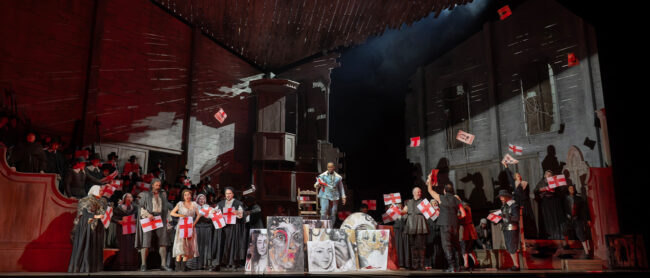
Edwards has designed for the Met in the past and in his first full production he basically provides the blank canvas (!) of a wooden Puritan church with pews either side of a very high pulpit. It is there as the room and hall of Bellini’s fortress, as well as his wooded area near it. Over the other two acts it becomes rather dilapidated mirroring the ongoing Puritans v. Royalists conflict. On display is a royal coat of arms which is not treated with much respect and apart from the odd change in stage furniture; a table and chairs for Act II and a cannon in Act III and some intriguing lighting effects too little changes. For most of the time the singers are restricted to the centre-front of the stage singing out into the audience. The pews serve to allow the chorus to do little more than simply stand or sit around, enter and exit. Gabrielle Dalton’s severe costumes for the Puritans seem historically accurate and mostly black and white, Arturo is adorned in some turquoise frippery with much lace, and the queen is in an extravagant yellow creation.
Edwards has a timeline projected onto the stage from time to time to keep the audiences aware of the important events in seventeenth-century England and begins the story during the Act I prelude with a younger version of Elvira becoming smitten with Arturo (and him with her) as she works on his portrait. After Edwards’s invention of an eight-year gap between the first two scenes; as apparitions – and with some icky green lighting – the young Elvira (particularly) and Arturo will at times ‘haunt’ the rest of the opera. This is amongst many gimmicks which hamper this production, including Riccardo singing his aria swigging from a hipflask and enlisting recruits; Elvira breaking her brushes during her duet with Giorgio; Enrichetta appearing to be their guest and painted by Elvira; and Riccardo risibly clueless that the figure – only with a simple white veil on her head – is Enrichetta and not Elvira. Not to forget an axe-wielding Arturo and his escape with the queen through a high-up window and this is only the first act! It all ends with Elvira having attempted to hang herself before confusing Riccardo with Arturo and straddling him.
More of the same in the final two acts: at one point during the extended mad scene Elvira conjures up the image of Arturo and starts to paint him and during the Riccardo and Giorgio battle cry those and other random men are painted with the Cross of St George, like English football ‘fans’ coming to the US for the World Cup later this year. (This symbol is also on the notices announcing the victory of the Puritans which flutter down at the end of the opera.) In Act III, Elvira is surrounded by her daubings of Enrichetta who she is obsessed with (at one point Elvira has one of the paintings around her neck). The canvasses will be formed into a pyre to immolate Arturo before he is set free. The ending is confusing as after Elvira and Arturo are briefly reconciled, Arturo climbs high up to embrace a figure from the very first scene who might be his father, or even Charles I or II. Your guess is as good as mine.
All comments on what was heard are tempered by the fact that I was listening through loudspeakers, but for me the singing and playing was very impressive. Regular visitor to the Met, Marco Armiliato, conducted vigorously, stylishly but with sympathy for his singers to ensure they were never swamped by the orchestra. There was rhythmic variation and interpretive insights and Armiliato’s idiomatic mastery of Italian bel canto is a given. He was well supported by the under-directed Met Chorus who sang loudly and lustily.
The roles of Elvira and Arturo are so technically demanding that perhaps understandably the singing of Lisette Oropesa and Lawrence Brownlee seemed to eclipse their acting, or was that Edwards’s fault? Elvira goes mad in Act I and remains mad until the very end of Act III and this is a challenge for any interpreter, especially when there is a mute doppelgänger sometimes distracting the audience. Elvira’s vulnerable state was frequently revealed in the coloratura runs and roulades Bellini demands which Oropesa made an extension of her vocal lines rather than mere vocal pyrotechnics. Brownlee also negotiated Bellini’s perilously high-lying phrases with consummate ease, he is a stylish, elegant singer with a delightfully sweet-sounding, lyrical voice but he does not portray the most ardent of lovers. Brownlee did hit the famous high F (above high C) in ‘Credeasi, misera’ in the last act, but, like Oropesa, there was no grandstanding.
The rest of the cast had great strength in depth in support of this wonderful double act: there was Christian Van Horn with his dark, sepulchral bass-baritone as Giorgio, Elvira’s benevolent uncle, and while most of the other characters are largely underwritten and make little impact there was possibly a star is born in Ricardo José Rivera, making his Met debut as a very late-replacement for Artur Ruciński as the infatuated Riccardo. With his strong and forthright baritone, the young Puerto Rican deserves further opportunities at the Met. Finally, David Pittsinger as Elvira’s father, Gualtiero, and Eve Gigliotti as the queen, did well with the little the composer allowed them.
Jim Pritchard
Featured Image: Charles Edwards’s new Met I puritani (final scene) © Ken Howard/The Met
Production:
Production & Sets – Charles Edwards
Costumes – Gabrielle Dalton
Lighting – Tim Mitchell
Movement director – Tim Claydon
Chorus director – Tilman Michael
Live in HD Host – Ailyn Pérez
Cast:
Bruno – Tony Stevenson
Riccardo – Ricardo José Rivera
Young Arturo – DeAundre Addison
Young Elvira – Taylor Massa
Lord Talbot – Richard E. Waits
Elvira – Lisette Oropesa
Giorgio – Christian Van Horn
Arturo – Lawrence Brownlee
Gualtiero – David Pittsinger
Enrichetta – Eve Gigliotti
I second all of Jim Pritchard’s assessments on the abysmal staging of I Puritani by Charles Edwards. You could have fried an egg on my forehead when witnessing Elvira’s sleazy reaction to being supposedly abandoned by Arturo… straddling Ricardo etc., …IN THE CHURCH no less…I suspect that if this had really happened in the midst of the Puritans they would have immediately drawn and quartered her. Ridiculous. And how about having someone urinate on the coat of arms…another churlish trick. And how about the distasteful public birth on a bloody mattress? This would NEVER have happened… and I could go on and on. This guy has no idea of history or propriety. I had a hard time enjoying the singing because of it. Bellini must have been rolling. BAH!