 United States Verdi, Aida: Soloists, Metropolitan Opera Chorus and Orchestra / John Keenan (conductor). Metropolitan Opera, New York, 9.5.2025. (RP)
‘It’s a long, long while from May to December’ goes Kurt Weill’s ‘September Song’, and the reverse is also true, give or take a month. The New Year’s Eve premiere of Michael Mayer’s production of Aida at the Metropolitan Opera went off the rails due to an ailing Piotr Beczała, who ill-advisedly attempted to sing the role of Radamès. There were calls for General Manager Peter Gelb’s head over what in hindsight seems a tempest in a teacup. With SeokJong Baek taking over the part for the next two performances, things were back on track. (For review, click here.)
Mayer’s production has its critics due to his injection of a ‘Tomb Raider’ concept into the plot. Eager and pert early-twentieth-century archeologists discover and carry off the treasures of the long-buried royal palace in ancient Memphis throughout the opera. One of them finds a dagger with a royal insignia, which Amneris plunges into her breast in the final seconds of the opera. None of this is in the script, but audiences vote with their feet, and there was a full house for this, the seventeenth and final performance of the run.
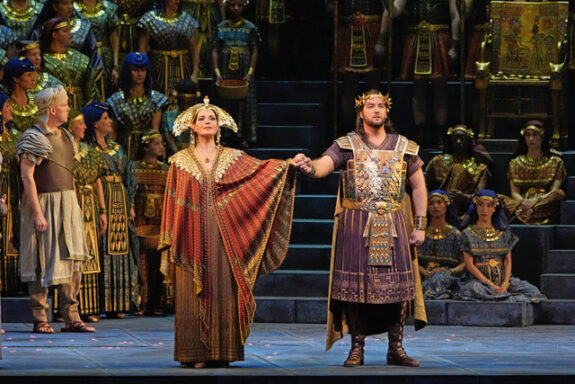
It is a grand production with rich architectural details and monumental sets. The Triumphal March is awash in color and full of spectacle as Egyptians and their Ethiopian captives fill the stage. Scene changes are quick and seamless, especially the final one in which the tomb where Aida and Radamès will die rises from the depths on the Met’s stage elevators.
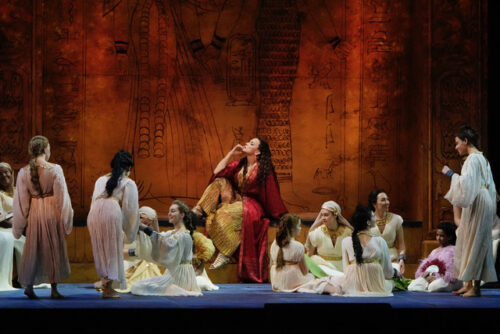
Oleg Glushkov’s choreography almost steals the show. The women dancers who entertain Amneris in her chambers beguile with their sinuous, fluid movements. The men’s athleticism, energy and precision created a sensation in the Triumphal March. There was a ‘whoopee’ from someone in the audience, and members of the chorus joined in the applause that erupted when they finished. Neither is an everyday occurrence at the Met.

Musically, this performance was also a triumph. Angel Blue was the first Aida of the run and returned for the final four performances. She was in glorious voice, and her portrayal has increased immeasurably in vocal and dramatic depth since January. While her high notes did not float and shimmer in ‘O patria mia’, they did in ‘O terra addio’, as did those of Brian Jagde, who sang his first Met Radamès in 2022. Jagde always had the voice of a warrior – big, bold and gleaming – but he has grown into the role dramatically, bringing emotional depth to the part. He is also a more subtle singer now, even though he didn’t take a stab at a diminuendo on the final high B-flat of ‘Celeste Aida’ that Verdi asked for. But how many tenors do before a live audience?
Absent from the Met since 2022, Elīna Garanča returned in April for her debut as Amneris, taking over from the powerhouse mezzo-soprano Judit Katusi. Garanča’s Amneris is cut from entirely different vocal cloth than that of Katusi. If decibel levels and a cavernous chest voice are your thing, Garanča won’t be your cup of tea, but she rewards with seamless, molten tone and thrilling high notes. Her Amneris can be girlish and frivolous, but she instantly becomes cold, calculating and vengeful when crossed. The ovation after her emotionally wrenching and vocally searing Judgement Scene was the loudest and longest of the evening. When she plunged the dagger into her chest, gasps were heard throughout the house.
The April cast changes also saw Amartuvshin Enkhbat return to the Met as Amonasro. He too has not been heard at the Met since his 2022 debut as Germont in Verdi’s La traviata. While Enkhbat’s voice is rich and commanding, a bit more fire in his gut as an actor would elevate him to the top echelon of today’s baritones.
Morris Robinson, who has sung Ramfis for most of the run, dominated the stage with his imposing voice and stature. Even taller and with an equally sonorous voice, Krzysztof Bączyk reigned supreme as King. Tessa McQueen, a member of the Met’s Lindemann Young Artist Development Program, made her Met debut as the Priestess. The rising soprano has a luscious voice, and although McQueen was never seen, she cast an exotic spell over the rites at the Temple of Vulcan.
Conductor John Keenan, who debuted at the Met leading Don Giovanni in 1990, was in the pit for this final performance. It was Keenan’s sole engagement at the Met this season, and he led a splendid performance. His timing was perfect, he breathed with the singers and got to the emotional core of every scene. He is not a regular presence at the Met these days, and more is the pity for that.
Rick Perdian
Production:
Production – Michael Mayer
Set designer – Christine Jones
Costume designer – Susan Hilferty
Lighting designer – Kevin Adams
Projection design – 59
Choreographer – Oleg Glushkov
Chorus master – Donald Palumbo
Cast:
Ramfis – Morris Robinson
Radamès – Brian Jagde
Amneris – Elīna Garanča
Aida – Angel Blue
King – Krzysztof Bączyk
Messenger – Yongzhao Yu
Priestess – Tessa McQueen
Amonasro – Amartuvshin Enkhbat