
 United States The Met: Live in HD – Giordano, Andrea Chénier: Soloists, Chorus and Orchestra of the Metropolitan Opera / Daniele Rustioni (conductor). Broadcast live (directed by Gary Halvorson) from the Metropolitan Opera, New York, to Cineworld Basildon, Essex, 13.12.2025. (JPr)
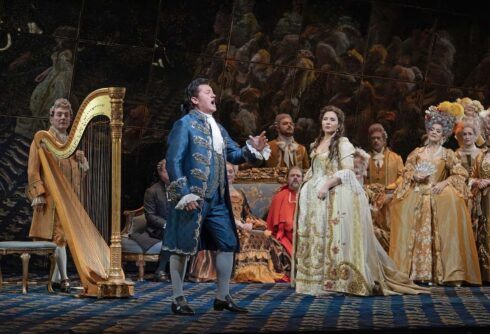
This was only the second production of Andrea Chénier I have any lasting memories of; although the mise-en-scène of Nicolas Joël’s 1996 traditional staging at the Met is not far removed from that which Sir David McVicar created for Covent Garden in 2015. That was as safe, conventional and uncontroversial as anything McVicar – a former enfant terrible – had ever directed. It may not be just any other Andrea Chénier you might have seen that the opera reminds you of, because Umberto Giordano’s work clearly ‘inspired’ his contemporary Puccini’s Tosca, first performed almost four years after Andrea Chénier premiered in 1896.
Andrea Chénier is essentially a ‘can belto’ verismo three-hander, C is infatuated with B (Maddelena), but she loves A (Chénier). To Giordano’s credit he makes Carlo Gérard, the ‘C’, less of the usual two-dimensional ‘villain’ by giving him a conscience. The most dramatically credible moments in Andrea Chénier are in Acts III and IV with Gérard becoming a kinder Scarpia after trying to force himself on Maddalena. She gets her heartfelt ‘La mamma morta’ which morphs into ‘Vissi d’arte’ in Tosca and later Chénier sings his reflective ‘Come un bel dì di maggio’ which will become ‘E lucevan le stelle’. There is that pivotal – and highly dramatic moment – in the second act of Tosca when Scarpia whisper ‘Ebbene?’ as the heroine prepares to offer herself in exchange for the hero’s freedom and this – and the word – is repeated in Andrea Chénier.
The stories of the two operas are related to the French Revolution to a greater or lesser extent: Andrea Chénier is set against France’s bloody ‘Reign of Terror’ and even if we are in Italy for Tosca, it is Napoleon’s post-Revolution French army who are in the background to all the events. It is not surprising therefore that both operas have the same librettist, Luigi Illica, and it is as though Puccini saw his contemporary’s popular success and thought ‘I can do that … yet better!’.
In Tosca there is that rousing climactic third-act soprano-tenor duet as Cavaradossi prepares for what he believes is a mock execution and the lovers get ready to flee Rome: Giordano has them bravely awaiting the guillotine. However, many will think at this point of how Aida and Radamès accept their fate in their Act IV entombment in Verdi’s 1871 opera, as well as Tristan und Isolde (more later).
Time to stop this now as I could go on since there is clearly so much that is familiar from something else including the powdered wigs, rouge, voluminous skirts and frock coats in Act I rekindling memories of the wonderful Carry On film, Don’t Lose Your Head, and the Tricolore-waving citizens revolting and demanding ancien régime change clearly bringing Boublil and Schönberg’s Les Misérables to mind!
In 1996 there were actually three intervals, but this is now reduced to two, though even that is one too many. Thankfully, a pastoral ballet in the first act is cut but there are still the longueurs of a hoary old melodrama which – with the sprinkling of memorable arias, duets and choruses which hold up the action, such as it is – is an emotional rollercoaster of love, liberty and the pursuit of happiness through revolution. Act I appears to have come from an entirely different production with just a huge sofa, a harp and stool, and not much else part from – to the back of the stage – an off-kilter false proscenium arch enclosing a huge mirror. Act II has columns and a colonnade arcade, Act III has a bench for the judges and tiered seating, and the imposing silhouette of a guillotine looms ominously in the background of the final act.
When new in 1996 Joël’s Andrea Chénier showcased Luciano Pavarotti attempting the title role for the very first time. Although he made a success of it – at 60 – his gifts were believed to be on the wane and he was becoming less able to move around the stage appropriately. This revival features another tenor approaching 60 also making his role debut; however, Piotr Beczała is still at the height of his considerable powers. Beczała was asked why he is singing this now and after saying that for a tenor the role is a ‘goal’ in the verismo world, he continued ‘Cavaradossi is beautiful but is very short but Andrea Chénier is [a] kind of soul-filling role. You know you have a beautiful four arias, you have two beautiful duets and the character is very, very interesting.’ It is 19 years since Beczała’s Met debut as the Duke in Rigoletto and he reflected on how his voice has only changed ‘slightly, not a huge change’. The Polish tenor revealed that he can still sing that role and how Andrea Chénier ‘is the same amount of high notes’ and, in fact, is higher with two b-naturals compared to one in the Verdi.
Indeed, Beczała is perhaps the most versatile of the leading tenors of this generation; he has great vocal stamina, sounds Italianate, heroic, loud (though without shouting), ardent, capable of elegant refinement and has impeccably clear diction. Also, he is still perfectly capable of conveying the doomed revolutionary poet’s youthful (well, slightly mature now) ardour. Before Madame Guillotine’s unkindest cut of all, the role needs the voice of a Siegfried particularly when having to sing ‘Vicino a te s’acqueta’ at the very end with a soprano who – like Brünnhilde in Siegfried – has been offstage more than on it! Though with the lovers hoping to triumph over death it is perhaps more Tristanesque.
Sonya Yoncheva acted convincingly Maddalena’s girlish infatuation with Chénier from the very first moment she catches sight of him, from then on she virtually stalks him because of her fixation. She loses her home, her mother (who is murdered) and lives off her servant Bersi’s immoral earnings. By the time she sang the famous Act III aria ‘La mamma morta’ Yoncheva’s voice had warmed up after a slightly uncertain start with her voice having a darker-toned, mezzo-ish timbre; however, when singing ‘La mamma morta’ Yoncheva was now at her considerable best recounting her character’s torment and travails, poignantly with great dramatic intensity and remarkable vocal colours. Unfortunately, Yoncheva treated it as a concert aria and came out of character during the thunderous applause that followed to mouth ‘Thank you’.
Carlo Gérard is a footman who is indignant at the sight of his aged father worn down by long years working for the nobles and this stirs his revolutionary zeal. Igor Golovatenko has a remarkably sturdy, forthright – and in many ways impressive – baritone voice but I would have welcomed more warmth and lyricism.
There was strength in depth in the supporting cast: Siphokazi Molteno was the loyal and plucky Bersi and Olesya Petrova provided an incredibly emotional vignette as the blind Madelon who gives up her young grandson to fight for the Revolution. Brenton Ryan was suitably wheedling and conspiratorial as the oddly named spy, Incredible. The veteran Maurizio Muraro was somewhat overparted though gave Mathieu a certain gravitas. Solid performances too from Alexander Birch Elliott as a foppish Fléville and Guriy Gurev as the supportive Roucher.
The Met Chorus made a resounding contribution when called upon. In his first appearance as the Met’s new Principal Guest Conductor Daniele Rustioni whipped his wonderful orchestra through to the incandescent final few minutes – as Chénier and Maddalena fearlessly prepare for death – with a Romantic sweep. There was ebb and flow as Rustioni navigated the opera’s dramatic shifts with an expert hand, without entirely disguising the longueurs. We heard from Rustioni during a pre-recorded segment about his connection to Andrea Chénier: ‘I grew up at home [in Italy] with the VHS of this wonderful production from the Met in 1996 and I consumed that VHS and for me it is a great honour and incredible pleasure to be at the centre of the musical storm and at the centre of this Reign of Terror and this French Revolution, it’s really an immense, immense joy.’
Jim Pritchard
Featured Image: Sonya Yoncheva (Maddalena), Piotr Beczała (Andrea Chénier) and Brenton Ryan (Incredibile) in Act II © Karen Almond/Met Opera
Cast:
Andrea Chénier – Piotr Beczała
Maddalena di Coigny – Sonya Yoncheva
Carlo Gérard – Igor Golovatenko
Countess di Coigny – Nancy Fabiola Herrera
Bersi – Siphokazi Molteno
Fléville – Alexander Birch Elliott
Abbé – Tony Stevenson
Major-Domo – Ben Strong
Mathieu – Maurizio Muraro
Incredibile – Brenton Ryan
Roucher – Guriy Gurev
Madelon – Olesya Petrova
Dumas – Jeongcheol Cha
Fouquier-Tinville – Christopher Job
Schmidt – Richard Bernstein
Creatives:
Production – Nicolas Joël
Revival Stage director – J. Knighten Smit
Set and Costume designer – Hubert Monloup
Lighting designer – Duane Schuler
Chorus director – Tilman Michael
Live in HD Host – Lisette Oropesa