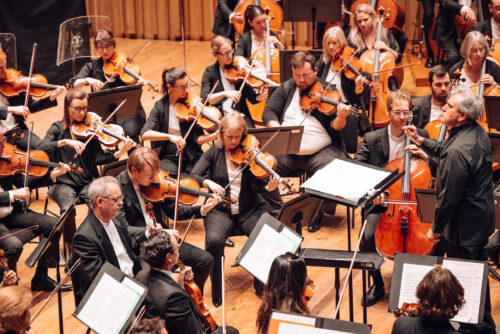
 United Kingdom Musgrave, Walton, Vaughan Williams: Antoine Tamestit (viola), London Symphony Orchestra / Sir Antonio Pappano (conductor). Bristol Beacon, 13.12.2025. (CK)

Musgrave – Phoenix Rising
Walton – Viola Concerto
Vaughan Williams – Symphony No.2: A London Symphony
Thea Musgrave is 97 years young: snapping at the heels of Dick van Dyke and Sir David Attenborough. She has composed prolifically: I suppose the blame for the fact that this was the first time I have heard her music in live performance should be apportioned between myself and those who decide what should and should not be played. More positively, I am grateful – as, I am sure, were many present – to Sir Antonio Pappano and the London Symphony Orchestra for playing Phoenix Rising in London and Bristol.
Phoenix Rising was written in 1997 and dedicated to Sir Andrew Davis, who gave the first performance: appositely and touchingly, Pappano dedicated this concert to Sir Andrew’s memory. In a little over 20 minutes it enacts a journey from darkness to light, from turbulence to peace: the disruptive timpanist (shades of Nielsen’s Fourth) and four percussionists batter away at drums of various sizes, transferring – as the phoenix rose – to mostly tuned percussion and sounds of the utmost delicacy. There was a theatrical element, decorous rather than dramatic: the hero (the principal horn) began offstage, while the villain (the timpanist) ruled the roost; when the horn appeared on the stage the rest of his section stood (a briefly Mahlerian moment); and as he joined them the timpanist retreated offstage the other side of the platform, his distant drums reduced to a desultory muttering.
Musgrave’s music is never less than interesting, and often compelling, as it moves from jarring dissonance via romantic intensity to shimmering calm. It is skilfully written – even in the loudest passages we could always hear what the strings were doing – and there were telling solos for flute and piccolo, cor anglais and contrabassoon, violin and cello. Timpanist, percussionists and solo horn – virtuosos all – richly deserved their ovations.
I wonder what its first audience made of Walton’s Viola Concerto, the earliest of his three concertos for a stringed instrument? Perhaps they recognised the lively Scherzo as the work of the young composer, still in his 20s, of Façade and Portsmouth Point (Belshazzar’s Feast and the First Symphony were yet to come): but the gentle seriousness of the opening movement must have come as a surprise. So too the extended and eventful finale, which opens in scherzo vein and seems to work its way back to the mood of the opening. The fine soloist, French violist Antoine Tamestit, called it ‘a nostalgic love story’: and that seems as good a description as any, since the solo part is given more to feeling than to obvious display (despite double-stopping), and the composer seems to be responding to the mellow quality of the instrument itself.
We heard Walton’s 1961 revision of the score, with added harp and reduced brass and woodwind (though Pappano opted for an extra piccolo and bass clarinet instead of having flute and clarinet double them). Walton puts the solo viola through some demanding and contrasting adventures, some intimate temporary relationships with orchestral instruments, and some noisy standoffs: but my enduring impressions are of the pensive opening of the work and the return to that mood at the very end, after a prolonged orchestral tutti which gives the last section – the viola musing over gentle bass clarinet and harp – a valedictory and reflective character. Tamestit’s fine and thoughtful playing of his encore – Henri Vieuxtemps’s Capriccio – seemed to continue the spell of Walton’s concerto rather than breaking it.
Vaughan Williams’s A London Symphony is as sheerly beautiful as any symphony in the repertoire. Does it dig as deep as Elgar, Mahler or Bruckner? It almost does – certainly in a performance of such imaginative and emotional amplitude as this one. There was no question here of viewing the symphony reductively as a sequence of picturesque tone poems: as Stephen Johnson wrote in his programme note. ‘there’s a current, like that of the River Thames itself, which not only carries the ideas forward, but also challenges us to seek out deeper meanings.’ Pappano and his orchestra were in the centre of this current from beginning to end. Every section of the LSO was outstanding: it hardly seems fair to pick out the shining, beautifully blended playing of the brass. What Pappano and the LSO are doing for British music is something to be treasured – and preserved.
Chris Kettle
Featured Image: Sir Antonio Pappano conducting the London Symphony Orchestra © Soul Media