 Hungary Puccini, La bohème: Soloists, Hungarian State Opera Children’s Chorus, Hungarian State Opera Chorus and Orchestra / Martin Rajna (conductor), Hungarian State Opera, Budapest, 12.12.2025.(AK)

Advertised as a final rehearsal for the current series of La bohème performances, which started the following day on 13th December, the performance on 12th December seemed ready to be enjoyed and written about. In fact, the production is uniquely old: the first presentation of this staging by stage director Kálmán Nádasdy, stage designer Gusztáv Oláh and costume designer Tivadar Márk premiered eighty-eight years ago on 11th May 1937.
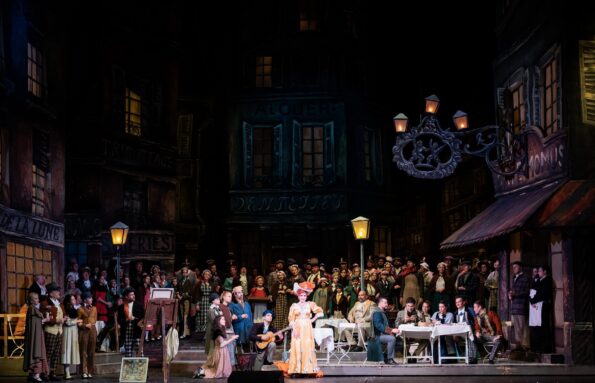
Stage direction, design and costumes are magical, heart-warming, deeply moving and true to Puccini’s masterpiece. Each scene looks truly as described by the libretto; the room of the four young men is a credible impoverished attic, the Paris scene in Act II could not be anywhere else but in Paris. The production is so good that I am delighted to report that since the past thirty-two years, from 1993, stage design and costumes have been protected: no change can be made to them.
Singers and orchestra ensure that the drama stays alive; it does not feel like a decades-old relic, on the contrary: the action is happening now. The team work on stage is exemplary. It is of note that outstanding bass singer Gábor Bretz fits in beautifully as one of the four Bohemians. He is an opera star with astonishing roles behind (and ahead) of him: in April I reviewed his astonishing double-bill (review here) – yet, dispensing with any star allure, here he is one of the boys. His rendering of Colline’s coat aria ‘Vecchia zimarra senti’ was as sensitive as restrained.
Sung in Italian with surtitles in English, Hungarian and also in Italian, we are not watching opera stars on the stage. We are watching – most credibly – real people with struggles which we can all identify with. The chorus does not overpower the main protagonists: they give full support; at times they act as a Greek chorus watching and commenting. Humour on stage is linked to the musical score: in Act II, string pizzicato and harp chords are mirrored by a mock guitar serenade with three young dancers on stage.
The little boy in Act II demanding a trumpet and a toy horse (‘Vo la tromba…’) was perfect. He stood directly opposite the conductor, looked at him attentively, and delivered his few notes with perfect pitching and timing. On the other hand, the two excellent lady protagonists (Lilla Horti as Mimì and Zita Szemere as Musetta) did not always follow the conductor’s rhythm to perfection. However, this was, after all, a rehearsal and no doubt, the few slips would have been ironed out by the first official performance.
Conductor Martin Rajna made me realise aspects of the score which I have not noticed before; his clear demarcation between orchestral sections heightened the drama. Rajna was also remarkable, for instance, with his very sensitive but non-sentimental orchestral introduction and conclusion for the Rodolfo – Marcello duet in the final act (‘O, Mimì tu più non torni’). Rajna, a lead conductor at the Hungarian State Opera is a young but serious conductor musician to watch; the future is in good hands.
Agnes Kory
Featured Image: Hungarian State Opera’s La bohème (previous performance) © Attila Nagy
Cast:
Rodolfo – Adorján Pataki
Schaunard – Azat Malik
Marcello – Csaba Sándor
Colline – Gábor Bretz
Mimì – Lilla Horti
Musetta – Zita Szemere
Benoît / Alcindoro – Dénes Gulyás
Parpignol – Botond Pál
Creatives:
Production – Kálmán Nádasdy
Revival Stage director – Sándor Palcsó (Junior)
Set designer – Gusztáv Oláh
Costume designer – Tivadar Márk
Chorus director – Gábor Csiki
Children’s Chorus director = Nikolett Hajzer