
 United Kingdom Cumnock Tryst 2026 – Mozart, MacMillan: Jess Gillam (saxophone), David Childs (euphonium), BBC Scottish Symphony Orchestra / Kanako Ito (leader and director), James MacMillan (conductor). Barony Hall, Cumnock, 2.10.2026. (SRT)
Mozart – Eine kleine Nachtmusik (directed from the violin)
James MacMillan – Saxophone Concerto; Where the Lugar Meets the Glaisnock
The small town of Cumnock, tucked away in East Ayrshire, might not be the sort of place you would expect to find high quality, professional classical music on offer; but Cumnock’s secret weapon is that it was the birthplace of the renowned composer Sir James MacMillan, and is home to the Cumnock Tryst.
The Tryst is an annual festival, founded and headed up by MacMillan, which runs every October and calls itself ’a meeting place for music’. It’s remarkable for two reasons. Firstly, MacMillan’s name acts as a draw for a remarkable collection of famous professionals to play in the town and its environs – which include Dumfries House, the King’s Scottish residence. And secondly, it places as much of an emphasis on music-making by the people of Cumnock as for them. The Tryst has a year-round programme that works with amateur groups in and around Cumnock, and one of its most important reasons for existence is to help music-making to flourish in the local community.
In previous visits to the Tryst, I have been left genuinely inspired by the work the Tryst does, with performances by the local brass bands or a group for adults with learning difficulties, that have stuck with me far more deeply than those by the slick professionals. My visit this year was briefer than usual, and the only concert I attended was 100% professional, featuring the BBC Scottish Symphony Orchestra and two professional soloists. Tellingly, however, their venue was the school hall of the local comprehensive, a strong symbol of grounding the Tryst in its local community.
Their programme, unsurprisingly, featured two works by MacMillan himself. In fact, Where the Lugar Meets the Glaisnock refers specifically to Cumnock and the two rivers that converge in the town. It is a concerto for solo euphonium and strings, a reference to MacMillan’s background, growing up in a family that had links to the local colliery bands. That helps to explain the nostalgic, almost mystical air of much of the writing, with iridescent strings that spiral around the euphonium at the opening, and a transcendental quality to much of the orchestral writing. The fascinating thing about it is that soloist and orchestra almost never do the same thing: when one plays fast music, the other plays slow; one is high while the other is low; one is busy while the other is calm and reflective. It makes for a fascinating dynamic to drive the music forwards, and it helped that the piece, which was receiving its Scottish premiere, was not only conducted by the composer but had its solo line played by the man for whom it was written. You could kind of tell, thanks to the relaxed ease with which David Childs played the often fiendish solo part, and the way he wove in and out of the orchestral texture, sometimes dancing with it and sometimes borne up by it.
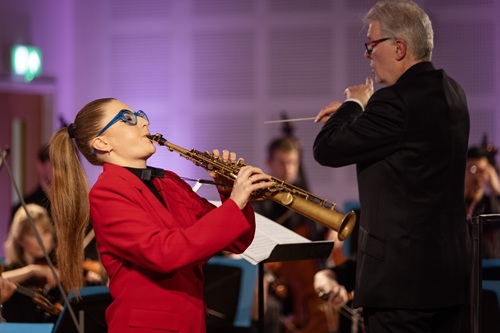
Macmillan’s Saxophone Concerto was inspired by several Scottish musical forms (Strathspey, Reel, Jig, for example), but its music is a cheeky look at those forms rather than an attempt to copy them. Think of Shostakovich’s mischievous take on jazz for a comparison. The orchestra sometimes supported Jess Gillam’s saxophone line and sometimes argued with it, and its first movement often resembled a crazy chase scene from a cartoon, the sax’s virtuosic chirruping resembling nothing so much as a standup comedian. The central slow moment, on the other hand, was inspired by Gaelic Psalm singing, the sax acting as precentor, its improvisatory line weaving in and out of a gorgeous halo of strings. Gillam took the virtuosic solo line completely in her stride, and MacMillan conducted forthright clarity, drawing lithe responsiveness from the orchestra.
The BBC SSO began proceedings with a full-fat, big-boned Eine kleine Nachtmusik. Leader Kanako Ito kept things moving with flexible grace, and the (slightly boxy) school hall acoustic was pressed into service by drawing underlining the bass line and making it sound richer and fuller than Mozart can ever have imagined it.
Simon Thompson