Director of the National Moravian-Silesian Theatre in Ostrava Jiří Nekvasil talks with Gregor Tassie
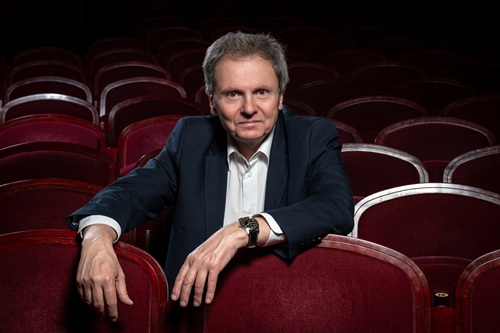
Jiří Nekvasil is one of the Czech Republic’s most distinguished opera producers; apart from his past work in Prague, his work has been seen in Europe and in South America. I have been very impressed, together with other visitors to Czechia’s third-biggest city, Ostrava, by the outstanding quality of both mainstream opera repertoire and neglected operas from both the 19th and 20th centuries. Remarkably, in contrast to the tendency for sensationalism and headline-seeking theatre elsewhere, Ostrava provides thought-provoking productions which draw audiences from both Czechia and abroad. When I was attending new productions of Rossini’s Moses in Egypt and of Prokofiev’s The Gambler, I managed to interview this leading opera director.
Gregor Tassie: During your career, you have worked throughout Europe on many different opera projects. What inspired you to pursue a career in the opera industry? Were your parents musicians or singers?
Jiří Nekvasil: I was introduced to theatre and opera at a very early age, even before I started school, and really without any intention on my part. My father, Miloslav Nekvasil, worked for several decades as an opera director in Ostrava. So, if there was no one else to look after me, I would sometimes go with him to rehearsals, sit quietly in a corner, and try not to get in anyone’s way. In a sense, I first discovered theatre from behind the scenes, watching through a child’s eyes as a production gradually came to life. I was fascinated by that world very early on, and that fascination with theatre has stayed with me ever since. I also loved going with my father when he was overseeing performances. I would join him for morning or afternoon shows and watch from the director’s box, just above the orchestra pit. My favourites were The Barber of Seville and The Cunning Little Vixen, although I saw many other operas as well. During my primary and secondary school years, I often appeared as an extra in opera productions, which meant I got to know a great many operas very closely. Opera simply became a natural part of my world. I never really imagined myself doing anything other than theatre. At the time, I was also very interested in drama, and that was actually what I originally intended to study. I have worked in drama throughout my professional career as well, but opera and music theatre have always been the main focus of my work.
GT: During your studies in Prague, you launched, with Daniel Dvořák, the experimental ‘Opera Furore’ company and later the ‘Chamber Opera Prague’. What attracted you to exploring both new opera and those by neglected composers? Is this a lifelong mission?
JN: I studied opera directing at the Music Faculty of the Academy of Performing Arts in Prague in the second half of the 1980s. Looking back, much of the work being produced by the major repertory theatres at the time felt rather conventional and, with a few notable exceptions, not especially adventurous. This was perhaps even more true of opera companies, where there was very little appetite for change or experimentation. The most contemporary and creatively exciting theatre was often happening elsewhere — on smaller and studio stages, in some puppet theatres, and among newly emerging semi-professional experimental companies. Daniel Dvořák and I wanted to bring some of that energy into opera as well: to create something experimental and provocative, to work in non-traditional spaces, and to reach a younger audience — people of our own generation. We were driven by the belief that the problem was not opera itself. Opera and music theatre still had something to say about the present; they simply had to be approached differently. Even a highly stylised art form can speak in a contemporary language. In fact, that was precisely what made its theatrical potential so exciting to us.
I had already begun exploring some of these ideas in my own productions. One of our inspirations at the time was the music video, which in the second half of the 1980s was, in many ways, much more sophisticated and inventive than it is today. They were essentially short, dynamic musical films. We were also influenced by postmodernism, which we mostly encountered through photographs, especially in architecture magazines. What we found in it was, among other things, a kind of resistance to the official lies that no one really believed any more, and to the spiritually exhausted atmosphere of the final years of ‘real socialism’ in Czechoslovakia. Opera Furore was created very much on a shoestring. There was no grant system in Czechoslovakia at the time. We persuaded friends to join us, and with the help of those closest to us, we made most of the sets, props, and costumes ourselves, paying for it all out of our own savings. We wanted to perform new operas, but no one was going to write one for us at such short notice, so we started looking to the past instead.
The first work we staged was the extraordinary two-act fragment Faust—A Provisional Presentation of the Opera Johannes Doctor Faust – written between 1965 and 1969 by the Brno avant-garde composer Josef Berg (1927–1971). It attracted attention. Some people were fascinated, others were provoked; we had our supporters and our critics, and we played to full houses. This was followed by the post-industrial operatic pasticcio Houslema do železa (Violin Against Iron), and then Andy Warhol, which we called ‘the most superficial opera of all time’ and which was based entirely on improvisation. We were young, and we wanted to provoke, to challenge stale conventions, to break things open. In a way, it was an operatic underground. But our ambitions were always aimed at the major opera houses. That was the natural next step. The path led from chamber opera, which later became Opera Mozart, to our joining the management of the Prague State Opera in 1998 — exactly ten years after Opera Furore was founded.
My first production at the State Opera was also the fulfilment of one of my earliest major dramaturgical ambitions. From the moment I first learned about the work, I knew I wanted to stage it: the world premiere of E. F. Burian’s opera Bubu of Montparnasse, written between 1926 and 1928. It is a provocative, monumental operatic statement. The work combines the avant-garde influences of its time with urban modernism and strong elements of 1920s jazz; the orchestration even includes instruments such as banjo, guitar, and piano. Its story takes us into the world of the Parisian underclass — brothels, pimps, and prostitutes. During our four years at the Prague State Opera, we presented a number of rarely performed operas and contemporary works in world or Czech premieres. These productions attracted considerable interest from audiences and critics, especially internationally, and brought a number of remarkable works to the stage — works that offered real possibilities for opera to become living theatre.
I had been deeply interested in opera dramaturgy, and especially in forgotten or neglected works, since my student days. Today I would sum it up very simply: life is too short to keep going to the same operas. There are many works that are rarely performed, hardly performed at all, or have never been staged in the Czech Republic, and many of them are absolutely worth discovering. When you work on a piece like that, neither the singers nor the creative team are constrained by an established performance tradition. It is new to everyone — the performers and the audience alike. We all come to it with curiosity, perhaps with a little apprehension, but without a fixed idea of what it is supposed to be. I think I must have made that my mission at the time. And that way of thinking about repertoire and dramaturgy has stayed with me ever since.
GT: You enjoyed a successful career at both the Prague State Opera and the National Opera, so was your return to Ostrava a matter of paying homage to your roots here in Northern Moravia?
JN: My return to Ostrava came about through a series of circumstances that happened to fall into place. It is a slightly longer story, but I will try to keep it brief. Twenty years ago, I was Music Director of Opera at the National Theatre in Prague. At the beginning of the 2006/2007 season, shortly after the national elections, the newly appointed Minister of Culture dismissed the General Director of the National Theatre, Daniel Dvořák, with immediate effect. The reasons for his dismissal were never properly explained. Under Dvořák’s leadership, the National Theatre had been doing very well, both artistically and financially, across all three of its artistic companies. Less than three months later, I was also removed from my position as Music Director of Opera by the theatre’s acting administrator.
I then spent almost four years working freelance, directing productions in the Czech Republic and abroad. My work was not limited to opera; I also directed drama and occasionally worked on music programmes for Czech Television. What happened next was, in a way, another coincidence. In 2009, after quite a long absence, I returned to Ostrava to direct at the Aréna Chamber Theatre, where I staged Strindberg’s A Dream Play. At the time, the director of the National Moravian-Silesian Theatre was dealing with a number of problems and controversies, which had also created considerable tension within the theatre. This eventually led to his dismissal. A competition was then announced for the position of General Director, and I decided to apply. I was successful, and I have been leading the theatre since 1 January 2010.
Returning to Ostrava professionally, and to a theatre I had known since childhood, after almost three decades in Prague was a major challenge. The first years were not entirely easy. The effects of the global financial crisis led to substantial budget cuts and as so often happens, the cultural sector was among the hardest hit. So even in that difficult situation, we had to find something positive — a way to use it as an opportunity to reset the theatre and prepare it for the next stage of its development. A major reorganisation was needed, not only within the opera company, but above all we had to decide what to do with the operetta company, which in its existing form was no longer sustainable, either artistically or operationally. We decided to transform it into a musical company. Despite the many obstacles and the financial constraints we were working under, the theatre gradually evolved over the following few years into the institution we know today.
GT: You have worked extensively in Europe and in South America, what special memories do you have of your work there? Are there specific colleagues that influenced you in your work?
JN: Every time I worked abroad, I came away with something new. It was always an interesting experience and a great source of inspiration. At the same time, I was also fortunate to meet and work with many exceptional people here at home, especially during my years at the Prague State Opera and the National Theatre. I am particularly grateful to have worked with such outstanding conductors as Bohumil Gregor, Jiří Kout, Jiří Bělohlávek, and Sir Charles Mackerras. For me, working abroad was also a chance to see how theatres function in different countries. That was incredibly valuable. You start to notice what is done in a similar way, what is organised differently, and what you might be able to improve in your own theatre. But you also realise that there are things we do very well at home. I am very grateful for all of those experiences and for everything they taught me.
GT: After being appointed director here in Ostrava in 2010, you introduced the biennial ‘New Opera Days Ostrava’. What are the aims of this project?
JN: The main aim is to create a genuinely creative space for contemporary opera and experimental projects. We had already explored a similar model at the Prague State Opera and later brought some of that experience with us to the National Theatre. It was here that we began thinking in terms of a festival format — one that would allow very different opera projects to be presented side by side over the course of several days. One of the basic conditions is that each work must be either a world premiere or a Czech premiere.
At the most recent NODO biennale in 2026, for example, we presented seven works in five days — six world premieres and one European premiere. Our programming has also returned several times to some of the major figures of new music. The very first NODO biennale in 2012 included a production of John Cage’s Europera 5. In 2021, we presented Luigi Nono’s monumental Prometeo. Tragedia dell’ascolto. And in 2018, we gave the world premiere of the six-hour opera Thy Kingdom Come by Alois Hába, composed between 1939 and 1942. One of the essential requirements for projects of this kind is an exceptionally high standard of musical preparation. NODO is organised jointly with the Ostrava Centre for New Music, which has also been running the Ostrava Days biennale of new and avant-garde music since 2001. Over the years, this collaboration has created an outstanding artistic environment, bringing together excellent performers and composers and providing a very strong foundation for this kind of work.
GT: In staging new operas or other forgotten stage works by neglected composers, what challenges do you experience in casting of singers and the production staff to attain agreement with your own conception of the opera?
JN: One of the first major challenges is often a very practical one: performance materials may be difficult to obtain, incomplete, or simply not in good condition. For singers, these works can be especially challenging. They often require a great deal of preparation, sometimes for only a limited number of performances, so the artistic commitment involved is considerable. The central challenge, though, is to make an unfamiliar work feel alive on the stage and capable of speaking to an audience today. For me, that means first understanding the composer’s original intention and the circumstances in which the work was created and then finding a contemporary theatrical language that can communicate that intention clearly and convincingly.
GT: In recent decades, you have developed an alternative career to your opera work through your documentaries and work for Czech television. This has been most notable in your films about Martinu and other Czech composers. What was your purpose in opening up to TV audiences the enlightenment of lesser-known composers, or was it a matter of simply extending our knowledge of these composers?
JN: I worked very closely with Czech Television, particularly during the 1990s. At that time, classical and contemporary art music had a much stronger presence on television than it does today. I had the opportunity to make a number of music documentaries, most of them focusing on 20th-century composers such as Alois Hába, Erwin Schulhoff, Jan Klusák, Josef Berg, and Gustav Mahler. Of all of them, I would probably single out the two films on Bohuslav Martinů — Return from Exile (Návrat z exilu) and Martinů and America (Martinů a Amerika) — as the projects that meant the most to me. With each documentary, we tried to find an approach that suited the subject. Every composer opened up a different set of possibilities, both visually and in the way the story could be told, and I found that very rewarding. My aim was always to draw the viewer in, offer a fresh perspective, and sometimes reveal a side of a composer that people might not have known before — not only through the music, but through the person behind it: their life, their ideas, and the world they inhabited. Above all, I wanted to spark people’s curiosity and make them want to discover the music for themselves.
GT: I have been very impressed by the production in Ostrava of operas by neglected opera composers such as Pavel Haas, Nino Rota, and the less well-known operas by Smetana. In the new 2026-27 season, Ostrava is staging operas by Pavel Vranický, Juraj Čiernik and Bernhard Lang. What can you tell us about these composers and the other new productions for next season?
JN: Pavel Vranický was a contemporary of Mozart. He was born in Nová Říše in 1756 and moved to Vienna when he was twenty. He became part of the musical world of Viennese Classicism and developed a successful career there as a composer, while also bringing his own individual voice to that tradition. His first stage work, the singspiel Oberon, König der Elfen (Oberon, King of the Elves), was premiered by Emanuel Schikaneder’s company at the Theater auf der Wieden in Vienna on 7 November 1789, two years before Mozart’s The Magic Flute. Schikaneder was clearly inspired by Oberon in a number of ways when he later wrote the libretto for The Magic Flute. The Vienna premiere itself did not attract much attention, but it changed completely the following year, when the work was performed in Frankfurt am Main for the coronation of Leopold II. It was a great success, with twenty-four performances following within just six weeks, and from there the opera found its way onto other European stages. Vranický was also highly regarded by Goethe, who asked him in 1796 to set a sequel to The Magic Flute. In Prague, Oberon was revived at the Estates Theatre in 1820 and remained part of the repertoire until Weber’s opera of the same name appeared in 1826.
Bernhard Lang, by contrast, is a composer of our own time, and for me one of the most interesting figures working in contemporary opera today. He has written more than twenty operas, many of which have been performed successfully at major opera houses and festivals in Austria and Germany. Since 2009, he has also had a close connection with the Ostrava Center for New Music. His opera Re was presented at NODO in 2014, and in 2023 Ostrava Days included Cheap Opera #2: Playing Trump, which I had the opportunity to stage here. His opera HIOB (Job) had its world premiere in Klagenfurt in 2023 and was very well received by both audiences and critics. The libretto is based on Joseph Roth’s novel of the same name. At the composer’s request, we will perform the work in Czech, in a translation prepared especially for our production. With Hiob, we are continuing a new strand in our programming that began last season with Philip Glass’s The Trial. The idea is to broaden the repertoire not only through works by the major composers of the 20th century, but also by bringing truly contemporary opera — works of the 21st century – onto the stage. Juraj Čiernik is a very versatile artist: an opera singer, musical-theatre performer, composer, and director. He has written several chamber operas for children as well as musicals. His project Fables was written specifically for the NDM children’s opera studio and he will also direct the production himself.
The 2026/27 opera season will open with a staged performance of Verdi’s Requiem and conclude with Eugen d’Albert’s The Dead Eyes. This opera has appeared on the Czech stage only once before — and that was here in Ostrava, in our theatre, in 1933.
GT: I have always been positively impressed by the good audiences in Ostrava for both the popular and the less well-known operas here in Ostrava, and by the very high quality of the productions. In the United Kingdom, the arts are constantly struggling to maintain opera at former levels; how does Ostrava manage to achieve such a high level of performance?
JN: We do everything we can, within the financial limits we have, to achieve the highest possible artistic standard — not only in opera, but across all our companies, including ballet, drama, and musical. We follow a very simple principle: whatever we present to our audiences, we want to present it in the best possible way. We often programme lesser-known works, but only when we are convinced that they are genuinely strong pieces and that there is a good reason to bring them back to the stage – or, in some cases, to introduce them to our repertoire for the first time. For me, the most important thing is always the quality of the performance itself: the musical preparation, the casting, and the creative team. If you maintain that quality consistently, you gradually build the audience’s trust. Then even an unfamiliar title can become something they are willing to take a chance on, because they know it may offer them a powerful theatrical experience. That trust is particularly important for us, given the limitations we work within.
GT: You have achieved a huge volume of work in diverse areas of the arts both in the Czech Republic, in Europe and Brazil, what targets do you have remaining in your career?
JN: Although we have been talking mainly about opera in this interview, my primary role is as General Director of the National Moravian-Silesian Theatre as a whole. I am responsible for the overall direction, performance, and public profile of the entire institution. The theatre has four artistic companies: Opera, Drama, Ballet, and Musical. We have two orchestras, one for opera and one for musical theatre. Over the course of a season, we give around 560 performances, attended by more than 200,000 people. We work across two large theatre buildings. The Antonín Dvořák Theatre, with 517 seats, is the home of the Opera Company, while the Jiří Myron Theatre, with 613 seats, is home to Musical. The Drama and Ballet companies perform in both venues. In 2018, we also opened the Theatre ‘12’, a newly built chamber space seating 60, which all four companies use for smaller-scale and experimental work.
My responsibility covers the theatre as a whole — artistically, operationally, and technologically. Of course, none of this would be possible without the excellent people around me: my closest colleagues in administration, finance, operations, and, naturally, the artistic leadership. Theatre depends on collective effort, not only on stage, but in every department and at every level of management. The NDM is the largest and oldest cultural institution in Ostrava and in the Moravian-Silesian Region. It began its work in 1919.
Our own productions are, of course, at the heart of what we do, but an institution of this size also has a wider cultural and educational responsibility. That means looking after the theatre’s history and memory through the care and development of our archive, running educational programmes for children, young people, adults, and seniors, working closely with schools, and cooperating with the University of Ostrava — not only with the Faculty of Fine Arts and Music, but with other faculties as well. And that is only part of it. Another important responsibility is the continuous development of our buildings and technical facilities. A few months ago, we began work on a new performance space created through the reconstruction of a former exhibition pavilion. It will be a flexible black-box theatre, something Ostrava has not had until now. With a capacity of around 220, it will allow for different configurations of both the auditorium and the performance area, and we expect it to be used by all four of our artistic companies. We also have plans in place for a major reconstruction and revitalisation of the Jiří Myron Theatre.
So my main ambition, if I have the opportunity — and the energy — is to continue working with my colleagues to support the further development and growth of NDM.
GT: What was your initial motivation to uncover the neglected sectors of Czech culture? What are your plans beyond next season?
JN: Czech music has an extraordinary richness; it’s the world’s fifth acknowledged music culture, and it goes far beyond the few composers who are internationally known and regularly performed — Smetana, Dvořák, Janáček, and Martinů. From the Baroque and Classical periods through the nineteenth and twentieth centuries, there are many remarkable Czech composers and works that have fallen out of the repertoire or have never received the attention they deserve. A number of them are absolutely worth bringing back to the stage, sometimes after many decades.
One project that was particularly important to me was our complete Smetana cycle in 2024, when we presented all eight of his completed operas in our own productions to mark the 200th anniversary of his birth and 140 years since his death. Another major project was our trilogy devoted to three composers connected with Terezín: Hans Krása, Viktor Ullmann, and Pavel Haas. The coming years will also bring several important anniversaries. In 2028, we will mark the centenary of the death of Janáček, who died here in Ostrava, at Klein’s sanatorium. In 2029, we will commemorate the anniversary of Martinů’s death, and in 2030 there will be further important anniversaries connected with both Martinů and Zdeněk Fibich. All three composers will have an important place in our programming.
One project I am especially looking forward to is Fibich’s monumental melodrama trilogy Hippodamia, which we are preparing as a joint production between the Opera and Drama companies. I sometimes describe it as a kind of Czech Ring (of the Nibelung) without singers: the dramatic roles are spoken by actors, while the emotional and dramatic weight is carried by a large-scale orchestral score. It is a truly unique work and deserves to be much better known. The complete trilogy is planned for autumn 2030 and will be presented over three evenings.
GT: Thank you immensely for giving me and our readers your valuable time to respond to my questions. I am sure everyone will wish you more success in your work here in Ostrava.