
 New Zealand Sibelius, Magnus Lindberg: Vesa-Matti- Leppänen (violin), New Zealand Symphony Orchestra / Pietari Inkinen (conductor). Michael Fowler Centre, Wellington, 15.8.2026. (PM)
Sibelius – Pohjola’s Daughter; Four Legends (Lemminkäinen Suite)
Magnus Lindberg – Violin Concerto No.2
I had already become reacquainted with Finnish conductor Pietari Inkinen’s rostrum presence in front of the New Zealand Symphony Orchestra the previous evening in the orchestra’s spectacularly-delivered Wagner concert ‘Radiance’ – so this evening’s ‘Myths and Legends’ concert was an added pleasure. It was heightened by Inkinen choosing a programme which featured the music of his most illustrious countryman, Jean Sibelius, most notably the Lemminkäinen Suite, or Four Legends as the work is sometimes called.
First up was the enigmatic Pohjola’s Daughter, its darkly focused tones created a world at once removed from time and place but at the same time ‘present’ in the hall’s ambiences as the music filled the spaces. This was the world of a Finnish hero, Väinämöinen, he of the national epic the Kalevala, as an adventurer advanced in years but still susceptible to female beauty, one who on his travels encounters the beautiful ‘daughter of the North’ a region known as ‘Pohjola’.
Väinämöinen’s steadfast and determined ‘adventuring’ theme suddenly gave way before the beautiful strains associated with ‘Pohjola’s Daughter’, depicted sitting on a rainbow weaving a cloth of gold. Väinämöinen invited her to join him in his travels homeward – however she told him that he needed to perform certain magical tasks before she would agree to accompany him. We were drawn by focused, evocative instrumental lines into the interplay of Väinämöinen’s and the Maiden’s dialogues as the venerable hero steadfastly undertook his labours – however with the final task (that of using his magic to build a boat from the distaff of the maiden’s spinning-wheel), Väinämöinen faltered and sustained an injury, causing him to renounce his quest (to the sounds of the maiden’s mocking laughter!) and sadly continue his homeward journey.
The playing-out of this tale’s retelling was palpable and moving, especially regarding the sense of failure and ultimate resignation of the hero towards the end. Apart from Tapiola, this is regarded as the composer’s most accomplished single orchestral work outside the great symphonies.
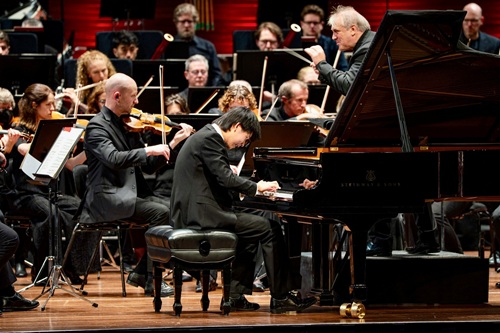
We next welcomed violinist Vesa-Matti Leppänen, normally the orchestra’s concertmaster, to perform a work described by one critic as ‘a romantic violin concerto in disguise’. Magnus Lindberg’s Second Violin Concerto came across as a thickly-woven, luscious-sounding work which has hyper-charged energy fields connecting order out of seeming cross-referencing chaos to produce various impressive focal points which I found could inspire, excite and disconcert simultaneously. The composer wrote the work for Frank Peter Zimmermann, one of the foremost German violinists of today, who gave the work’s premiere in 2015.
Beginning with a three-note phrase from the soloist that recurred in various elongated form throughout the work, this theme found its way via various instrumental echoings and developments to an exciting, full-toned orchestra sonority. Then, to the accompaniment of a dancing violin solo the orchestra traced a rich panoply of sounds, in places trading dance-trajectories with the soloist while in others giving different voices tongue, as with some delighted/irascible swirls from the piccolo along with the other winds in one frisson-dominated moment!
The solo cadenza, towards the end of the slow movement, followed some Korngold-like gestures from the orchestra. Vesa-Matti mixed arco and pizzicato notes among other explorations, including some spectacularly high harmonic-like sounds, almost a string-playing fireworks display, with occasional three-note motif-references thrown in for effect! Near the movement’s end the luscious late-romantic soundworld was again evoked, with another, briefer solo cadenza – we heard due pomp and ceremony in some concluding orchestral phrases, with the solo violin in places almost beside itself with excitement, allowing the orchestra its ‘grand peroration’ before unexpectedly handing the work’s ending back to the soloist for a wry three-note concluding gesture.
After the interval, we were returned to Sibelius’s world of myth and legend by way of the composer’s Lemminkäinen Suite, with the eponymous hero’s adventures drawn, like Väinämöinen’s in the earlier Pohjola’s Daughter, from the Finnish national epic, the Kalevala.
Sibelius here has him firstly travelling to the island of Saari (Lemminkainen and the Maidens of Saari), where he seduces as many women as he can before fleeing to escape the vengeance of the men of the island. The music, built around two groups of themes presents firstly the young man’s longing for the excitement of adventure, and his journeying to the island, and his encounters with various women – There is an almost Tristanesque Wagnerian quality expressed by the seduction music as it builds towards a suggestively orgasmic kind of release at the end, the brass signalling a final consummation of desire in returning to the home key as the energies of the piece subside. Inkinen and his players capture it all, at a tempo which enables the detailing of both the hero’s journeyings and his carousings to be fully savoured.
The composer changed the order of the two middle movements at various times, resulting in differences in recorded versions – my first recording (Thomas Jensen and the Danish Radio Orchestra) put ‘The Swan of Tuonela’ first but others have since reversed the order. Here we were plunged eerily and scarily into the ‘Land of the Dead’ with music that was malevolent in character and obsessive in its repetitions. Such was the playing’s concentration and focus we were irrevocably gripped and held by the spectral tones and harsh textures, though respite eventually came from a sudden and transformative episode of unearthly calm, strings and winds magically and uncannily countering the evil with some kind of strangely ‘healing’ textures, representing the mother of the hero in search of her son, entering Tuonela, retrieving his dismembered body and sewing the different parts together as per the Kalevala’s story.
As if proclaiming the dominion of Tuonela’s embodiment of death, the following movement featured the suite’s easily most celebrated section, The Swan of Tuonela, here given the most sublime performance I could ever imagine hearing from all concerned, and especially from the orchestra’s cor anglais player, Michael Austin. Inkinen got his strings in the latter stages to ‘dig into’ the phrasings as much as steadily and patiently maintaining the macabrely beautiful ambiences right through to the piece’s resounding silences at the end.
After this, some sort of deliverance was urgently needed as a ‘return to life’ metamorphosis and was duly provided in surgings of renewed energies with the work’s concluding movement, Lemminkainen’s Homecoming. The playing now returned to life our own beleaguered sensibilities in the wake of gruesome adventurings into and through a Finnish version of a dismal underworld, from which emancipation was a truly joyous experience.
Peter Mechen