 United Kingdom Grimeborn Opera Festival 2026 – Bitter Visions: By Order of Hildegard [Hildegard von Bingen, Ordo Virtutum]: Soloists, Ololyga. Arcola Theatre, London, 19.8.2026. (CR)
Hildegard von Bingen’s Ordo Virtutum (c.1150) is a more or less unique musical work – although other mediaeval morality plays exist, this is the only one which survives with music, enabling its performers and audience to be caught up in the composer’s holistic, mystical vision of words, singing and drama. As an allegorical narrative, in a sense it pre-empts the oratorios of the Baroque period in which moral or theological ideas are personified for the spiritual edification of their listeners, perhaps the most famous being Handel’s Il trionfo del Tempo e del Disinganno. More was at stake for Hildegard and her fellow nuns, however, who first performed this music at the abbey of Rupertsberg, having made vows to live out together the Christian virtues which are lauded in what amounts to an enacted liturgy. Central among these was virginity.
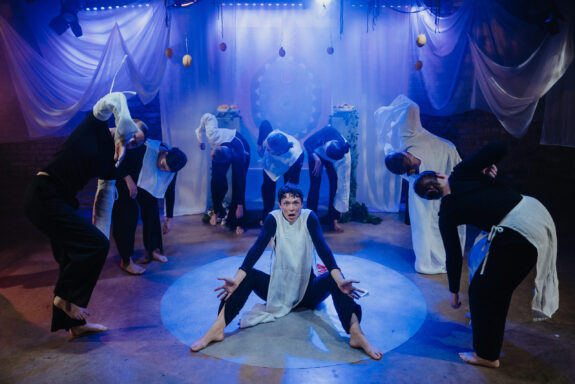
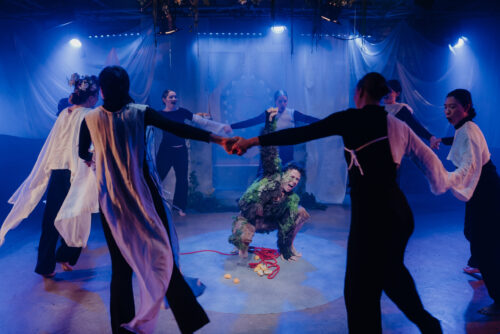
Florence Carruthers Andrews and the group Ololyga take up the work in something of that spirit, as a ritual of existential import instead of a mere moral lesson, by reinterpreting and staging it as a consciously feminist drama. It charts the progress of the (female) Soul – here as Everywoman, if not Everyman – buffeted by inner conflicts with notions that lead to shame and fear. As the programme puts it, the production offers the play as ‘an alternative model of virtue, one rooted in self-acceptance, self-knowledge, and personal agency’. The Devil represents, then, not so much a dualistic concept of evil and vice opposed to the human soul, according to traditional Christian theology, but rather something more like the id which is tamed and synthesised to take on a higher, freer form of being. That is alluded to in the opening scene when the Devil – dressed in a shaggy outfit like a feral Green Man – and the Soul are positioned back-to-back, almost like Siamese twins, under the Soul’s white veil, as though poised to undergo the subsequent moral trial together. Where the Devil first leads the Soul on a rope like a dog, at the climax the Soul masters the Devil by binding the latter to herself as a more completely realised being, rather than casting them out. At the same time, the Devil is cleansed by the other characters squeezing lemons over them, seemingly providing a Mediterranean zestful prompt to the whole group’s triumphant cries and shrieks inspired by the practice of ololyga (ὀλολυγή) by ancient Greek women in moments of high tension or passion, from which the performers take their name. ‘Bitter Visions’ here become ecstatic or acidulous ones.
The musical performance is adapted by Carruthers Andrews from Hildegard’s monodic, unaccompanied score, but remains tethered to it, unlike the much more wide-ranging, acoustical mash-up of Ensemble Belcanto’s recording on the ECM New Series label which startles listeners who expect to hear in some form the melodic outlines which Hildegard wrote. Here an ambient electronic background sets a gentle, otherworldly sonic space, shifting with each scene, in which the vocal monodies take wing, often diffracting into heterophonic or polyphonic lines as additional singers take up a melody.
Carruthers Andrews takes the part of the Soul, and her tense singing with occasional wobble or other occasional ornamentation deliberately imposed lends the music an urgency and drama beyond simple serene plainsong. The other characters tend to take a mellower approach to their lines so that the central protagonist stands out more, but they do instil the music with some rhythmical alacrity so that it takes on greater propulsion. The work is sung in Latin without any surtitles, though that doesn’t strictly matter since its narrative thrust is re-written and emerges clearly and poetically from the choreography and the programme note. Those with sufficient knowledge of Ecclesiastical Latin will make out enough of the text from the performers’ generally precise diction in any case. Overall, the project is a fascinating recreation of a nearly 900-year-old composition by one of the most extraordinary women of her age, working sympathetically with how her vision may speak to women and the discourse of feminism today.
Curtis Rogers
Featured Image: Grimeborn Opera Festival 2026’s Bitter Visions: By Order of Hildegard
Production:
Producer, Arranger and Electronics – Florence Carruthers Andrews
Movement director – Katie Kelly
Costumes – Bea Viña
Lighting designer – Eli Hunt
Cast:
The Soul – Florence Carruthers-Andrews
The Devil – Eleanor Westbrook
The Virtues – Salome Siu, Miranda Ostler and Amy Kearsley
Queen Humility – Lydia Ward
Victory – Emily Beech
Discretion – Sara Knight
Mercy – Issy Roberts