
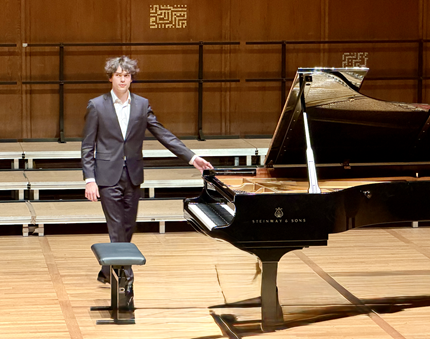
 United States Various: Tom Borrow (piano). Cal Performances, Hertz Hall, Berkeley, 6.10.2026. (HS)
Mozart – Piano Sonata No.8 in A minor
Liszt – Réminiscences de Don Juan; Piano Sonata in B minor
Encore: Schubert (arr. Godowsky) – Six Moments Musicaux, No.3, Allegro moderato
Tom Borrow, the 26-year-old Tel Aviv-born piano phenom who burst onto the scene seven years ago as a last-minute replacement with the Israel Philharmonic for Khatia Buniatishvili, showed what he has to offer in an impressive Berkeley recital. He navigated a challenging program that cannily tied sonatas by Mozart and Liszt together with a Liszt fantasy on music by Mozart. It was not his first appearance in Berkeley: he was here in 2023 in a recital touching on Debussy, Chopin, Rachmaninoff and Prokofiev.
If all that sounds like standard fare for classical pianists, the description fits his musical approach too. Looking serious, with no conversation with the audience (even to identify an encore), he played with admirable precision. Any drama lay not in external flair but in a sturdy approach to the music. His recital focused on sonorities revealed by a touch that ranged from soft to powerful, dexterity in the most complex passages and clarity in the simplest.
He also showed a clear understanding of how the music should go, tying together phrases with logic and emphasizing the expected aspects. If he tended to use more pedal than I like, the contrasts in texture emphasized the clarity of passages when he didn’t. Sometimes the use of pedal created telling touches. In the recurring falling scale that begins the Liszt Sonata in B minor, he made sure to use the pedal to connect the first two notes, a minor second interval. It created a tangy dissonance that added spice.
The Liszt sonata was the highlight of the concert, in a performance that emphasized the composer’s ever-shifting tones and colors and made them feel inevitable. Each of the disparate phrases in the opening measures had their own taste, and when he got to the grand gestures they shone. It is obvious that a lot of thought went into executing these elements.
Thoughtful, well prepared and impressively executed. What was missing was the excitement that comes from a performance steeped in a sense of improvisation, something the great pianists can do, a feeling that the next thing emerges out of a new thought. That is what creates surprise even when we already know what is coming. He did it with the pedal on those first two notes of the Gypsy scale, and several times with unexpected hesitancies in returns of phrases already heard. It would have benefited from more.
The opening work, Mozart’s Sonata in A minor, reached for extra emphasis on the full chords and racing runs in the first movement, even if pedaling blurred some of the distinctions. Better was the sublime second movement which delivered the singing textures of a Mozart Andante beautifully. Borrow didn’t try to make the Presto finale go too fast, and the clarity of his playing here was easy to like.
Réminiscences de Don Juan has more heft to it than Liszt’s other elaborate piano fantasies on music from famous operas – in this case Mozart’s Don Giovanni. The first part, which elaborates on music from the two scenes with supernatural overtones (the Commendatore’s statue in the graveyard and the Don’s descent into hell), got blurry from lots of pedal and heavy-handed chords. But in the long middle section, with the many variations on ‘Là ci darem la mano’, the freshness was there to reflect the Don’s faux-innocent seductiveness. Borrow’s deft touch paid dividends, even if the tone may have been a bit too serious.
The final section, a lickety-split take on what is known as the ‘Champagne Aria’, could have had more rhythmic bounce, but the performance’s encore, Schubert’s Six Moments Musicaux, No.3, showed the rhythmic vitality and dance flair that it needed.
Harvey Steiman