
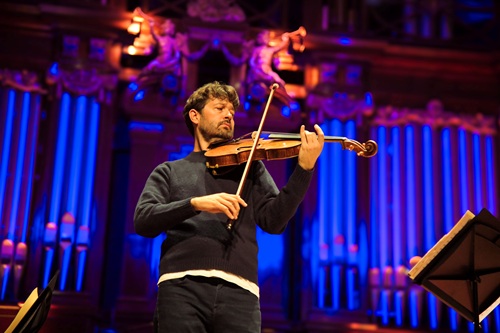
 United Kingdom Bach, Schnittke, Shostakovich: Lawrence Power (viola), Royal Scottish National Orchestra / Patrick Hahn (conductor). Glasgow Royal Concert Hall, 3.10.2026. (GT)
J.S. Bach (arr. Stokowski) – Komm, süsser Tod, BWV 478
Schnittke – Viola Concerto
Shostakovich – Symphony No.5 in D minor, Op.47
The three works in this concert are all linked, for the music of J. S. Bach was close to both Schnittke and Shostakovich; both Schnittke and Shostakovich wrote pieces influenced by the German composer, and his works appeared in quotations in their music. Leopold Stokowski was an early proponent of Shostakovich’s music after visiting the composer in the 1930s, and there is a fine recording of the Fifth Symphony available.
Stokowski’s arrangements of pieces by Bach were frequently performed however fell from attention of concert programmers with the advent of period performance, yet the English-born conductor’s arrangement here from Bach’s 69 Sacred Songs and Arias gave a suitable and appropriate opening to the concert with ‘Come, sweet death, come, blessed rest!’ with the rich luscious orchestration showing off the remarkable virtuosity of the Royal Scottish National Orchestra.
There was a time when the music of Alfred Schnittke was heard often in performances worldwide; yet his name largely disappeared from concert programmes after his passing in 1998. His popularity seemed to coincide with Perestroika in the former Soviet Union, as if his music represented neglected composers who were banned for many years. The Viola Concerto was one of the most striking works that was premiered in Western concert halls; I recall an impressive performance in Glasgow City Hall by the work’s dedicatee, Yuri Bashmet, in 1989.
From a Jewish family of German ethnicity, and having converted to Catholicism, Schnittke was unlike any other Soviet composer. The Viola Concerto from 1985 is, like much of his creativity, polystylistic. The opening Largo sets the tone for the entire work with a rather elegant motif based on the German notation of Bashmet’s name (who premiered the concerto) against the darkly hued, dramatic chords from the orchestra. This motto reappears throughout the three movements. A highpoint were the disturbing sounds from the percussion and the brass against the searching playing from the viola, rising to a sudden blast from the brass and percussion. Throughout the second movement (Allegro molto) there emerged bizarre quotations from movies, café-style waltzes, and military marches, all suddenly broken off – as if memories from the composer’s life. Yet there was no real development with this everlasting mixture of themes that don’t go anywhere. The final movement is another Largo, absorbed in a mood of resignation, as if the composer knew his death was coming. Without passion, except for a morbid lyricism, the music slowly died away with an uncertain, yet almost beautiful closure. Lawrence Power rewarded the audience with an encore of Marin Marais’s Les Voix Humaines in a beautifully nuanced dialogue with the principal cellist Pei-Jee Ng.
If Schnittke’s music is rarely heard, that cannot be said of Shostakovich’s Fifth Symphony, and it has never been out of the repertoire of the world’s orchestras since its premiere in 1937. The work, from the opening Moderato, almost from the first bars, reveals those elements of a great awe-inspiring work, with the immediately momentous announcement on the strings. Contributions from the flute of Katherine Bryan, the clarinet of Timothy Orpen and David Hubbard’s bassoon led to long sections on the violins of an awesomely attractive theme, which later, after piano chords, becomes more intense and dramatic. The brass and percussion entered to input a degree of violence, yet the drama is pulled back to a more reflective passage on the horns. There emerged a beautiful passage from the flute, followed by the violins with a solo from Maya Iwabuchi and ending poignantly on the celeste. By this time, it was clear that the young Austrian conductor, Patrick Hahn believed in this music, and with clear expressive movements directed the musicians with accurately precise gestures. The climax was superbly handled with the brass and percussion, intensely exciting, yet never over dramatic.
The second movement (Allegretto) burst from the low strings in a determined passage aided by chirpy woodwind heralding yet again great drama from the whole orchestra and a tuneful theme from the woodwind. There was another, more extensive solo from Iwabuchi and again more from the flute, clarinet and bassoon with an optimistic idea. The third movement (Largo) was momentous in its beautiful harmonies which at times emerged reflective in its beauty, enhanced with a desperately sad strings and incantations from the oboe of Adrian Wilson and the clarinet of Orpen, masterly handled by the conductor. The passage of the two flutes heard against the harp of Pippa Tunnell was exquisite. Here in this slow movement, Shostakovich showed his greatness as a symphonic composer, and why this is among the finest symphonies of the 20th century.
In the Allegro ma non troppo finale the composer reveals either a magnificently optimistic work, or contrarily, something which can sound hollow; here the percussion appeared to reveal its full glory in the contributions from the timpani. Hahn brought this work to a dramatic close by forcing a seemingly faster tempo through to the final closure on the percussion, as if to tell us something more about what this music is about, and maybe it was not so optimistic after all.
This was a fine concert revealing all the magnificent qualities of this orchestra, superbly directed by an outstanding young Austrian conductor in performances of 20th-century Russian music. In a way, the concert reflects that Schnittke’s popularity was from a period of change and transformation, and perhaps has now lost its relevance, yet Shostakovich’s Fifth Symphony is as meaningful today as it was during the dark thirties in Europe when humanity faced a terrible crisis.
Gregor Tassie