
 United States Various, The Village Trip – ‘Village Voices’: Soloists, St. John’s in the Village, New York, 2.10.2026. (DS)
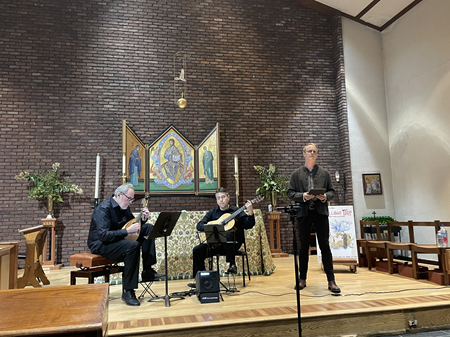
Kile Smith – ‘Tom Deadlight’
Akemi Naito – ‘Melville’s Sea’
Scott Wheeler – Blue Ridge (world premiere)
Chester Biscardi – Madrigal
Ella Milch-Sheriff – Irgendwer (world premiere)
The multi-week Village Trip festival in downtown New York is not a 1970s psychedelic event. But concerts in the church of St. John’s in the Village do transport listeners across time and space with an eclectic mix of styles. At the ‘Village Voices’ performance on 2 October, baritone Nathaniel Sullivan opened with a fiery, commanding rendition of ‘Tom Deadlight’ by Kile Smith. Set to a Herman Melville text written from the perspective of a forlorn sailor reliving his memories, the song set off the evening with the shapes and gestures of rocky sea currents. The guitar and mandolin accompaniment added an uncanny, dare I say trippy, quality.
The journey continued with another Melville-inspired song, Akemi Naito’s ‘Melville’s Sea’. Soprano Sharon Harms mixed lyrical song with punchy speaking lines in this rugged yet meditative piece that required brawny tones from both singer and cellist Kirsten Jermé. Jermé showed particularly plucky commitment to navigating the wide-handed chords that traveled – like a ship pitching against the winds – up and down the alto range of her voice. The experience was dramatic.
Melville was once a resident below 14th Street. However, as the organizers pointed out, many of the evening’s composers no longer live in nor wrote about the Village, leaving only some thready connections.
No matter! Under any festival name the world premiere of Scott Wheeler’s Blue Ridge – a four-movement work for saxophone and piano – the type of piece I would hurry to hear. It is a wondrous work of compositional creativity and complexity, densely packed with evocative musical imagery. Wheeler’s approach – ranging from the contrapuntal to the postmodern while combining the dissonant and the tonal – ignites a curious listener’s imagination. He captures a feeling of physical landscape, as in the movement ‘Highway to the Chesapeake’, while sharing a personalized, emotional memory of it. In a time where nature, including that of Virginia’s ecosystems, is once again under attack by the removal of environmental safeguards, honoring localized natural spaces and the history of the people living there (as Wheeler does with patchy passing moments of jazz and folk material) is a show of how music can deliver ethical messages.
Tim Ruedeman was on saxophone with Wheeler at the piano to tackle Wheeler’s unforgiving score, which often sounds like two people playing four or more parts. Ruedeman commands the sax heroically and emitted a rainbow of colors and textures from it. Fast, articulate trills gave the church acoustics a brassy shimmer. Swiftly ascending and descending passages stretched the limits of sonic range and swerved in musical chase-like scenes. A lyrical passage evoked sublime sunrise. And the final movement, ‘Mountain Forge’, ended with the two players joining in a swoon and a jab. Our travels through the region came to an end.
As a short interlude but with its own stand-alone power, composer Chester Biscardi performed Madrigal for piano. Drawn from influences as distant from each other as Petrarch and Fellini’s Satyricon, the work sounded like an expanded madrigal. Biscardi proved a skilled craftsman of balance: he began with youthful, loud expressiveness, moved into a quiet middle section with sublime inversions and ended with hovering chords (his hands cupping the air above the keys at varying lengths) that were perfectly paced.
To end the trip, we straddled Berlin and New York through the words of a poet and settings by Israeli composer Ella Milch-Sheriff. Irgendwer is a song cycle based on writings by a once-unhappy resident of Greenwich Village, the poet Mascha Kaléko. She fled from Berlin to New York, never liked it and lived her last years in Zurich. The poems in German were filled with juxtapositions of urban imagery and internal searching. They looked for meaning where it had been lost long ago or, as in ‘A song for tomorrow’, explored the struggle between remembrance and trying to imagine a bright future.
Milch-Sheriff wrote for voice, piano and cello through a variety of lenses: Weimar style cabaret, Dada expressions, Serialism, satirical caricature and Richard Straussian song cycles. It was hard to be anything but transfixed by the breadth of the songs. Sharon Harms sang them with electrifying purpose. Along with pointed theatricality, her sound embodied each shift in style, each thematic mood. Her German diction was so clear that even someone who had never heard the language might feel they had known it forever, and her wide black-and-white checkered glasses added a brilliant effect.
A performance like this is a wonderful reminder of what the Village in New York City has meant and still must try to be, despite the encroaching luxury stores and never-ending influencer lines that crowd its streets. It is a place where people could always express themselves in myriad ways – from the first days of Peter Stuyvesant to Stonewall to today’s new Manhattan political leadership that is allocating more money to arts grants. The Village Trip festival helps in this endeavor: not simply by looking back but by setting the stage for more of what needs to come.
Daniele Sahr
Performers:
William Anderson – Mandolin
Chester Biscardi – Piano
Oren Fader – Guitar
Joan Forsyth – Piano
Sharon Harms – Soprano
Kirsten Jermé – Cello
Tim Ruedeman – Saxophone
Nathaniel Sullivan – Baritone
Scott Wheeler – Piano