
 Hungary Sibelius and Haydn: Budapest Festival Orchestra / Sir John Eliot Gardiner (conductor). Müpa, Budapest, 4.102026 (LJ)
Sibelius – ‘Sydämeni laulu’ (Song of My Heart), Op.18 (1898), No.6; Symphony No.2 in D major, Op.43 (1901-2)
Haydn – Symphony No.103 in E-flat major (‘Drumroll’), Hob.I:103 (1795)
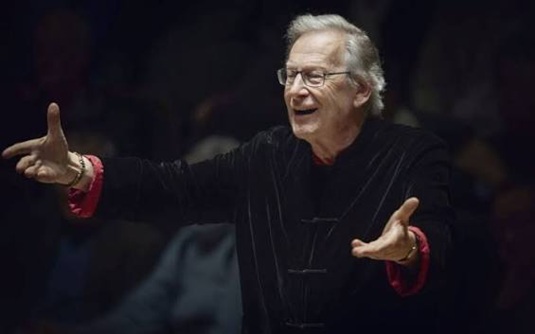
This concert marked the debut collaboration between renowned British conductor Sir John Eliot Gardiner and the Budapest Festival Orchestra (BFO). Appropriately, the mood at the Béla Bartók National Concert Hall was charged with high hopes and anticipation. For the first half, the BFO performed Sibelius’s ‘Sydämeni laulu’ (‘Song of My Heart’), Op.18, No.6, followed by Haydn’s ‘Drumroll’ Symphony. After the interval, they played Sibelius’s Second Symphony. Throughout, Gardiner conducted the BFO in a way that demonstrated his attention not just to how sound fills a space, but to how it also enters and leaves this space. The music was beautifully crafted with character and verve. The performance showed very promising signs of a fruitful relationship between conductor and orchestra.
Sibelius’s ‘Sydämeni laulu’ is the final song of his Six Partsongs, originally written for a male choir. Sibelius subsequently arranged songs 1, 3, 4, and 6 for mixed choir, and it was this format that begun the concert, (with I think, select orchestra members forming a choir). The song is a setting of a poem by Aleksis Kivi about a child, who, finding themself deep in a grove, is lulled into an eternal sleep. It was fitting that Gardiner, known for founding some of the best choirs and conducting some of the most memorable choral works, commenced with a choral work. By commencing with such a moving and intimate choral piece, Gardiner instantly wooed the audience.
Haydn’s ‘Drumroll’ Symphony somewhat abruptly changed the pace and atmosphere. This piece, composed in 1795, belongs to Haydn’s ‘London Symphonies’. It is known for the dramatic opening solo timpani roll, which Gardiner instructed the timpanist to play when the audience was still applauding his arrival onto the podium. This instantly created a heightened sense of drama and took the audience into the world of the late 18th-century.
Indeed, the symphony’s opening is especially striking. It was described by musicologist Elaine Sisman in her book Haydn and the Classical Variation (1993) as ‘one of Haydn’s most shocking dramatic strokes’ as it is an unmeasured drum roll, which, when followed by a low, chant-like phrase in the bassoons and strings, invokes the Dies irae. For Sisman, it is significant because it ‘destabilises the listener’s sense of tonality and meter before a single bar of main allegro is even heard.’ In the BFO’s performance, bassoons and strings also created an appropriately suspenseful mood.
Haydn is known for his masterful balance between wit, folk-inspired themes, structural elegance, and captivating solos. Lead violinist, Daniel Bard, played the violin solo during the second movement (Andante piú tosto allegretto) with resonance and expressivity. With his reputation for historically informed performances, Gardiner conducted this piece in a way that brought out the essence of Haydn. It was full of anticipation and excitement, contrasting heavy darkness with brisk, crisp articulation and lilt.
For the second half of the concert, the BFO returned to Sibelius, performing his Second Symphony, which, at approximately 47 minutes, is the composer’s longest. Of the work, Sibelius said that it ‘is a confession of the soul’. It moves from pastoral serenity in the first movement to a brooding tension in the second, fierce scherzo in the third, and it finishes with a triumphant fourth movement.
Sibelius also remarked that the framework of a symphony ‘must be so strong that it forces you to follow it, regardless of the environment and circumstances.’ This was certainly the case with Gardiner’s precise phrasing which was evident during the pizzicato duet between the double basses and cellos at the opening to the second movement (tempo andante, ma rubato). The bassoons’ solo that immediately follows this pizzicato section was also impressive. Here, one bassoon plays a reedy lower octave and the other takes a hollower mid-range octave to introduce the movement’s melancholic main theme in a mournful (lugubre) timbre. Throughout this movement, string and woodwind instrumentalists were excellent.
The decision to combine Haydn’s ‘Drumroll’ and Sibelius’s Second Symphony was not immediately apparent to me. Upon hearing the performances live, however, I realised a clear connection between these works and Beethoven, particularly his Fifth Symphony. Where Haydn’s piece probably inspired Beethoven, Sibelius was likely influenced by Beethoven’s Fifth. For instance, Haydn’s decision to halt a fast allegro near the end of the first movement and bring back the slow, mysterious introduction (and drumroll) before charging into the final coda can be heard in both Beethoven’s Piano Sonata No.8 Op.13 (the Pathétique) and Fifth Symphony. Additionally, the way in which Haydn builds his finale on a single horn call and motif, generating a powerful phrase through continuous variation rather than using multiple contrasting melodies, finds its parallel in Beethoven’s four-note motif that drives the first movement of the Fifth. For Sibelius, Beethoven’s teleological form that moves purposefully towards a resolution, seamless transition via attacca linking of the scherzo into the finale, and tendency to move from a minor-to-major trajectory each appear in the Second Symphony.
It would be exciting to hear more collaborations between Gardiner and the BFO, one that perhaps sees them perform some of Beethoven’s symphonies. The charged synergy between conductor and orchestra could indeed become a strong partnership.
Lucy Jeffery