 Italy Mozart, Mitridate, re di Ponto: Soloists, Orchestra del Teatro di San Carlo / Riccardo Frizza (conductor). Teatro di San Carlo, Naples, 1.10.2026. (AD)
The opera seria genre consistently favoured the figure of a ruler who strays from the right path but ultimately recognises the error of his convictions and responds with an act of magnanimity. The genre once served as a form of moral education for the political elite: rulers were expected to acknowledge their mistakes and, having done so, to act nobly and restore the moral order. A touching idea, to be sure. Today, however, it seems almost implausible.
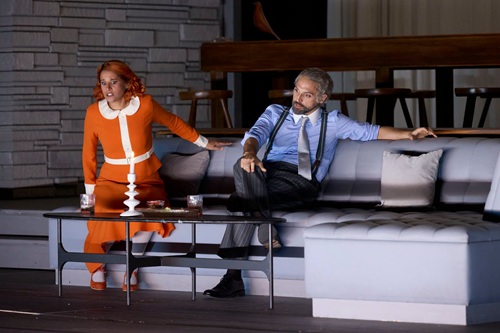
At the Teatro di San Carlo in Naples, Claus Guth brings Mitridate into the present day. But this is not a cosmetic modernisation of an 18th-century opera. Guth is not interested in period. He is interested in the human psyche in all its complexity, conscious and unconscious, and in the forces that actually govern our feelings and decisions. The entire stage world is divided into two realms. The first is an affluent villa, the domain of social roles, rules and visible actions. The second is a realm I call the chambers of the unconscious: a space of hidden forces, fantasies, fears and desires. Guth reveals the links between what the characters do and the forces that govern them.
It is here that Guth finds a way to restore dramatic force to the very element for which opera seria is so often criticised: affect. An aria suspends outward action because the character is held within a single affect. In Guth’s production, however, that suspension becomes the moment when what remains invisible in the world of the villa acquires a theatrical life of its own.
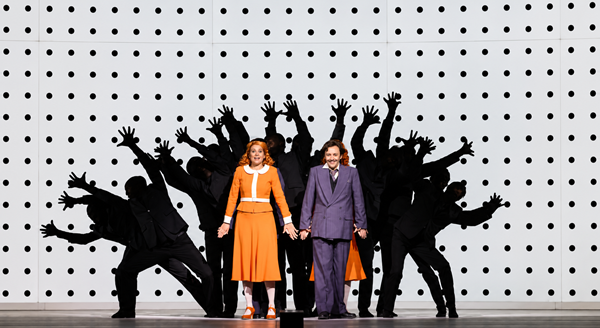
The chambers of the unconscious obey the logic of dreams. Here, actions, motives and situations are refracted: the real and the unreal, the logical and the illogical, fragments of familiar situations and their surreal distortions are woven into a single fabric. The story told in the villa returns here in an inside-out version. Faceless figures in black, enormous shadows and doubles give visible form to what normally remains hidden and alter the meaning of the relationships we have already seen in the villa. The dreamworld is meticulously conceived as a theatrical language. But Guth’s real achievement lies elsewhere. We do not always understand what exactly is happening in these scenes. Cause and effect begin to dissolve, disconcerting events unfold, and yet we watch, transfixed, as though hypnotised or quietly drawn into someone else’s dream.
A significant part of this hypnotic effect comes from the Orchestra del Teatro di San Carlo under Riccardo Frizza. The orchestra plays with precision and stylistic awareness, but without any sense of historical reconstruction. What matters most, however, is that Frizza never allows the musical flow to break. It never loses momentum, never stalls, never becomes dull. The performance breathes: the recitatives are not a formality but the rhythm of the heart; the arias are not pauses in the action but the turbulence of psychic processes. Music becomes an organic part of the stage, a physically palpable texture of the characters’ emotions and feelings. At a certain point, one realises that this is no longer simply a matter of tempo or flexibility. Frizza sustains a continuous through-line of musical action – something rarely achieved in opera and absolutely essential to Guth’s conception. It is this unbroken movement that creates the sensation of being drawn ever deeper into someone else’s dream.
In the villa, we see Sifare as a man in love with Aspasia, and Farnace as a son weaving political intrigues against his father’s will. But once we enter the chambers of the unconscious, those familiar explanations begin to fall apart.
It is precisely the gap between how the characters understand their own actions and what the chambers of the unconscious reveal that becomes the central drama of Guth’s production. Guth’s Mitridate is no longer the powerful ruler of historical drama, but an ageing man with his own fears and vulnerabilities.
Giovanni Sala’s Mitridate reveals a paradox of character that fits precisely into Guth’s conception. The vocal writing itself is designed as a display of royal power: an enormous range, abrupt leaps, brilliance at the top, virtuoso aggression. Yet Sala’s natural strength lies not in dazzling heroic squillo, but in lyrical flexibility, mezze voci, the softness of his phrasing and the suppleness of the voice. This is exactly the effect Guth needs. Sala’s beautiful, full-bodied voice creates not the image of a heroic king, but of a relaxed, slightly weary wealthy man. His Mitridate is more convincing not when he displays strength, but when that strength begins to crack. Sala is especially compelling in moments of lyrical revelation, which is why the finale becomes almost physically piercing.
Mitridate’s loyal son Sifare, sung by Mariangela Sicilia, is an almost flawless piece of characterisation, in which everything, from costume to vocal nature, contributes to a single coherent image. The baggy jacket, knitted waistcoat, round glasses and deliberately careless appearance create the image of a nerdish, emotionally immature young man absorbed in ideals. This becomes one of the important ideas in Guth’s production. Sifare’s devotion to his father appears less as moral strength than as a consequence of immature idealism. And his love for Aspasia? Guth gives us reasons to doubt even that.
The extraordinary precision of these details does something else as well: it removes one of opera seria’s conventional barriers, the fact that a male role is sung by a soprano. Here, this no longer feels like a genre convention but becomes part of the character’s psychological construction. Sicilia’s light lyric soprano, with its warm centre, long-breathed line, flexible cantilena and remarkably natural freedom in the upper register, gives the character an extraordinary emotional sensitivity, allowing us to register the finest nuances of Sifare’s inner experience. In the outward world of the villa, he speaks of loyalty to his father and of love for Aspasia.
But once Guth opens the door to the chambers of the unconscious, it becomes clear that what Sifare experiences as love is far more complex than romantic feeling. In Sifare’s unconscious, the image of Aspasia multiplies. We no longer see a single beloved woman, but a group of identical red-haired women, all dressed in the same vivid orange dress. So whom does Sifare actually love? The one woman before him, or the image created by his own imagination? Guth is especially precise here. He creates action precisely where, in theory, there should be none. While the aria suspends external time, Sifare’s world in the chambers of the unconscious becomes crowded with figures, repetitions and shadows of desire.
The story Guth tells through Sifare is one in which dependency, illusion and fantasies generated by the forces of the unconscious are mistaken for love. We see what the character himself does not know about himself.
And the director takes us further into his investigation of the human psyche. Farnace, unlike his brother, appears to be fighting his father and therefore free of him. In reality, this is merely another form of dependence. At first glance, Farnace defies his father, chooses Rome, lays claim to his woman and, in effect, tries to take his place. But look more closely and something almost grotesquely funny emerges: everything Farnace wants already belongs to Mitridate. His wealth and power, his status, his woman.
Farnace thinks of himself as a rebel. The problem is that his entire rebellion consists of his father’s property. He is not building a life of his own; he is trying to become Mitridate in place of Mitridate. His rebellion, then, does not free him from his father. On the contrary, it keeps him bound to him. Franco Fagioli’s voice works almost perfectly within this construction. His countertenor does not possess the same seamless lyrical beauty we hear in Mariangela Sicilia. Farnace is above all demonstrative: abrupt shifts between registers, virtuosity, a physical attack in the sound. He is constantly presenting himself to the world and asserting his right to his own choices.
That is precisely why his final transformation matters so much. Once the need to fight his father and prove something to him disappears, the vocal bravura disappears with it. In ‘Già dagli occhi il velo è tolto’, attack gives way to a long line, legato and inward stillness. For the first time, Farnace stops performing the man who wants to defeat Mitridate.
What deprives all these gifted, privileged people of their peace of mind? It may seem to be a woman. In fact, it is something else entirely. Sara Blanch gives Aspasia an extraordinary vocal presence. Her bright, flexible soprano, with its warm, full-bodied timbre, effortless coloratura and long legato line, places her at the centre of the drama. And yet, paradoxically, Aspasia’s function in Guth’s production is not to become the heroine of a great love story, but to expose the fact that no such love story really exists. This is where Guth finally dismantles the familiar romantic framework. Sifare does not encounter Aspasia simply as a real woman; in his unconscious, her image is shaped by fantasy and projection.
What in opera seria should appear to be a story of forbidden love becomes, in Guth’s hands, a collision of subjective worlds that do not coincide. This is precisely why the director so consistently removes everything that might sustain the illusion of a romantic couple. The story Guth tells is ultimately about how little control we have over the forces that shape our lives. We believe we are choosing power, love, loyalty or freedom, while the unconscious quietly redirects those choices into something else. We think we want power and end up destroying what we meant to possess. We think we love, and drive the person we claim to love towards self-destruction. We think we are acting freely, while remaining bound to forces we do not recognise as our own…
‘Think of your own peace of mind. That is what you must preserve.’ Ismene sings these words, and they unexpectedly become a key to the entire production. What might otherwise have remained a line assigned to a secondary character becomes, in Guth’s hands, almost an epigraph to the work’s central idea. The key to Ismene lies above all in Giuliana Gianfaldoni’s voice. Firm support, a warm, rounded timbre and an almost unyielding assurance, technical, vocal and psychological, create the image of an observer who retains an extraordinary composure amid the chaos unfolding around her.
Defeat someone else? Seize power? Prove something to your father? Far more difficult is to preserve your own peace of mind. That was true in the time of the historical Mitridate. It is no less true today. The characters believe themselves to be the authors of their own decisions, while the audience repeatedly sees forces they neither control nor, at times, even know exist.
It is easy enough to laugh at these characters: one mistakes dependency for love, another rivalry for freedom, a third possession for power. It becomes rather less amusing when we realise that Guth has not been talking only about them. For the modern individual, accustomed to thinking of life as the result of conscious choice, this may be the production’s most uncomfortable idea.
Alexandra Derbeneva
Featured Image: Mitridate, re di Ponto at Teatro di San Carlo © Luciano Romano
Production:
Director – Claus Guth
Revival director – Marcelo Buscaino
Set design – Christian Schmidt
Costumes – Ursula Kudrna
Lighting – Olaf Winter
Choreography – Sommer Ulrickson
Cast:
Mitridate – Giovanni Sala
Aspasia – Sara Blanch
Sifare – Mariangela Sicilia
Farnace – Franco Fagioli
Ismene – Giuliana Gianfaldoni
Marzio – Alasdair Kent
Arbate – Agustín Pennino