 United Kingdom R. Schumann, Mendelssohn: Sir András Schiff (fortepiano/conductor), Orchestra of the Age of Enlightenment, Royal Festival Hall, London, 22.5.2025. (AK)

R. Schumann – Konzertstück (Introduction and Allegro appassionato) for Piano and Orchestra, Op.92
Mendelssohn –A Midsummer Night’s Dream, selection (Overture, Op.21; Intermezzo, Op.61, No.5; Nocturne, Op.61, No.7; Scherzo, Op.61, No.1)
R. Schumann – Piano Concerto, Op.54
This was an exceptional event in more ways than one. Scholarship and musicality were presented at their best to a sold-out house with a responsive audience (none of whom clapped between movements throughout the whole concert). The Orchestra of Age of Enlightenment pulled out all stops, including a probably excellent pre-concert talk of which, most frustratingly, I was unaware until after the concert. Surely Laura Tunbridge, Heather Professor of Music in Oxford, is luxury offering for a pre-concert talk; it is a pity that my e-ticket for the concert did not mention this event.
The programme notes were also of high-quality. Jessica Duchen’s introduction consisted of an abundance of relevant quotes from an interview with Sir András Schiff, giving valuable insight to his thought processes. Laura Tunbridge provided important but easily digestible details about the programme: unlike many authors of concert programme notes, Tunbridge does not confuse transparency for audiences with academic analytical discourse.
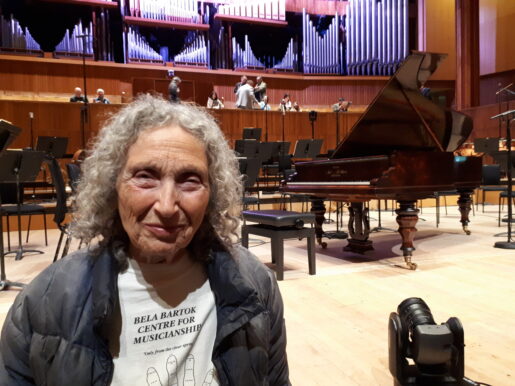
Entering the hall for the concert, one had the impression that the star of the evening would be the handsome brown Blüthner fortepiano, placed mid-stage with fully opened lid. Many audience members queued in front of the stage to take pictures of the rare instrument. Catalogued as Blüthner Number 726 in the collection of Clavierwerkstatt Christoph Kern in Staufen, Germany (where it was restored), this instrument was built around 1859. With its parallel-strung thin strings, each register on the keyboard has different tone colour. I loved the bass part because of its clarity although Schiff’s technical mastery and musical insight had much to do with the sound produced.
Robert Schumann’s Op.92 Konzertstück was much appreciated by his wife Clara who first premiered it in 1850 and then again, in the revised form, in 1851. Clara liked the piece and, judging by his loving performance, so does András Schiff. Nevertheless, I wonder if Schumann wrote the piece for Clara to show off her virtuosity or to give her practice time with countless arpeggios. The fast arpeggio sections are relentless throughout the whole piece, which lasts about 15 minutes, even during the Introduction which is marked Langsam (=slowly). The solo piano does get its much repeated three-bar melodic motive in one hand but the orchestra – especially the winds – are in the foreground. Schiff is quoted as saying that the piece is rarely played because its length makes it difficult to incorporate in orchestral programmes. I would argue that the piece is rarely played because it is tiring for the pianist while the orchestra gets the shine. Schiff played from memory and, also, with ease. I cannot imagine any other pianist playing this piece with such dedication, so I am not expecting to come across it in the concert hall any time soon.
The Blüthner got removed from the stage – making an unofficial interval in the first half of the concert – and Schiff stood on the same spot to conduct Mendelssohn’s Midsummer Night’s Dream excerpts. No conducting platform, he just stood between first and second violins as if part of the orchestra. Also, Schiff does not use any conducting baton; he conducts as if the orchestra was his large piano and he plays the piano as if the piano keys represented orchestral instruments.
Schumann and Mendelssohn were contemporaries, and for a while both lived in Leipzig. They were friends, so performing works by both at the same concert makes historical as well as musical sense. However, I am not sure about performing the Midsummer Night’s Dream pieces unless surtitles display the relevant spots in the play. Even if one is familiar with Shakespeare, title movements like Intermezzo, Nocturne and Scherzo do not necessarily recall their places in Mendelsohn’s incidental music. In the programme notes Laura Tunbridge specifies the relevant details but surtitles would be more immediate. The Overture, which the 17-year-old Mendelssohn composed in 1826 (and premiered in 1827), has become a standalone concert piece and needs no explanation. However, the other pieces, composed sixteen years later and premiered in 1843, do need guidance. Schiff clearly knows his Shakespeare and every note of Mendelssohn’s score. He conducted from memory; his musical guidance evoked all the magic of Shakespeare and Mendelssohn.
The combined skills of Schiff and the OAE ensured a rock-solid start for Schumann’s Piano Concerto. This was no mean feat! The first movement is Allegro affettuoso with a metronome marking of 84 to a minim. It starts with a forte quaver chord for the full orchestra; the solo piano enters after a semiquaver rest. I am not entirely sure who brought in the orchestra (although it was probably leader Matthew Trustcott) – Schiff was not visibly conducting and the orchestra leader sat behind Schiff’s back – but the forte chord and then Schiff’s entrance was spot on. Schiff played with disciplined passion without any sentimentality and with immense technical skills. The orchestra superbly adjusted to his agogics (rubato in the bar); we had lovely dialogues between piano and oboe, piano and flute. The unity between soloist and orchestra was better than at many performances with a separate conductor. Here the OAE was an extension of Schiff’s fortepiano, with solo horn and timpani bringing in their exposed statements without any prompting from anybody.
We had two generous encores. First came a lovely solo piano piece, the historically fascinating Albumblatt by Brahms. Composed in 1853 for a guest book in Göttingen, it was discovered in Princeton in 2011. It is a shame that we had no announcement about this piece and there was no mention of it in the programme notes. However, there is a fascinating discussion as well as Schiff playing the piece in January 2012 here.
The second encore was Mendelssohn’s Hebrides (Fingal’s Cave) Overture. Although over ten minutes long, orchestra and Schiff showed no sign of exhaustion at the end of their long concert: beauty and excitement filled the hall.
The OAE is remarkable for their excellent individual players and their unity. I remember their early days some forty years ago – I knew many of their players well – and their many concerts in the following four decades. Self-confidence and marketing were not always in sync with musical delivery. However, these days they are on the top and may they remain so.
The strength of the OAE is their combined unity of purpose and delivery. Nevertheless, on this occasion, special credit is due to Lisa Beznosiuk (flute), Daniel Bates (oboe), Katherine Spencer (clarinet), Roger Montgomery (horn) and Adrian Bending (timpani).
This concert was the ninth of OAE’s eight-city tour (Vienna, two performances in Graz, Antwerp, Amsterdam, Munich, Zurich, Hamburg, London), starting on 11th May. During this period two former members, cellist David Watkin and theorbo player Dai Miller, sadly died. At the start of the concert, bass player and players’ artistic committee chair Cecelia Bruggemeyer announced that this concert was dedicated to their memory. Orchestra and András Schiff wore full black, their musical delivery was second to none.
András Schiff is the embodiment of music without equals. His musical memory is staggering, so is his physical capacity. It was a joy and privilege to witness his indomitable spirit.
Agnes Kory
Featured Image: Agnes Kory with the fortepiano used in this concert