
 Bulgaria Wagner, Götterdämmerung: Soloists, Chorus and Orchestra of Sofia Opera and Ballet / Evan-Alexis Christ (conductor). National Opera and Ballet, Sofia, 3.7.2025. (GT)
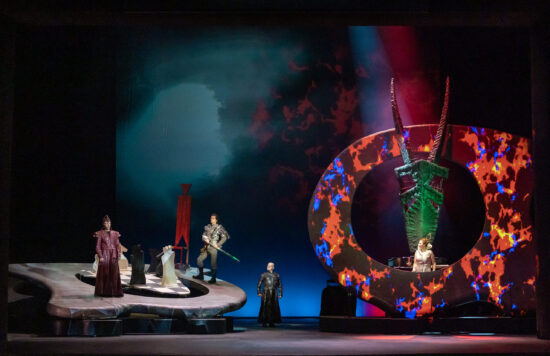
In introducing the 2025 Wagner Festival in Sofia this summer, Plamen Kartaloff adopted the theme of ‘Wagner in Colour’. This is the third such event in three years, and the repertoire has continued to grow with a new production added annually, last year the newcomer was Lohengrin (review here), and now with only one stage work left to come, Die Meistersinger von Nurnberg in 2026, after the new Tannhäuser this year which opened the festival before the revival of the Ring cycle. Though, of course, the rarely-staged Rienzi would be another possibility.
The surprising development of the Wagner repertoire in Bulgaria has been achieved and dominated by Bulgarian singers – itself a unique factor as few Wagner operas staged in German opera theatres can boast exclusively German or Austrian singers. To bring Wagner to Bulgaria successfully, is in itself an achievement, to hire Bulgarians in every singing role is a miracle.
This performance of Götterdämmerung is more than a revival of the 2023 production as there has been a substantial revision by Kartaloff through introducing enhancements in the scene changes, upgrading to the lighting and subtle fluctuations in accentuating the narrative of the Ring. The theme of redemption that runs through all the composer’s operas is most of all reflected on the last day in the tetralogy. Another element – advanced in the publicity for the festival – was ‘Wagner in Colour’. Certainly, in past cycles, Kartaloff demonstrated his productions with strong and vivid reds, yellows and blues, and now there was more deft use of shadings and in the half lit scenes which evinced the character of each performer on stage.
Innovation of the scenes allowed greater expression to the voices and to the narrative as the lighting in several scenes was intensely beautiful beginning from the opening scene of the Three Norns in the Prologue with the playing with the three globes as the Norns moved through the great triskels, there was more attention to phrases and the singing, and the colourfully projected scenes were intensely beautiful – as if we are witnessing a magical fairytale. The third scene of Waltraute and Brünnhilde in the first act opened with Waltraute asking ‘Schläfst oder wachst du?’ and attains greater significance as Waltraute pleads in beseeching Brünnhilde to give up the ring, ‘Den Rheintöchtern gib ihn zurück!’
The dialogue is accompanied by the silent entry of the gods reminding us of past glories. The characterisation of Waltraute by Alexandrina Stoyanova-Alexandrovna was astounding in her every facial and body movement, then the appearance of the Valkyries on their red steeds. This scene was very deeply emotive and superbly enacted and sung as Brünnhilde rejects her sister’s plea, ‘Den Ring entfürst du mir nicht!’ This was a hugely effective scene powerfully characterised by both singers.
The Brünnhilde of Iordanka Derilova was the star of the whole evening; she has achieved greater insight in both her voice and characterisation. Every time in this part, she adds something more to the role. It is difficult to see anyone who can match her Brünnhilde. The Hagen of Petar Buchkov was magnificent in the personification of evil, both in voice and acting, once again he – like Derilova – has found something extra in presenting this malevolent, yet tragic character. An additional element in many of the scenes was the frequent appearance of Alberich; he was a constantly lurking presence in the shadows as if awaiting his moment of revenge. In Act I, the scene of Hagen’s preparation of the potion for Gutrune was more visibly portrayed, and especially noticeable was the subtle shading and colours given to each transforming scene. Gunther was once again superbly taken by Atanas Mladenov who brings more craft to his portrayal, in his postures and acting, he was a major success in this staging. Another great singing- actor from Sofia Opera was Tsvetana Bandalovska and her Gutrune was tenderly emotive – once more significantly greater in her interpretation from last year. Kostadin Andreev delivered an excellent Siegfried, showing notable improvement over two years ago with superb singing and outstanding acting.

The work by Andrej Hajdinjak in creating the lighting and the vividly presented colours were amazing making the whole performance a thing of beauty, never seen before in previous evenings, here or elsewhere, and ably assisted by Elena Shopova’s multimedia projections. The costumes by Hristiyana Mihaleva-Zorbalieva were dominated by steely greys, reds for the Valkyries, whites and blacks, mixed with beige and brown for those in the Gibichung Hall. The lighting projected on the great triskels was spectacular adding to the whole dramatic and exhilarating narrative.
In Act III, the vassals were immensely powerful in their singing and impressive in their presence – often threatening and sometimes beseeching with Hagen as he killed Siegfried. The limiting of the vassals within the great triskels implied their powerlessness in the murder of the hero. Throughout the Ring cycle, the American Evan-Alexis Christ conducted the orchestra with great sensitivity and his overall intense direction was outstanding in transforming this orchestra into a top-class Wagnerian ensemble. This is a significant achievement as the orchestra pit only allows for seventy-six musicians and thus limits the strings group while giving emphasis to the Wagner horns and brass group. His work in both rehearsing the orchestra and bringing out all the drama and excitement of Wagner’s score was fundamental to the success of the performance. Evidence of the increasing popularity of Wagner’s operas here was the ten-minute standing ovation from a very appreciative audience – at a few minutes short of midnight!
Gregor Tassie
Production:
Director – Plamen Kartaloff
Sets – Hans Kudlich
Lighting – Andrej Hajdinjak
Multimedia – Elena Shopova
Costumes – Hristiyana Mihaleva-Zorbalieva
Chorus master – Violeta Dimitrova
Assistant Director – Yulia Krasteva
Head of Production – Nella Stoyanova
Artist – Christiyan Stoyanov
Constructive development – Eng. Georgi Georgiev
Design and Sculptural work – Boryan Belchev
Cast:
Brünnhilde – Iordanka Derilova
Siegfried – Kostadin Andreev
Hagen – Petar Buchkov
Gunther – Atanas Mladenov
Gutrune – Tsvetana Bandalovska
Alberich – Plamen Dimitrov
Waltraute – Alexandrina Stoyanova-Andreeva
Woglinde – Stanislava Momekova
Wellgunde – Ina Petrova
Flosshilde – Alexandrina Stoyanova-Andreeva
First Norn – Tsveta Sarambelieva
Second Norn – Ina Petrova
Third Norn – Silvia Teneva