 United States The Met: Live in HD – Mozart, Così fan tutte: Chorus and Orchestra of the Metropolitan Opera / Nimrod David Pfeffer (conductor). Broadcast live (directed by Gary Halvorson) from the Metropolitan Opera, New York, 3.10.2026, and viewed at Everyman Winchester, 6.10.2026. (DH) ****
The stage history of Così fan tutte in this century implies that directors see it as a ‘problem opera’ for which a framing premise for the narrative’s emotional upheaval must be provided. Arguable, perhaps, but one can understand why they might think that in a plot involving misogyny, contrivance, and lovers manipulated like puppets. One of the prerequisites of such a frame, however, must surely be credibility. The last production I saw before this one was of Barrie Kosky’s 2024 realisation in Vienna. He placed the action in a rehearsal room where Don Alfonso, a director conspicuously past his prime, is putting two young couples through a brutal exercise in method acting. A shaky starting place you might think, and so it proved: the artificiality an instant divide, an audience uninvolved. In an interesting (or depressing, depending on your point of view) trend, Kosky’s was the third rehearsal-room Così to have been served up in Vienna within a ten-year period. One weary local critic commented laconically that ‘Barrie Kosky doubtless considers his concept original’.
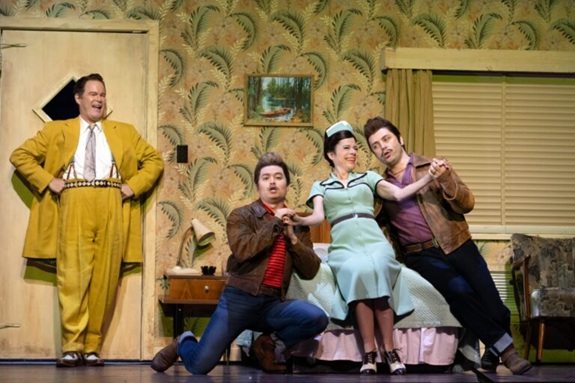
Phelim McDermott’s production, now revived at the Metropolitan Opera and shown in cinemas as the first live transmission of The Met: Live in HD’s twentieth season, is unquestionably original. It is also scenically and emotionally believable, inventive, but not over-intellectualised. McDermott, one feels, never forgot that Mozart and Da Ponte saw Così as a comedy. His framing has a strong sense of place. We are in the US of the 1950s at a seaside amusement park with more than a passing resemblance to Coney Island. Two officers, Ferrando and Guglielmo, are taking a vacation with their fiancées, sisters Dorabella and Fiordiligi, at the ‘Skyline Motel’. Unfortunately, whilst at a nightclub Ferrando and Guglielmo make a new friend, one Don Alfonso, who has a cynical view of the fidelity of women, and so the plot is sprung. ‘Sprung’ here feels an apt choice of words because amidst the often very funny action in Sara Erde’s tightly staged revival there is an engrossing array of fairground skills on display provided by some very talented artists. The tricks start in the overture with some witty wordplay effected by the remixing of signs and are a constant feature, brilliantly evoking time and place as well as providing some delightful incidental entertainment. With a fire breather, sword swallowers, contortionists, and a snake charmer there is something for everyone, as they say. The skills ensemble also doubles as a sort of silent chorus, sometimes as co-conspirators with Don Alfonso, at other times sympathetic observers, a clever and effective piece of stagecraft.
The production requires first-class acting as well as singing to come off. It gets it. Duke Kim and Andrey Zhilikhovsky as Ferrando and Guglielmo are a great double act. Variously confident, mercurial and at times almost despairing, they are highly credible and humorous without becoming caricatures, somehow conveying a 1950s maleness which goes some way to explaining their behaviour. This reaches its apotheosis in Guglielmo’s second-act aria, ‘Donne mie, la fate a tanti’, which puts to bed once and for all the notion that the women’s behaviour is worse than the men’s; Zhilikhovsky positively explodes with indignation and male entitlement.
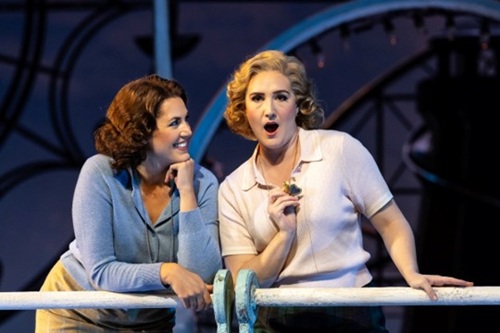
Federica Lombardi’s Fiordiligi and Samantha Hankey’s Dorabella are necessarily more nuanced. Lombardi is very good in the way she establishes Fiordiligi’s moral credentials in her initial refusal of Ferrando’s advances so that her later chastisement of Dorabella and subsequent ‘fall’ have real emotional impact. Her delivery of ‘Per pietà, ben mio, perdona’ from a balloon flying around the stage feels like the emotional as well as theatrical centre of the staging. Hankey, meanwhile, is excellent at portraying Dorabella’s changeable nature. Halfway through her aria ‘Smanie implacabili’ in the first act, she makes as if to strangle herself on her bed with stockings. Five minutes later she is jumping about frivolously on the same bed, spirits lifted by the start of Despina’s attempts at persuasion.
As Despina, Ana María Martínez handles the difficulties Da Ponte throws at the character — she has a scheming nature but a good heart, is overworked but also generous — with real panache and is a highly accomplished comic actor into the bargain. Her ‘healing’ of Ferrando and Guglielmo as ‘Dr Magnetico’ with her ‘famous vibration machine’ is hilarious. Gerald Finley’s Don Alfonso has the cynicism and controlling nature the character requires, but there is a hint of humanity too. And he is so at ease with whatever is thrown at him, even when singing while sucking a lollipop or maintaining authority whilst wearing an absurd spangly suit.
Musically this is as satisfying a Così as I can remember. I listened to the Met’s audio stream last week, which was highly enjoyable experience in its own right, whose virtues were only enhanced in the cinema. The singing of each of the principals is uniformly strong. Apart from Don Alfonso, whose single aria is brief, each has a key aria in each act and delivers it wonderfully, but it is the glorious ensemble singing that will stay with me most. The Met Chorus were excellent and the orchestra under Nimrod David Pfeffer superb. This was a masterclass in how to do historically informed Mozart on modern instruments: light, taut, and sprightly. I also very much liked Jonathan C. Kelly and Kari Jane Docter’s beautifully judged fortepiano and cello continuo playing. As always the Broadcast Team provide cinema audiences with a genuinely immersive experience. We get to see Tom Pye’s fantastic sets and the stage action from what feels like prime seats.
Does McDermott ‘solve’ this problem opera? On the whole, I think yes. The misogyny is blunted, not least because the men emerge no better. But the production never takes itself too seriously, a real virtue in a work that is, after all, a dramma giocoso. The staging originated at English National Opera before debuting at the Met. I feel it is a bit like another ENO production, the Jonathan Miller Rigoletto, which always seems to come up trumps when revived. This Così was frenetic, witty, spectacular and fresh. Crucially, it also felt emotionally true. Catch it if you can.
You can find The Met: Live in HD programme for the 2026–27 season here.
Dominic Hartley
Featured Image: Gerald Finley (Don Alfonso), Duke Kim (Ferrando), Ana María Martínez (Despina) and Andrey Zhilikhovsky (Guglielmo) © Marty Sohl/Met Opera
Cast:
Fiordiligi – Federica Lombardi
Dorabella – Samantha Hankey
Ferrando – Duke Kim
Guglielmo – Andrey Zhilikhovsky
Despina – Ana María Martínez
Don Alfonso – Gerald Finley
Creatives:
Production – Phelim McDermott
Revival Stage director – Sara Erde
Set designer – Tom Pye
Costume designer – Laura Hopkins
Lighting designer – Paule Constable
Chorus director – Tilman Michael
Live in HD director – Gary Halvorson
Live in HD host – Christine Goerke