 United States Verdi, Macbeth: Soloists, Chorus and Orchestra of the Metropolitan Opera / Yannick Nézet-Séguin (conductor). Metropolitan Opera, New York, 5.10.2026. (ES-S)
‘There are only three roles, and there can only be three: Lady Macbeth, Macbeth and the chorus of witches’, Verdi insisted while revising Macbeth for Paris in 1865. Making her Metropolitan Opera debut, director Louisa Proske takes the composer at his word in the new production that opened the company’s 2026–27 season.
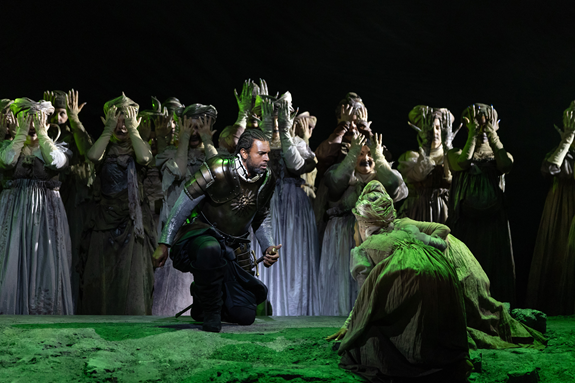
Her witches form a restless, flexible collective body, their jumps, turns and contortions responding remarkably well to the alert rhythms of Verdi’s score. They creep and swarm across the desolate landscape and remain present for much of the action; indeed, at times their absence seems more conspicuous than their presence. The opening is particularly striking: hovering over the bodies of dead soldiers, they seem almost to feed on them, perhaps accounting for their prominent crimson lips. Yet for all the kinetic energy, their dramatic function remains an ancient one: they embody the inexorability of fate, as in Greek tragedy.
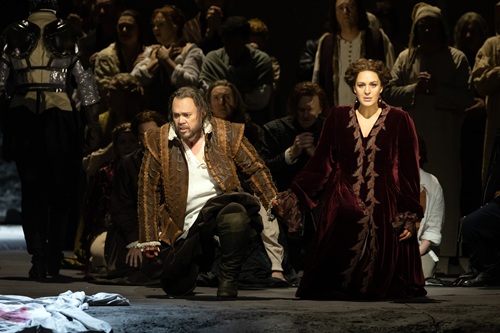
Jon Bausor’s monumental revolving set places the action in a world at once war-ravaged and post-apocalyptic. Large niches carve out interior and exterior spaces but remain framed by essentially the same enormous structure, a device that eventually becomes somewhat monotonous. Montana Levi Blanco’s costumes introduce more specific historical references, not always persuasively: at one point, Lady Macbeth’s elaborate ruff, pearls and exaggerated sleeves evoke the iconography of Elizabeth I, for reasons that remain obscure.
Jorrell Lawyer-Jefferson’s choreography is not limited to the witches’ movements. His elegant leaps and twists for the soldiers in battle were often captivating, even when their dramatic purpose was less apparent. However, placing three dancers on the banquet table for a perfectly executed sequence of knee drops and turns, recalling a Caucasian folk dance, seemed decidedly over the top. At times, the sheer number of bodies made the stage feel overcrowded.
Proske’s conception of the witches remains her most compelling contribution, their pervasive presence giving the production an identity of its own. Otherwise, her staging offers plenty of atmosphere and theatrical energy but few comparably fresh insights into the characters and dramatic situations.
At the center of the performance was Quinn Kelsey’s Macbeth, sung with the dark, burnished tone and effortless authority that have made him one of the Met’s leading Verdi baritones. Vocal weight was only part of the characterization: Kelsey allowed uncertainty and vulnerability to register from the outset, suggesting a man susceptible to the witches’ prophecy rather than one propelled by an already formed ambition. Ample power was complemented by finely shaded dynamics and a wide range of vocal color. In the third-act encounter with the apparitions, his mounting obsession with the prediction that Banquo’s descendants will inherit the throne remained strikingly controlled, conveyed through an inward intensity rather than overt psychological unraveling. That restraint paid still greater dividends in ‘Pietà, rispetto, amore’, where the grandeur of his voice gave way to a more reflective, desolate tone as Macbeth confronted what his victories had cost him.
Lise Davidsen’s relatively recent exploration of Verdi invites comparison with Birgit Nilsson, another great Scandinavian dramatic soprano whose formidable instrument extended beyond Wagner and Richard Strauss into the Italian repertory. Davidsen has approached the transition cautiously: after taking on Elisabetta in Don Carlo in 2023 and Leonora in La forza del destino at the Met the following year, Lady Macbeth is another role debut. She has herself spoken of the ‘elasticity and lightness’ this music requires, qualities she acknowledges are very different for her voice from those demanded by the repertory with which she is more closely associated.
On Tuesday night, her lower register had sufficient presence but lacked the brilliance and unmistakable individuality of her upper register. Her Italian favored seamless legato over incisive consonants. The beauty of her voice made this a Lady Macbeth more imposing than poisonous: menace and malevolence were not her most instinctive colors. Nor was her relationship with Kelsey’s Macbeth always entirely convincing.
Yet Davidsen’s extraordinary resources were evident throughout. There was genuine dramatic incisiveness in ‘Or tutti, sorgete’ while ‘La luce langue’ revealed a wide palette of colors and finely graded dynamics. In ‘Si colmi il calice’, she achieved considerable lightness and mobility despite the scale of her voice. Her blazing high notes were only one part of the arsenal: she repeatedly drew the sound back into beautifully sustained pianissimos and shaped phrases with remarkable delicacy. These qualities paid their greatest dividends in the sleepwalking scene where Davidsen conveyed Lady Macbeth’s disintegration with haunting vocal subtlety, even if her physical characterization remained perhaps less fully realized. She may be more naturally at home in Wagner and Strauss, but sheer technical mastery allowed her to meet most of Lady Macbeth’s very different demands.
Ryan Speedo Green was an elegant Banquo, his warm, finely shaped singing perhaps too refined for the production’s brutal environment but bringing particular distinction to ‘Come dal ciel precipita’. Freddie De Tommaso’s Macduff made a vivid impression in ‘Ah, la paterna mano’, his ringing tenor conveying a father’s grief with urgency. He began with restraint, lending the opening phrases a reflective quality before giving the climaxes their full force.
The Metropolitan Opera Chorus combined imposing weight with clarity in Verdi’s prominent choral writing. Yannick Nézet-Séguin drew an urgent, alert performance from the responsive Met Orchestra, maintaining rhythmic precision while bringing out the score’s darker sonorities. The result had momentum without haste, sustaining dramatic tension throughout a remarkable evening – one that, early in the season, bodes well for what is to come.
Edward Sava-Segal
Featured Image: Ryan Speedo Green (Banquo) in Verdi’s Macbeth © Marty Sohl/Met Opera
Production:
Production – Louisa Proske
Sets – Jon Bausor
Costumes – Montana Levi Blanco
Lighting – Adam Silverman
Choreographer – Jorrell Lawyer-Jefferson
Chorus director – Tilman Michael
Cast:
Macbeth – Quinn Kelsey
Banquo – Ryan Speedo Green
Lady Macbeth – Lise Davidsen
Lady Macbeth’s Lady in Waiting – Marcy Stonikas
Servant – Jeongcheol Cha
Malcolm – Jonathan Burton
Macduff – Freddie De Tommaso
Murderer – Christopher Job
Herald – Yohan Yi
Doctor – Bradley Garvin
Fleance – Anu S. Alerte
Banquet Dancers – George Goderdzishvili, Data Darakhvelidze, Luka Kikacheishvili