 Germany Verdi, Un ballo in maschera: Soloists, Sächsischer Staatsopernchor Dresden, Sächsische Staatskapelle Dresden / Daniele Gatti (conductor). Semperoper Dresden, 4.10.2026. (AB)
Verdi’s Un ballo in maschera is an unusually difficult opera to bring convincingly to the stage. Political violence and private betrayal are inseparable, while comedy repeatedly interrupts a tragedy whose conclusion has already been foretold. Angela Denoke, whose international career as a soprano has recently acquired a second chapter in directing, might have seemed particularly well placed to explore these emotional contradictions. Her eagerly anticipated Semperoper direction debut, however, offers considerably more assurance in its visual arrangements than in its understanding of the people who inhabit them.
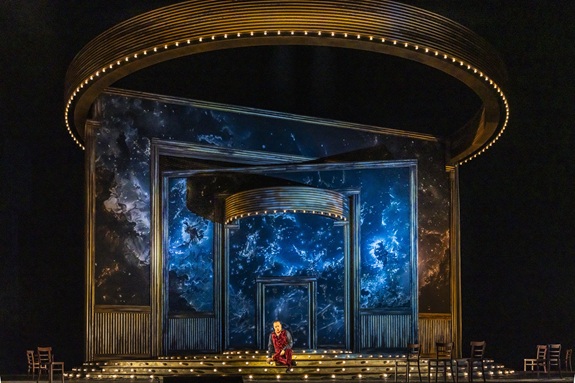
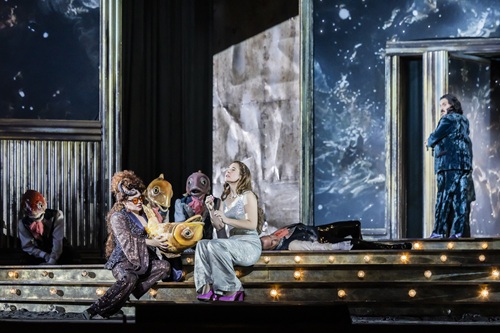
Visually, the production is certainly stunning. Timo Dentler and Okarina Peter have built a magnificent circular stage within the stage, whose scale and technical ingenuity make an immediate impression. Three concentric, stepped rings revolve independently, supplemented by a rotating wall, while a surrounding curtain can conceal or enclose the entire construction. The changing perspectives and the depth of the spaces they create are arresting. Fabio Antoci’s lighting, including a starry backdrop, brings further richness to these transformations, creating particularly powerful, darkly atmospheric images around Ulrica as she foretells Riccardo’s murder.
Unfortunately, this impressive setting also becomes the production’s central difficulty. Its machinery more often than not gets in the way of the direction of the characters: the singers occupy the spaces it provides, but their relationships rarely seem to determine how those spaces are used. Continual rotation promises dramatic movement without quite supplying it. The eye remains engaged, yet the changing configurations do little to clarify an encounter, expose a hesitation or sharpen a conflict.
The problem is immediately apparent in the treatment of the chorus. Whether representing a public caught up in the political tensions surrounding Riccardo or a gathering absorbed by Ulrica’s predictions, its members can do little more than stand dutifully on the circular platforms and sing. They sing excellently, but one wishes they had been given rather more to do. The absence of a convincing collective presence is all the more keenly felt.
The opera’s history makes this particularly regrettable. Antonio Somma’s libretto draws on Eugène Scribe’s treatment of the public assassination of King Gustav III of Sweden at a masked ball in Stockholm in 1792. Censorship forced Verdi to relinquish his royal protagonist, and the work eventually received its premiere at Rome’s Teatro Apollo in February 1859, with the action transferred to colonial Boston and Riccardo as governor, which is the version chosen for Dresden.
The private encounters fare little better. Riccardo’s love for Amelia, the wife of his closest friend Renato, exposes the dangerous disparity between his public standing and his personal desires. Yet their declaration of mutual love takes place in front of the revolving structure, with little sense of intimacy developing between them. When Renato discovers their attachment, condemns Amelia to death and reluctantly grants her plea to see their son once more, the staging again seems almost to get in the way.
Denoke’s emphasis on Ulrica as an embodiment of fate offers no adequate substitute. Renato’s decision to join the conspirators and murder Riccardo fulfils her prophecy; but treating that prediction as the explanation for everything diminishes the characters’ responsibility. Riccardo’s generosity does not erase his recklessness, nor does Renato’s suffering justify his revenge. Suggestions of a further intimacy between the men, and of Oscar’s emancipation beyond the conventional role of a page to Riccardo, remain undeveloped. The conspirators’ grievances might have complicated the portrait of a benevolent governor, but their political hostility towards Riccardo receives little attention beyond its function in preparing the assassination.
Musically, the evening has considerably greater substance. Daniele Gatti draws beautifully refined playing from the Sächsische Staatskapelle Dresden, revealing the score’s intricate construction without sacrificing its warmth. Carefully judged tempi allow phrases to unfold naturally, and the orchestral textures remain transparent throughout. Coordination with the singers is not invariably secure, however, and occasional uncertainty interrupts the musical flow.
Nicole Car’s Amelia provides the strongest vocal impression. Her soprano combines a glowing middle register with a silvery upper range, retaining expressive flexibility across the part’s lyrical and dramatic demands. Germán Enrique Alcántara brings a warm, rounded baritone to Renato, with a cantabile that suggests emotional shades the production seldom allows him to embody. Francesco Meli’s Riccardo is less consistently nuanced: the tenor has ample presence, though his reliance on a cultivated forte limits the character’s vulnerability. Yulia Matochkina’s dark, resonant Ulrica has genuine vocal authority, while Rosalia Cid’s bright soprano and agile articulation give Oscar welcome lightness.
When Riccardo is killed at the masked ball, his dying assurance of Amelia’s innocence exposes the futility of Renato’s revenge. The music makes this recognition moving, but the production has done too little to prepare for the climax. Exceptional visual splendour, excellent singing and distinguished orchestral playing cannot quite compensate for the missing dramatic exchange. In the end, the evening remains somewhat less than the sum of its parts.
Andreas Bücker
Featured Image: Francesco Meli (Riccardo) © Jochen Quast
Production:
Director – Angela Denoke
Assistant Director – Fabio Toraldo
Staging & Costumes – Timo Dentler, Okarina Peter
Lighting – Fabio Antoci
Choir conductor – Jan Hoffmann
Dramaturgy – Jörg Rieker
Cast:
Riccardo – Francesco Meli
Renato – Germán Enrique Alcántara
Amelia – Nicole Car
Ulrica – Yulia Matochkina
Oscar – Rosalia Cid
Silvano – David Roy
Tom – Tilmann Rönnebeck
Samuel – Vladyslav Buialskyi
Guard – Frank Blümel
Servant – Meinhardt Möbius