
 United States Various: Nicola Benedetti (violin), San Francisco Symphony / Karina Canellakis (conductor). Davies Symphony Hall, San Francisco, 9.10.2026. (HS)
Victoria Borisova-Ollas – The Kingdom of Silence
Prokofiev – Violin Concerto No.2 in G minor
Encore: Jay Ungar – ‘Ashokan Farewell’ (unaccompanied)
Rachmaninoff – Symphonic Dances
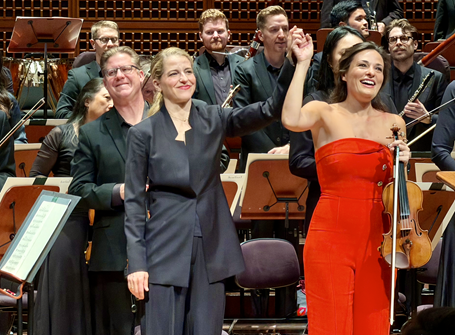
Karina Canellakis, now an annual visitor to the San Francisco Symphony conductor’s podium, keeps chalking up hits. Her ability to charge up the orchestra without losing any of the necessary balances makes her stand out from a parade, so far this season, of conductors who encouraged over-the-top blasts and rough edges in their programs.
Her lineup this time reflected the Russian roots of its three pieces. The range stretched from a sonically eerie 2003 tone poem by Victoria Borisova-Ollas and the dazzle of Prokofiev’s Violin Concerto No.2 in the first half to the shifting rhythms and orchestral colors of late Rachmaninoff. Her athletic conducting style communicates what she wants from the music with body language as much as her baton. She drew effusive and crisp playing. When appropriate, a calming palm kept the sound within bounds.
The effervescent violinist Nicola Benedetti brought her own mix of pinpoint technical precision and go-for-it expression to the concerto. She is not one to stand still while playing either: she was practically dancing to the more rhythmic portions of the concerto. Somehow, she never let that feel exaggerated, just bringing life to the stage as well as musical acumen.
The Prokofiev concerto opens with the violin ruminating on a simple minor triad. When Canellakis sneaked in the orchestra under it, the music began to intertwine with a simplicity that somehow felt like it was discovering itself. When the second theme arrived, Benedetti framed the Romantic melody with elegance. In the quieter second movement, the subtle rhythmic balance between pizzicato strings and the soloist’s song created a seraphic atmosphere. Prokofiev’s harmonic shifts arrived without any extra emphasis, the virtuosic adornments were played gently and the subtlety was breathtaking. Then, in the lively finale, Benedetti grabbed the moment to show off, and it made for an appropriately flashy finish.
After these, the encore calmed things down with an unaccompanied arrangement of ‘Ashokan Farewell’, American composer Jay Ungar’s fiddle piece. Though it is best known as the theme music of the 1991 PBS documentary The Civil War, the Scotland-born Benedetti said it conjured up a Scottish folk song for her. The arrangement began with virtuosic flourishes before settling into the simple tune, to which she added double- and triple-stops without losing the melodic thread.
Good as all that was, the evening’s highlight was Rachmaninoff’s Symphonic Dances, a late work (1940) for the Russian-born composer who spent his last 25 years living in the United States. Its 35-minute span and three-movement format felt more like a coherent symphony than a collection of brilliantly orchestrated ballet music (which the piece started out to be, but that’s another story). Canellakis managed to corral these rhythmic incidents into a logical and coherent narrative.
Especially appealing were the different colors she found in each dance segment. In the opening movement, the woodwinds’ sound when they entered was ravishing, and each of the solos exacted a different expression. It was a mesmerizing few moments, and when the strings picked up the same music a sense of destination began to form.
Each new dance seemed to emerge from a link with the previous one in a way that felt like new discoveries. Rachmaninoff’s collection of original music could be mistaken for folk songs or other composers’ waltzes, but they are original, including several borrowed from his early works. Canellakis fashioned each one with a freshness that could turn bold in one and hesitant in the next, sleek here and stomping there, happy at one moment and then introspective. The playing through all this was thrilling, the confident sound of a great orchestra flexing but never to extremes. It felt like the entire orchestra was improvising as one.
Born and educated in Russia, Victoria Borisova-Ollas has lived in Stockholm since moving there in her 20s. The Kingdom of Silence explores moments before death in its own way and relies on tone color to do it as much as Rachmaninoff did. The 14-minute piece, previously performed by this orchestra in 2006 under Vladimir Ashkenazy, started off with a sense of repose, barely audible celesta and glockenspiel against faraway violin tremolos, and gradually rose into some frightening episodes before settling into the peaceful music with which it began.
Along the way, Borisova interrupts the flow with quick trumpet fanfares, rumbling undercurrents and string glissandos. The sense of harshness arising and finally quieting came through vividly.
Harvey Steiman