
 United States Various: Jonas Kaufmann (tenor), Berliner Philharmoniker / Kirill Petrenko (conductor). Carnegie Hall, New York, 8.10.2026. (RP)
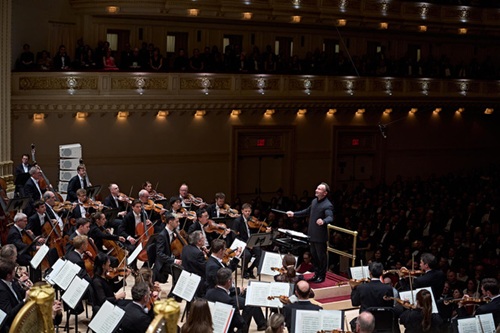
Carnegie Hall launched its season with a four-day residency by the Berliner Philharmoniker and its chief conductor, Kirill Petrenko – a substantial commitment rather than a flashy concert or two. The orchestra appears four times in as many days, including two performances pairing Richard Strauss’s Also sprach Zarathustra with Brahms’s Piano Concerto No.1 and featuring Víkingur Ólafsson as soloist. It began with a gala devoted to colorful, emotionally charged Italian music, with tenor Jonas Kaufmann as the featured soloist.
The opening sounds were the three ominous chords of the Overture to Verdi’s La forza del destino. Petrenko alternated explosive urgency with sweeping melodic lines in a masterclass in musical storytelling. The reading also showcased the artistry and distinctive tone of the ensemble’s new principal clarinetist, Kilian Herold, whose playing was one of the evening’s defining pleasures.
Kaufmann stepped outside his usual tenor repertoire for the first of his four arias, choosing Tonio’s Prologue from Leoncavallo’s Pagliacci. Although Canio is his natural domain, he has sung the baritone aria in recital. Before Kaufmann sang a note, Petrenko and the orchestra established the opera’s emotional world in the brief introduction, most notably with the plaintive horn solo. The aria revealed the richness of Kaufmann’s middle register, while the climactic high A-flat was arguably the most thrilling note he produced all evening. His soft, lyrical delivery of the line about memories deep in the soul was especially beautiful. He sang with noticeable restraint which took on greater significance as signs of illness emerged later.
In the Intermezzo from Pagliacci, Petrenko shaped the music with expansive breadth, heightening its undercurrent of melancholy. The transparent, shimmering sound, particularly the silvery, penetrating violins, made this moment of repose all the more poignant. Kaufmann returned for ‘Vesti la giubba’, conveying the inexorable conflict between a clown compelled to make an audience laugh and the violent reaction of a man just discovering his wife’s infidelity. He delivered the searing lament in bronze tones, his voice seeming to collapse into an emotional void as he sang the famous closing words, ‘Ridi, Pagliaccio’ (‘Laugh, clown’).
According to the program notes, Respighi’s wife, Elsa, said that her husband did the world a favor by capturing the dreadful sounds of automobiles and other vehicles in Fountains of Rome, composed in 1916. Petrenko and the Berliner Philharmoniker repaid the favor with a reading that sparkled with an apparently inexhaustible array of orchestral hues. In the opening measures, the sun seemed actually to rise over the Eternal City, the solo clarinet and flute adding to the tonal shimmer. The horns evoked Tritons blowing conch shells with swirls of witty, honey-colored sonorities. Petrenko, usually economical with his gestures, became expansive as he drew majestic phrases from the players in the depiction of the Trevi Fountain at midday. In the final vignette, the sun set over the Villa Medici Fountain in a stillness as lovely as the opening sunrise but imbued with repose rather than anticipation.
In Cilea’s L’arlesiana, Kaufmann impressed from the opening measures of Federico’s lament, ‘È la solita storia del pastore…Anch’io vorrei’, with the soft beauty of his voice. His exquisite sotto voce conveyed Federico’s longing for oblivion in sleep, an escape from his obsession with the woman who has bewitched him. The emotional peak came not at the aria’s close but in Kaufmann’s projection of the protagonist’s desire to forget everything. A cough interrupted the final phrase, revealing the cause of Kaufmann’s restraint. The audience rewarded his commitment and courage with a rousing ovation.
The final aria, ‘Amor ti vieta’ from Giordano’s Fedora, made relatively modest demands on the tenor. The singing was safe and perfunctory but his sustained legato and expressive phrasing remained rewarding. His repeated coughing and evident good humor during the ensuing applause made clear that illness had taken its toll.
Pines of Rome ranks among the most dazzlingly colorful and atmospheric works in the Italian orchestral repertoire. Petrenko joined the long line of conductors, from Ormandy and Bernstein to Dutoit, who have reveled in its glories. Children playing at the Villa Borghese sprang to life in sparkling swirls of activity, punctuated by brilliant trumpet blasts. In an instant, the low brass conjured sepulchral gloom beneath the pines near the catacombs.
The moonlit vista from Janiculum Hill emerged in delicate textures, with Herold’s languorous clarinet solo yielding to a nightingale’s recorded song. Petrenko paced the advance of a Roman legion with measured, inexorable precision, building toward its triumphant approach to the city in a blaze of sound. The orchestra’s grandeur was matched by Petrenko’s masterful release of the tension he had so skillfully built.
A surprising but inspired choice of encore, ‘Folk Festival’ from Shostakovich’s The Gadfly Suite, brought the evening to a close. The brief dance bubbled with infectious rhythms and catchy melodies, tinged with Italian popular music. It ended the concert with panache rather than power.
Rick Perdian
The repertoire performed at the Carnegie Hall programs is available on the Berliner Philharmoniker Digital Concert Hall (here) from other concerts.
Verdi – Overture to La forza del destino
Leoncavallo – ‘Si può? Si può?’; Intermezzo; ‘Recitar!…Vesti la giubba’ from Pagliacci
Respighi – Fountains of Rome; Pines of Rome
Cilea – ‘È la solita storia del pastore…Anch’io vorrei’ from L’arlesiana
Giordano – ‘Amor ti vieta’ from Fedora
Encore: Shostakovich – ‘Folk Festival’ from The Gadfly Suite Op.97a, No.3