
 United States Tanglewood 2025 [1] – Debussy, Ravel: Seong-Jin Cho (piano), Boston Symphony Orchestra / Andris Nelsons (conductor). Koussevitzky Music Shed, Lenox, 12.7.2025. (ES-S)

Debussy – Prélude à l’après-midi d’un faune; La mer
Ravel – Piano Concerto in G major; Piano Concerto for the Left Hand; ‘À la manière de Borodine’ (encore)
The Boston Symphony Orchestra’s affinity for French music is a tradition deeply rooted in its history, shaped above all by the legacy of Charles Munch, who served as music director from 1949 to 1962. A native of Strasbourg, Munch brought to the BSO a distinctly idiomatic approach to Debussy, Ravel and Berlioz – one that emphasized color, transparency and rhythmic flexibility. This sensibility was preserved and extended by his successors, from Seiji Ozawa to Andris Nelsons.
In this context, a program devoted wholly to Debussy and Ravel felt entirely natural – pairing Ravel, whose 150th anniversary is being marked this year, with his kindred spirit in orchestral invention, whose sense of form and timbral imagination he both inherited and challenged.
Surrounding the two Ravel piano concertos with two of Debussy’s most iconic orchestral works – Prélude à l’après-midi d’un faune and La mer – proved to be more than just eloquent programming. It offered a chance to reflect on the aesthetic dialogue between two of France’s most original musical voices, and a lens through which to explore both the affinities and the divergences between these masters of modernism. While Ravel’s music often reveals a sharper sense of structure and rhythmic articulation, Debussy tends toward fluidity and atmospheric suggestion. Yet both share an obsession with timbre, color, the expressive possibilities of the orchestra and a sense of suspended time – crafting soundworlds that are at once precise and dreamlike. Heard together, their works highlight not only distinct artistic sensibilities but also a common pursuit: to reinvent orchestral writing for the modern era without abandoning beauty, clarity or emotional depth.
The program opened with Debussy’s Prélude à l’après-midi d’un faune, his famed interpretation of Mallarmé’s symbolist vision. From the first languid curve of Lorna McGhee’s solo flute, evoking the dreamlike sensuality of that imagined world, Nelsons adopted a spacious approach that occasionally risked feeling overly measured but allowed every detail to emerge with striking clarity. Under his direction, the fluid orchestration breathed in long arcs, closer to reverie than desire. The orchestra responded with finely etched detail: the muted warmth of the horns, the glint of the harp and the soaring lines from oboe and violin all contributed to the score’s elusive balance between sensuality and abstraction.
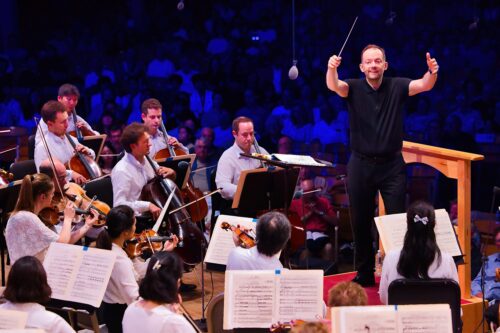
At the end of the evening, the miraculously expanding and contracting sound waves of La mer were gloriously rendered in the BSO’s performance. The numerous solo interventions were exquisite, and the interlacing between strings and winds demonstrated the ensemble’s remarkable cohesion. Echoing Debussy’s own disdain for the label ‘Impressionism’ – with its connotations of blurred outlines and vague atmosphere – Nelsons’s interpretation emphasized clarity of detail and well-shaped forms without lingering excessively on them, as he sometimes has a penchant to do.
Rather than sharply delineating each movement, the conductor shaped the work as a continuous arc. In the first movement, the long crescendo was paced with restraint; textures accumulated gradually before the climactic release. ‘Play of the Waves’ shimmered on the surface, with winds and percussion dancing lightly while remaining integrated into the broader flow. The final movement brought a deepening of intensity, with firm low strings and incisive brass driving the music forward – yet even at its most turbulent, the transparency of texture prevailed.
It was in the transitions – fluid, precisely timed and obeying the music’s natural flow – that the performance found its most distinctive character: the seamless shift from atmospheric haze to surging motion in ‘From Dawn to Noon on the Sea’, the subtle swell that carries the second movement from quiet radiance into kinetic sparkle, and the measured escalation in ‘Dialogue of the Wind and the Sea’, where drama emerges not through abrupt gestures but through a mounting tension shaped by rhythm and color.
The pairing of Ravel’s two piano concertos – the G major and the ‘Left Hand’ – offered a study in contrast and an ideal showcase for Seong-Jin Cho’s clarity, poise and expressive restraint. His interpretation was shaped less by bravura than by a finely calibrated sense of musical line and texture. In the Concerto in G major, Cho favored elegance over brilliance, with buoyant fingerwork in the outer movements and an inward, unhurried approach to the long solo that opens the Adagio assai. There, the melody was spun out with restraint and suppleness – not overtly sculpted, but sensitively weighted. While it might have benefited from a touch more spontaneity, Cho brought a quiet integrity to a movement that can easily lapse into sentimentality. The BSO offered sparkling support under Nelsons’s direction, with crisp percussion and lithe winds contributing to a reading that emphasized the score’s wit and refinement without exaggerating its jazz inflections. The seamless rapport between soloist and ensemble was undoubtedly deepened by their recent collaboration in recording, under Nelsons’s baton, both Ravel concertos for Deutsche Grammophon.
The ‘Left Hand’ concerto revealed a different side of Cho’s musicianship: more rhetorical, grounded in physical weight but no less exacting. His entrance after the long orchestral build-up was commanding without excess, and the extended cadenza unfolded as a single architectural span, with drama shaped by dynamic control rather than expressive inflation. From the brooding, sepulchral orchestral introduction to the thunderous cadenza that erupts midway through, Cho delivered a performance of commanding physicality and tonal richness. Nelsons and the orchestra matched Cho in atmosphere and discipline, maintaining transparency even in the score’s densest sonorities.
This concert was no isolated tribute: Cho has dedicated Ravel’s 150th anniversary year to a worldwide exploration of the composer’s music – in recital programs devoted to the complete solo piano works, as well as in orchestral performances built around the two piano concertos. He included ‘À la manière de Borodine’ as an encore on this occasion – a gesture that spoke to the pianist’s deep affinity for Ravel’s idiom.
Edward Sava-Segal