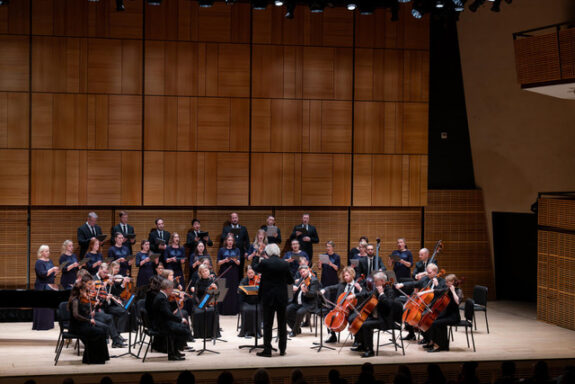
 United States Pärt: Maria Listra (soprano), Annika Lõhmus (soprano), Danila Frantou (countertenor), Raul Mikson (tenor), Toomas Tohert (tenor), Estonian Philharmonic Chamber Choir, Tallinn Chamber Orchestra / Tõnu Kaljuste (conductor). Carnegie Hall, New York, 24.10.2025. (RP)
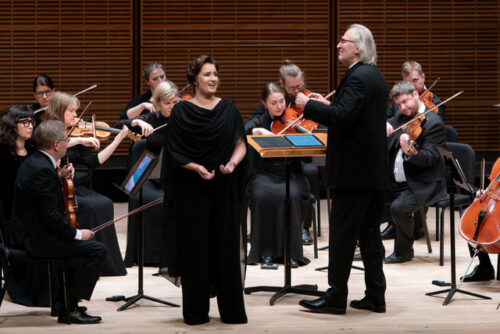
Pärt – Für Lennart in memoriam, L’abbé Agathon, Stabat Mater, Magnificat, Te Deum
Estonia’s choral tradition unified the country during its darkest days in the twentieth century, and conductor Tõnu Kaljuste was an active participant in the country’s struggle for independence from the Soviet Union. In 2014, Kaljuste was named the second-most outstanding Estonian. First place went to Arvo Pärt, whose music Kaljuste has long championed. The conductor returned to Carnegie Hall with two ensembles he founded, the Estonian Philharmonic Chamber Choir and the Tallinn Chamber Orchestra, to join its celebration of Pärt at 90.
Kaljuste began with an instrumental piece, Pärt’s Für Lennart in memoriam, which was first performed at the 2006 funeral of Lennart Meri, Estonia’s president from 1992 to 2001 and a childhood friend of the composer. Pärt was inspired by an ode from the ‘Canon of Repentance to Our Lord Jesus Christ’, an Orthodox hymn in Church Slavonic. The piece opened with the deep, rich sound of the lower strings playing the instrumental equivalent of Russian Orthodox chant. Brighter, yet equally solemn sounds were followed by two cellos intoning a more hopeful, hymn-like melody, before the somber sonorities that began the piece returned to end it. Kaljuste permitted the music to unfold spontaneously, releasing its beauty and penetrating emotions seemingly effortlessly.
Pärt set a wide range of religious-themed texts. One of his more eclectic choices was the story of the fourth-century Abbott Agathon’s encounter with a leper. The monk successfully passes the seven tests posed by the leper, who then reveals himself to be an angel from God. In 2005, Pärt set a French-language version of the legend for soprano and string orchestra entitled L’abbé Agathon. The vocal part is a combination of recitative and arioso, with the strings generating the drama and musically painting key elements of the story. Soprano Maria Listra sang with a simple and direct style, her expressiveness enhanced by her sensitivity to text. Pärt captured the leper’s revelation to Agathon in an ecstatic melody, which Listra sent floating skyward in clear, crystalline tones.
Pärt composed his setting of the Medieval hymn Stabat Mater in 1985 on commission from the Alban Berg Foundation in celebration of Berg’s 100th anniversary. Pärt described the piece as the confluence of two opposing elements, such as molten lava flowing into water. His approach was driven by the text, which describes a similar phenomenon, the Virgin Mary’s immeasurable sorrow during the crucifixion of her son Jesus Christ, contrasted with the possibility for consolation arising from his ultimate sacrifice.
Originally composed for two complementary trios of soprano, alto, tenor and violin, viola and cello, Pärt arranged it for a three-part mixed choir and string orchestra in 2008. His setting follows the natural flow of the text, where a long, stressed syllable is followed by a short, unstressed one. The Stabat Mater’s structure mirrors that of L’abbé Agathon, with the chorus singing the text in a plain, direct manner to minimal accompaniment, and instrumental interludes providing an emotional release from the tragedy being related. The choral parts may be straightforward, but Kaljuste and the singers interjected drama through dynamics. A striking example was the intense force with which the choir sang of the Mother’s pain, followed by soft, transparent sounds when singing of the sufferings of her son. The piece ends with the sopranos entering one by one on a high A on the final ‘Amen’, followed by silence. The emotional impact of the performance was so great that no one dared move.
Pärt’s Magnificat for five-part a cappella chorus is one of his most performed works. He employed his tintinnabuli style to create a joyous setting of St. Luke’s account of Mary’s visit to her cousin Elizabeth. As always, Pärt’s musical lines follow the flow of the text, but he spiced it with dissonance to create a supernatural aura to the mysteries of which Mary sings. Kaljuste drew wonderful colors to paint the meaning of the words from the singers, as well as dynamic variances to generate emotion. The choir sang the text Suscepit Israel with a richness and force that was seldom heard in the concert.
The final work on the program was Pärt’s setting of another great hymn, Te Deum. Completed in 1985 and revised in 2007, the work is scored for three choirs (women’s choir, men’s choir and mixed choir), prepared piano, string orchestra and pre-recorded wind harp. The Swiss painter Martin Ruf once said to Pärt that he could distinguish over 20 shades of blue in the mountains. His words served as a creative impulse for Pärt in composing Te Deum musically and visually. When the structural lines of the piece are illustrated on paper, a majestic mountain panorama is seen.
Te Deum is another example of Pärt’s ability to transform a text from the conventional to the sublime with an aesthetic sense informed by his tintinnabuli style. Traditionally, the hymn is set in triumphant strokes, but Pärt imbues it with mystery. The piece begins and ends with a drone produced by the wind harp, as if the music materialized out of a cosmic void and dispersed into the same after the final Amen and three-fold repetitions of Sanctus resounded.
A joyful performance of the composer’s choral arrangement of Pärt’s Vater Unser, the German version of The Lord’s Prayer, was the one encore. There will be more concerts of Pärt’s music at Carnegie Hall in the coming months. This one, with its profound beauty and spirituality, has set the gold standard for those that follow.
Rick Perdian
Featured Image: Tõnu Kaljuste (conductor) leading the Estonian Philharmonic Chamber Choir and Tallinn Chamber Orchestra © Jennifer Taylor