 United States Still, Gulda, Mozart: Mark Kosower (cello), Pro Musica Chamber Orchestra / David Danzmayr (conductor). Southern Theater, Columbus, 14.12.2025. (MSJ)
William Grant Still – The American Scene: Suite No.1, ‘The East’
Friedrich Gulda – Concerto for Cello and Wind Orchestra
Mozart – Symphony No.22 in C major, K.162; Symphony No. 35 in D major, K.385, ‘Haffner’
It seems hilarious now that so many dismissed Friedrich Gulda as an eccentric and crank back in the heady days of classical high modernism: it turns out the world just wasn’t ready for his genius. Famous as a classical pianist, Gulda’s recorded cycle of the Beethoven piano sonatas is still competitive against other masters who have preserved their interpretations of those keystones of Western music.
But Gulda’s curiosity didn’t end with playing other people’s works. He also had a deep interest in jazz improvisation and in the composition of new music. He was innovative for shedding the formal tuxedo of classical concerts and wearing more comfortable clothes; on a few infamous occasions, he opted to shed all clothing entirely while he played. He didn’t mind charting his own path.
Much of his polystylistic music was regarded with condescension during a time when ‘serious’ composers were either academic serialists or experimental avant-gardists. Gulda’s incorporation of jazz and popular elements was anathema to the high priests of modernism. Decades later, our world has grown quite accustomed to sudden shifts, making Gulda’s music sound not eccentric but eclectic, channel-surfing or doom-scrolling before such things were invented.
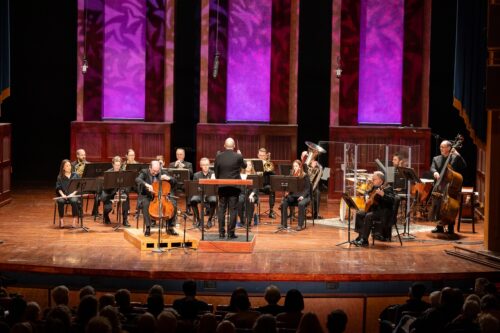
When David Danzmayr and the Pro Musica Chamber Orchestra of Columbus contacted cellist Mark Kosower for a return engagement as guest soloist, they asked if he had a work he would like to do. Kosower, principal cellist of the Cleveland Orchestra, knew exactly which piece to suggest: the Gulda Concerto for Cello and Wind band. Written in 1980, the concerto manages to be both delightfully of its time yet somehow timeless. The opening movement startles when it goes from a solemn introduction into a main theme built as a twelve-bar blues, with a drum kit providing a rhythm groove that sits right on the cusp between pop/rock and disco. When it was time to go to a more lyrical, contrasting theme, Gulda made no attempt to transition, merely turning the channel to something right out of Austrian folk music. The return to the blues later is just as abrupt. Kosower clearly savored the wit, mischief, lyricism and directness of Gulda’s music.
The second movement begins with a brass chorale in the manner of Austrian alphorn music, with a central ländler dance led by the woodwinds. Throughout, Kosower wove cello lines that alternated between sweetly melodic and sharply tangy. What became clear is that while the humor, tunefulness and directness of many passages was not ironic, that didn’t mean it couldn’t flow from that lightness into deep seriousness at any given time. The intensity came to the fore in the long cadenza, the true heart of the concerto, which ranges from introspective darkness to explosive virtuosity and includes passages to be fleshed out ad libitum by the soloist. Kosower breathtakingly took those passages to the most treacherous heights of the instrument’s harmonics, proving this music could range from comic to cosmic. The fourth movement Menuett introduced a Moorish flair, but nothing was as startling as the finale’s pure abandon into romping polka music, with the cello taking off in a hilarious, daredevil moto perpetuo. This music was brilliant, entertaining and, not least of all, something all too often lacking in the concert hall: it was fun. For an encore demanded by the enthusiastic audience, Kosower opted to play something ‘a little calmer’ and gave a rich, noble performance of the Sarabande from Bach’s First Cello Suite.
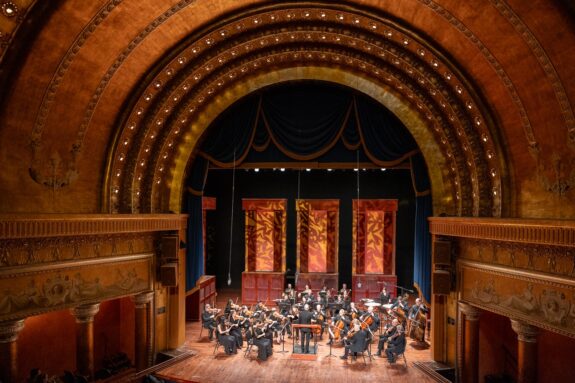
The Pro Musica Chamber Orchestra is a gem, and they play in a gem of a hall, Columbus’s Southern Theater, built in the mid-1890s. The hall, seating less than a thousand, has a ceiling of concentric rings running outward from the stage, projecting beautifully clear sound. But the acoustics are hardly the only reason the orchestra sounded so fine: music director David Danzmayr drew notable shape and articulation from his players. That was immediately evident in the opening work on the program, the Suite No.1 from William Grant Still’s The American Scene, one of many works by the African-American master that, in recent years, are starting to be regularly played, as they should be. Danzmayr kept the first movement evocation of a New England village green balletically lilting, while the deeply felt starscape of the second movement was enhanced by expressive solos from concertmaster Katherine McLin and principal cellist Marc Moskovitz. The final movement summoned images of a classy, jazzy Manhattan. One can only hope Danzmayr will share more sections of this worthy piece in the future.
What became evident as Mozart’s rarely heard Symphony No.22 was played is how artfully well-programmed this concert was. Around the core concerto, with its American and Austrian elements, the Still and Mozart served as anchors to more traditional sounds. Even as mainstream as the Mozart is, what stood out were its same roots in sweet Austrian folk music as the Gulda, while celebrating the fact that even in as early a work as this, written in his mid-teens, Mozart was standing head and shoulders above most of his contemporaries. And its sense of poise also served as a callback to the neoclassical elements of the Still piece.
The concert closed with Mozart’s ‘Haffner’ Symphony, one of his flat-out masterpieces. Danzmayr brought fire, vigor and articulation to the work, finding the kind of shape in phrases that brings such music to sparkling life. The daredevil speed of the finale, in itself a fine throwback to the finale of the Gulda, flew like the wind, the players reminding us how vital the deep joy of music can be.
Mark Sebastian Jordan
Featured Image: David Danzmayr leads the Pro Musica Chamber Orchestra in Mozart © Rick Buchanan/PMCO