 United States Various: Paul Jacobs (organ), Cleveland Orchestra / Daniele Rustioni (conductor). Mandel Concert Hall at Severance Music Center, Cleveland, 2.4.2026. (MSJ)
Fauré – Suite from Pelléas et Mélisande, Op.80
Poulenc – Concerto in G minor for Organ, Strings and Timpani
Encore: Bach – Fugue in A minor
Casella – Italia, Op.11
Debussy – La mer
I wasn’t convinced by Daniele Rustioni’s Brahms’s First during his debut last summer with the Cleveland Orchestra, but I thought that there was enough to his Wagner and Liszt to warrant a second look. So, I was happy to see him on the downtown schedule this season. But if that Blossom Festival concert was a bit of a gloss, Rustioni was determined to show what he can do this time around and, wow, he certainly did.
Italia, Alfredo Casella’s symphony-sized fantasy based on folk and popular music from his home country, was performed in Cleveland in 1923 with the composer conducting. I doubt if it has been heard here since, but it proved to be a delight. The movements range from highly dramatic (even melodramatic) to plaintively reflective (including a long, expressive English horn solo delivered with both elegance and ache by Robert Walters, who is surely having the season of his career this year), to over-the-top romping. The latter came in a finale that made use of ‘Funiculì, Funiculà’, the Luigi Denza song we last heard here in 2018 when Cleveland Orchestra music director Franz Welser-Möst conducted Richard Strauss’s early tone poem, Aus Italien. Strauss used the tune without permission, thinking it was a folk song, and he ended up having to pay a hefty sum to Denza for copyright violation. Casella knew better, and got Denza’s permission.
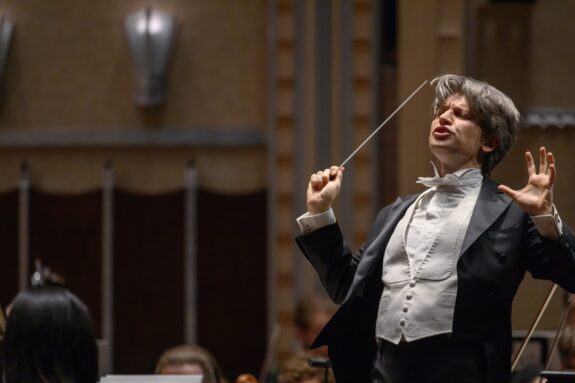
Almost as if to mock Strauss, Casella turned his version of the tune into an orgiastic riot of orchestral color which, frankly, leaves Strauss in the dust. Rustioni tore into this rarity like a man possessed, and the orchestra gave him a performance that rocked Severance Music Center to the rafters. Rustioni’s final cutoff was so vehement, he ended up halfway spun around, facing the audience, while the viola players retrieved his baton which had gone flying. No matter, it was a thrilling encounter with a piece that proves Italian composer Ottorino Respighi was part of a movement of nationalist composers intent on using every capacity of the modern orchestra in the early twentieth-century to dazzle and stun audiences. Deploying such resources on music based on slight tunes is a little like deploying a thermonuclear guided missile to kill a handful of mosquitos, but when it is this entertaining, why not?
I wondered if the rambunctious Casella piece would make Debussy’s La mer seascape seem anticlimactic, but I needn’t have worried. Rustioni wasn’t having any of the vague, ‘impressionist’ half-tints often imposed on the piece. Instead, he encouraged the orchestra to color boldly while he kept the tempo moving along, avoiding the longueurs that so often beset performances. The conductor kept a keen eye on the flow of phrases and knew where to ease the tempo at key transition points. The opening was resolute, building and ebbing in a single breath; the middle movement was daringly deft; and the finale was, for once, a thrilling battle of the elements. This was the sixth La mer I have heard live, and it was the best by far. As an extra detail, for those who keep track of such things, the performance included the interpolated brass calls near the end, despite their dubious authenticity, and I was glad of it. If Debussy didn’t write those, he should have: their inclusion helps build the stormy drama of the closing pages and once heard, the passage sounds too sparse without them.
The first half of the concert had been considerably more veiled in color and rightly so. Gabriel Fauré wrote a suite of incidental music for a production of Maurice Maeterlinck’s gloomy Pelléas et Mélisande. (And I can say that about Maeterlinck because I once acted in a college performance of one of his doleful pieces and became intimately familiar with the playwright’s cryptic, oppressive world.) It was so startlingly different from anything else written in this period that it bewitched many composers, including Debussy, Sibelius and Schoenberg. Fauré’s set of four character-pieces is particularly effective at countering all the gloom with an elegant, lyrical elusiveness. The last time I heard them in Cleveland was in a rather matter-of-fact performance led by Marek Janowski over a decade ago. Daniele Rustioni was far more sensitive to the magic of this music, giving it space to work its considerable spells while allowing soloists like Jeffrey Rathbun on oboe and Jessica Sindell on flute to take the lead on limpid solos.
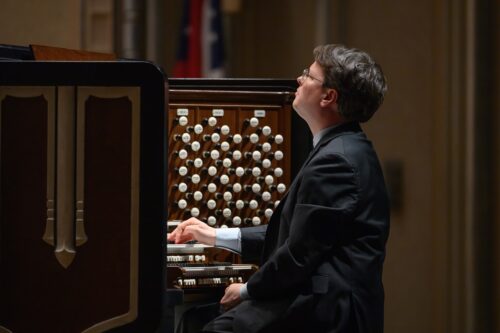
The first half closed with a compelling rendition of Francis Poulenc’s imposing organ concerto, featuring Paul Jacobs on the restored E.M. Skinner pipe organ which has graced Severance for decades. The instrument gradually fell out of use until it was restored and repositioned during the stage improvement in 2000. Jacobs shook the hall with the organ’s stern attack, and Rustioni coordinated carefully with him to bring in the orchestra with whipcrack sting. A composer known for having both monk and jester sides to his personality, Poulenc was mainly in monk mode for this concerto, written in the aftermath of the death of a close friend, but Rustioni made sure to invest the chirpy violin passage near the middle of the concerto with an energy and lightness that nodded toward the jester. Jacobs was commanding as he knitted together both agonized and meditative passages, culminating in a wrenching closing. He followed it up with a stunning encore, Bach’s Fugue in A minor, including a thrilling pedal solo near the end that brought the house to their feet. It served as a reminder that this magnificent instrument needs to be featured more often. We have had some lovely piano recitals this season, and it is time for an organ recital.
Out of these related but distinctive pieces, the orchestra welded one of the best concerts of the season, under the leadership of an energetic conductor and with a stellar soloist. It was particularly gratifying to see Rustioni complicate the ongoing search for a music director to succeed Franz Welser-Möst by inserting himself solidly into the race.
Mark Sebastian Jordan
Featured Image: Daniele Rustioni conducting the Cleveland Orchestra © Yevhen Gulenko/TCO
I was a tad underwhelmed by Rustioni’s La mer, but it was fine. Better than the mannered Maazel recording, and it’s promising Rustioni doesn’t use his impressive technique just to demonstrate what he can do. Still, Boulez/Cleveland is my go to recording.
Yes, it has been fairly evident that you did not care for Rustioni’s Brahms 1st last summer. Still, the reviewer in the Cleveland newspaper felt otherwise and noted hefty applause from both the audience and the stage. I thought the Fauré performance on Saturday was very musical. It can easily turn into mushy boredom. Not this time! Rustioni kept me engaged through the entire program, even in works that may not be top shelf.
There have been many impressive conductors leading the Cleveland Orchestra lately. It’s hard to pick who will be the one. But there appear to be many good choices this time. Let’s hope for the best.
Yes, sometimes I end up in a minority opinion. Plenty of people seemed to enjoy Rustioni’s Brahms 1 last summer, but after a lifetime of listening to various performances and recordings, and studying in depth books about Brahms, such as the excellent Jan Swafford biography, I just felt like there was a whole world of emotion in that music which Rustioni didn’t even attempt to touch. Ah, well. I stand by my curmudgeonly moments and hope that readers understand that I don’t give such opinions to be contrary, I’m just trying to imagine the ultimate realization of the works in question.
The great thing about this moment is the extraordinary opportunity we have to sample so many interesting guest conductors. We may well look back some day on the last year or two in Cleveland as a golden age, between the level that Franz has gotten to, and all the interesting guests. I am privileged to have the chance to comment on this exciting period of transition.