 United States Wagner, Götterdämmerung: Soloists, Atlanta Opera Chorus and Orchestra / Roberto Kalb (conductor). Atlanta Opera, Cobb Energy Performing Arts Centre, Atlanta, 5.6.2026. (RP)
The Music Critics Association of North America descended on Atlanta over the first weekend of June for its annual meeting. Each year, MCANA seeks a destination that offers noteworthy opera and symphony performances. It was mission accomplished with Wagner’s Götterdämmerung at the Atlanta Opera and Mahler’s ‘Resurrection’ Symphony at the Atlanta Symphony Orchestra. Unsurprisingly, quips about death and destruction on one night and rebirth on the next abounded.
Atlanta Opera ranks among the top ten opera companies in the United States, measured by budget which is the standard metric in the industry. The Metropolitan Opera, the world’s largest opera company, operated on a budget of approximately $330 million in 2026, while Atlanta Opera, ranked tenth, had a budget of roughly $15 million. Israeli-born Tomer Zvulun has served as the company’s general and artistic director since 2013 and, judging by his Götterdämmerung, imagination need not be constrained by budget.
Zvulun’s The Ring of the Nibelung has rolled out over four seasons, starting in 2023 with Das Rheingold. The first three installments met with critical and popular success due to their mix of tradition and innovation, as well as the internationally renowned cast of Wagnerians he assembled. The same formula proved successful for Götterdämmerung, bringing the cycle to a spectacular and fiery end.
The performances were dedicated to Speight Jenkins, who led Seattle Opera for 31 years. Long associated with Wagner’s Ring, Seattle Opera gained international attention with Stephen Wadsworth’s 2001 production, dubbed the ‘Green Ring’ for its inspiration from the natural beauty of the Pacific Northwest. Zvulun, who worked at Seattle Opera from 2006 to 2015, cites Jenkins as one of his most important mentors, and he served as associate director for the 2009 revival of Wadsworth’s Ring.
Zvulun deftly defines the three realms in which the final epochal events of the Ring unfold. Tradition largely reigns in scenes where gods, water nymphs and other mythical beings appear. In the opening scene, the three Norns weave the Rope of Destiny in a rocky nook near Brünnhilde’s mountain aerie which is as straightforward as a rock can be. The massive gold ring is impossible to miss whenever it changes hands. The Rhinemaidens cavort in the river’s depths, conjured through a stunning combination of shimmering streamers, lighting and digital effects.
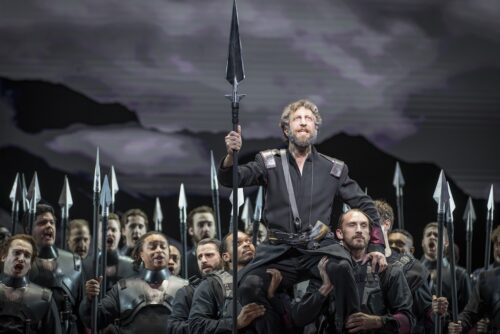
Zvulun’s imagination takes flight in Gibichung Hall, where Siegfried arrives on his ‘Rhine Journey’. The setting is realized in stark Brutalist style, reinforced by the military uniforms worn by Gunther and his men. Using a combination of physical stage elements and digital projections on a massive LED screen, the hall expands into a sprawling complex that appears to stretch into infinity. Such touches are as far as Zvulun goes in imposing a directorial concept.
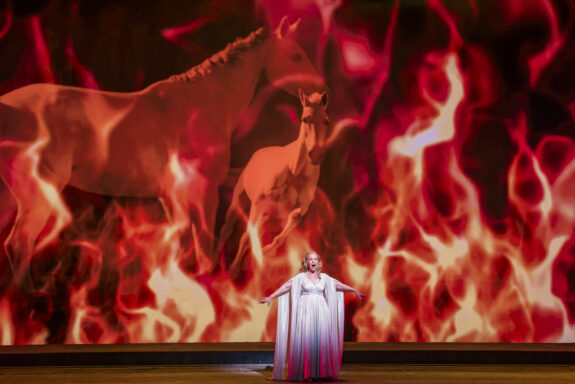
In the final scene, the gods are silhouetted in traditional garb, with Wotan’s winged helmet being the most prominent and instantly recognizable feature. Valhalla is depicted through digital recreations of tall, gleaming glass towers, the likes of which can be found in Atlanta or any other metropolis. During the ‘Immolation Scene’, Brünnhilde sings alone on the stage, engulfed in a raging fire with her steed Grane furiously racing through the flames.
Lise Lindstrom as Brünnhilde and Stefan Vinke as Siegfried are world-renowned Wagnerians, but they got off to a vocally uneven start at this performance. Lindstrom was visually striking and dramatically compelling but vocally inconsistent, with squally top notes and an often-inaudible lower register. She was at her finest in Act III when Brünnhilde orders Siegfried’s funeral pyre and delivers her great farewell. Here she sang with eloquence and complete command, matching the blazing intensity of the inferno behind her during the ‘Immolation Scene’.
Vinke’s tenor initially lacked focus, suggesting he was conserving resources for the long evening ahead. If so, the strategy paid off, as his voice gained both luster and security over the opera’s five-hour span. The youthful buoyancy he brings to the role, both physically and dramatically, was evident from the outset.
David Leigh’s sinister Hagen dominated every scene in which Wagner’s chief villain appears. Le Bu’s Gunther was little more than putty in his half-brother’s conniving hands, but his youthful, velvety bass-baritone won the evening’s vocal sweepstakes. Sylvia D’Eramo was a sympathetic Gutrune, her lovely lyric soprano cutting effortlessly through the orchestra.
Tamara Mumford performed double duty as Waltraute and the First Norn. Her rich-voiced, passionate account of the gods’ dismal condition and impending doom, along with her desperate pleas for Brünnhilde to return the cursed ring to the Rhinemaidens, was superbly sung and dramatically compelling. In his brief appearance as Alberich, Aleksey Bogdanov urged his son Hagen to murder Siegfried and seize the ring with wonderfully wicked glee. Among the Norns and Rhinemaidens, Gretchen Krupp’s sumptuous mezzo-soprano made Flosshilde particularly memorable.
Mexican-born conductor Roberto Kalb led a perfectly paced performance in which the details emerged clearly from the Atlanta Opera Orchestra’s scintillating, vibrant sound. The brass playing, both on-stage and off, was excellent. Siegfried’s ‘Rhine Journey’ reached a thrilling climax, while the ‘Funeral Music’ unfolded with cinematic sweep and an overwhelming sense of desolation.
Götterdämmerung is the only Ring opera with a chorus, with the men garnering most of the honors as the Gibichung vassals. They responded to Hagen’s horn call with thrilling, thundering singing. The full chorus celebrated the double wedding of Siegfried to Gutrune and Gunther to Brünnhilde with light, lilting tones. The solemnity of Siegfried’s funeral procession was amplified by both the richness and solemnity with which the men sang as they accompanied his body to Gibichung Hall.
Diehard Wagnerians may disagree, but Zvulun’s Götterdämmerung succeeds on every level. In remarks to MCANA members, he described his conception of the cycle as two distinct miniseries, with Götterdämmerung serving as the second installment. Perhaps so, but the musical, dramatic and visual context established in the previous three operas was still keenly felt. Fortunately, audiences will have an opportunity to experience the entire saga when Atlanta Opera presents two complete, consecutive Ring cycles over two weeks in June 2029.
Rick Perdian
Featured Image: Lise Lindstrom as Brünnhilde in the ‘Immolation Scene’ © Raftermen
Production:
Stage Director – Tomer Zulun
Scenic and Projection designer – Erhard Rom
Costumes – Mattie Ullrich
Lighting – Robert Wierzel
Live Action Director – Ran Arthur Braun
Chorus master – Walter Huff
Cast:
Brünnhilde – Lise Lindstrom
Siegfried – Stefan Vinke
Gunther – Le Bu
Hagen – David Leigh
Gutrune – Sylvia D’Eramo
Waltraute / First Norn – Tamara Mumford
Second Norn – Olvia Vote
Third Norn – Catilin Lynch
Alberich – Aleksey Bogdanov
Woglinde – Cadie J. Bryan
Wellgunde – Alexandra Razskazoff
Flosshilde – Gretchen Krupp
First Vassal – John Arnold
Second Vassal – Wayd Odle