 United Kingdom BBC Proms 2026 [5] – Verdi, Walton, Respighi: Jonathan Aasgaard (cello), Sinfonia of London / John Wilson (conductor). Royal Albert Hall, London, 24.7.2026. (CK)
Verdi – Overture, The Force of Destiny
Walton – Cello Concerto
Respighi – Roman Festivals, Fountains of Rome, Pines of Rome
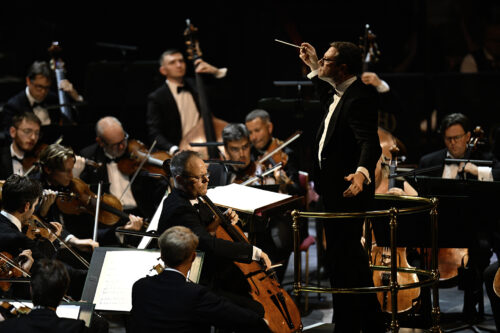
A feast of Italy-themed music on a warm summer evening in Kensington Gore. And, with John Wilson and the hand-picked Sinfonia of London on hand, some spectacular playing – loud, yes, but spectacularly quiet too. A fizzing performance of Verdi’s Force of Destiny Overture got us under way: bold brass fanfares, coiled-spring strings, that sultry tune heard first in the woodwind – everything laid out with maximum clarity and immediacy. I could almost feel the heat.
Walton’s Cello Concerto is a very different kind of Italianata. In place of seething Verdian passions its opening suggests the composer half-dreaming in the warmth and comfort of an Ischian afternoon; there is toughness and passion to come in the scherzo and finale, but these are not its central discourse or the mood in which it opens and closes. The opening, indeed, was so quiet that we had to sharpen our ears to hear it: it drew us in to the composer’s dreamscape. The cello sang on, woodwind supporting it with a gentle web of sounds, flecks of colour from harps and celesta. The scherzo’s needle-sharp syncopations were meat and drink to the Sinfonia of London, with amazingly clear articulation from Jonathan Aasgaard in what is in effect a moto perpetuo for the soloist.
The highly original finale brought playing of beauty and absolute consistency from Aasgaard. Indeed, as the performance unfolded it generated, at least for me, an extraordinary illusion: his playing, never loud, never striving for effect, flowed throughout like a river, a self-communing that seemed unaffected by the orchestra. Nothing the orchestra did appeared to disturb him: after their single, magnificent tutti in the finale he resumed his communing as if he hadn’t heard it. The ending was lovely, as dreamlike as the opening. The whole orchestra clapped him enthusiastically at the end; when he turned to acknowledge them it was as if he had been unaware of them until that moment.
I have never heard Respighi’s Roman Trilogy performed complete, so this seemed too good an opportunity to miss. Roman Festivals is the longest of the three suites and the one that makes the least impression: too much noise (there are only so many gong crashes you can hear before their impact is blunted). Circuses was brash and gaudy with its flaring trumpets, its nine percussionists, four-handed piano and so on; the pilgrims in Jubilee took too long to get to the top of Monte Mario and their grand view of Rome. I enjoyed October Festival, though, with its tolling bell and fine work from the horns (the solo horn – Christopher Parkes – almost suggesting that a holidaying Siegfried was coming down the Tiber), its mandolin and its magical evanescence. Epiphany was unruly and roof-raising with its Petrushka-like bustle, its woozy trombone, those percussionists in almost continuous action; in Wilson’s hands the ending was predictably spectacular.
After that, the opening of Fountains – like the opening of the Walton concerto, at the edge of audibility – felt like balm. Lovely solos from Fergus McCready’s oboe and Chris Richards’s clarinet; and a guest appearance, so it seemed, from Richard Strauss’s Silver Rose. On to the Triton Fountain, its horn fanfare galvanising the harps; and the Trevi Fountain, with Neptune’s magnificent, organ-capped procession, a sea of sixty string players threshing in vain, drowned in the tumult. The hushed, jewelled sounds of sunset at the Villa Medici, a single bell tolling, raised the heretical thought: is Respighi at his best when he’s quietest?
Pines was beautifully played: a vividly discordant opening, frisson-making quiet playing in the Catacombs, the offstage trumpet sounding from aloft, tugging at the heart like Mahler’s posthorn; bassoons colouring the sound as the climax approached. Piano, horn, clarinet cast a spell in the Janiculum, over strings like velvet; the nightingale sang, so it seemed, high up in the Royal Albert Hall’s dome. The ghostly sounds that take us to a misty Appian Way raised the neck-hairs: partly, of course, because we knew what was coming.
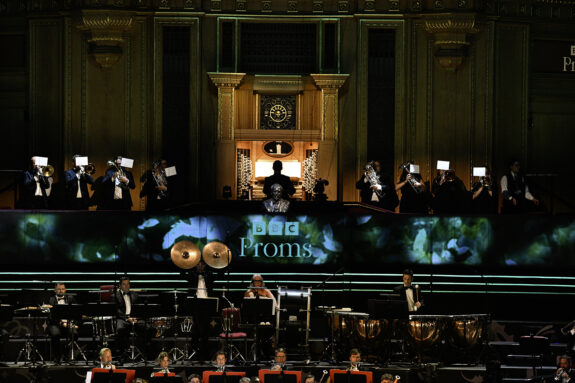
As the sun rises and the Roman legions come into view Respighi asks for six buccini, Roman trumpets: here, brass were popping up all over the place, trumpets to the left, trombones to the right, flugelhorns, saxhorns and euphoniums ranged either side of the organ console. More brass than in Janáček’s Sinfonietta, or Belshazzar’s Feast, or the Leningrad Symphony. It was a colossal, hedonistic racket; and it roared on and on. And even that wasn’t the end: Rossini joined the party in a scintillating encore, the final section of the William Tell Overture.
A fabulous concert. Excess, once in a while, can do wonders for you.
Chris Kettle
Featured Image: Respighi’s Pines of Rome performed by Sinfonia of London conducted by John Wilson © BBC/Chris Christodoulou
A lovely review, and as one who was there, one to bottle up and remember for years to come!