 United States Bard Summerscape – Richard Strauss, Die ägyptische Helena: Soloists, The Bard Festival Chorale, The American Symphony Orchestra / Leon Botstein (conductor). Fischer Center at Bard, Annandale-on-Hudson, 24.7.2026. (RP)
Hugo Hofmannsthal considered his libretto for Die ägyptische Helena the finest of his collaborations with Richard Strauss. Posterity has largely disagreed, elevating Der Rosenkavalier to that distinction while leaving Die ägyptische Helena, one of the partnership’s later works, as an occasional rarity. Leon Botstein, a longtime advocate for neglected works of this period, made the opera the centerpiece of Bard College’s 2026 SummerScape festival.
The Helen of the title is the legendary Helen of Troy, whose beauty was said to have launched a thousand ships. Hofmannsthal draws on an alternative Greek tradition in which Helen never reaches Troy: Paris carries only a phantom image of her to the city, while the real Helen remains in Egypt. The Greeks and Trojans waged a destructive, decade-long war over an illusion.
In Hofmannsthal’s version, Menelaus believes Helen spent the war years with Paris and intends to kill her. The sorceress Aithra intervenes, bringing the couple into her magical realm and using a potion of forgetfulness to convince Menelaus that the faithful Helen had remained hidden away in Egypt. The spell cannot entirely suppress his memories, with echoes of the past returning as suspicion and jealousy and leading to tragedy. Helen ultimately gives him the potion of remembrance, forcing them both to confront the past. Menelaus forgives her, and their daughter Hermione reunites the family.
Director Christian Räth frames the opera through the lens of celebrity culture, cinematic fantasy and constructed identity. The concept is not new – Robert Carsen used a similar approach in Handel’s Giulio Cesare – but Räth goes further by treating Helen as an alter ego of Aithra, shifting the focus toward female identity and alliance.
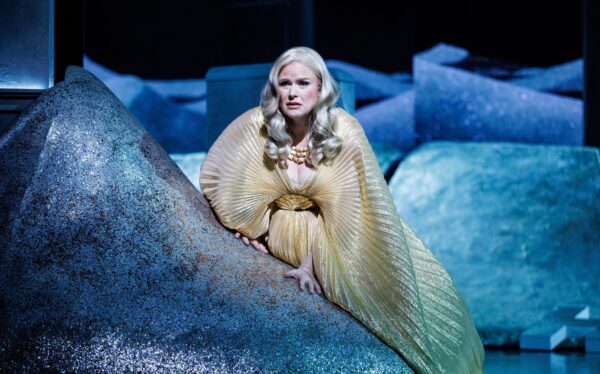
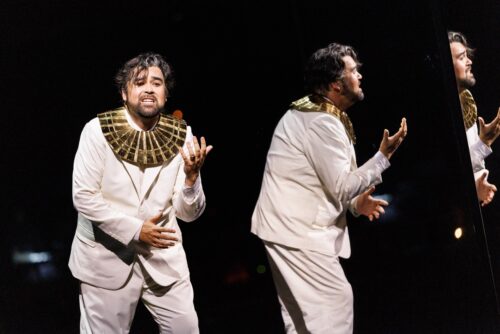
Räth and Daniel Unger’s designs are visually striking. The opening scene unfolds in a dove-gray room where Aithra’s magic is enhanced by digital projections, including crashing waves and three flying birds. Later, the production embraces Hollywood glamour: Helen appears as a screen siren in a gold pleated peignoir and platinum-blond wig, while their ‘second wedding night’ unfolds around a luxurious golden bed. Mirrors expand scenes into an almost infinite landscape, creating a particularly effective setting for Menelaus’s psychological struggle. The staging is most successful when restrained. At times, however, excessive movement – especially in Aithra’s scenes and the chorus sequences – distracts from the drama. The production’s choreography is imaginative and skillfully executed but occasionally overwhelmed by the activity onstage.
The opening night performance suffered from being too loud. Botstein, normally a careful craftsman of transparency, allowed Strauss’s textures to become too heavy. In Act I especially, the score’s delicacy and glittering detail were frequently lost beneath the orchestral weight. Act II’s larger forces – with brass, percussion and soaring strings evoking the overwhelming emotional landscape – were equally overpowering.
Botstein assembled a cast capable of meeting Strauss’s formidable vocal demands. Hailey Clark was an outstanding Helena, producing a wealth of radiant sound while maintaining flexibility and expressive nuance. Her ‘Die zweite Brautnacht’ was both vocally resplendent and dramatically penetrating, capturing the opera’s central idea that genuine reconciliation requires memory not escape from the past. John Matthew Myers faced one of Strauss’s most punishing tenor roles as Menelaus. While not the most imposing heroic presence, he sang with impressive stamina, power and commitment. His finest moment came in Menelaus’s Act II monologue where he combined lyrical introspection with the role’s demanding heroic writing.
As Aithra, Jana McIntyre brought a luminous soprano to a role filled with Strauss’s characteristic brilliance: high-lying lyricism, dazzling coloratura and radiant declarations. Although Räth’s concept limited some of the character’s mystery, McIntyre made Aithra an elegant and persuasive force. Blake Denson’s charisma and commanding baritone made Altair a more formidable rival to Menelaus than the role might suggest on paper. Shawn Roth gave Da-ud a youthful sincerity and delivered one of the evening’s most affecting and intimate performances. Deborah Nansteel brought humor and mystery to the unusual role of the Omniscient Sea Shell, while Catherine Creed was delightful as the First Servant.
Fully staged productions of Die ägyptische Helena remain rare, particularly in New York. The Metropolitan Opera has presented it only twice, in 1928 and 2007. Botstein deserves credit for championing a work he has called ‘the kind of masterpiece that needed a future generation to discover it and assign it to its proper place’. That reassessment has yet to arrive, but this production offered a valuable opportunity to encounter one of Strauss’s most fascinating and unjustly neglected operas.
Rick Perdian
Featured Image: Hailey Clark (Helena) © Maria Baranova
Production:
Director – Christian Räth
Sets – Christian Räth and Daniel Unger
Costumes – Mattie Ullrich
Chorus master – James Bagwell
Cast:
Helena – Hailey Clark
Menelaus – John Matthew Myers
Aithra – Jana McIntyre
Altair – Blake Denson
Omniscient Seashell – Deborah Nansteel
Da-ud – Shawn Roth
First Servant – Catherine Creed
Hermione – Keya Upadhyaya