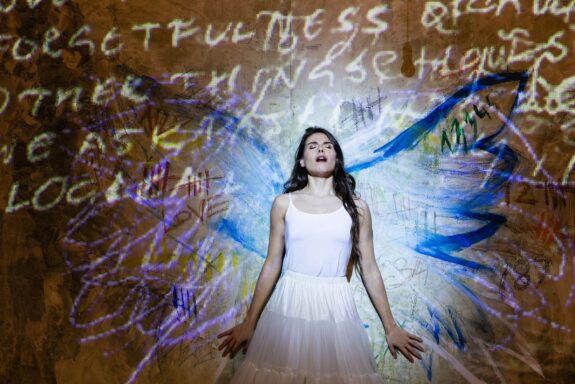
 Germany Verdi, Rigoletto: Soloists, Bavarian State Orchestra, Bavarian State Opera Chorus / Maurizio Benini (conductor). Nationaltheater, Munich, 19.3.2026. (AL-L)
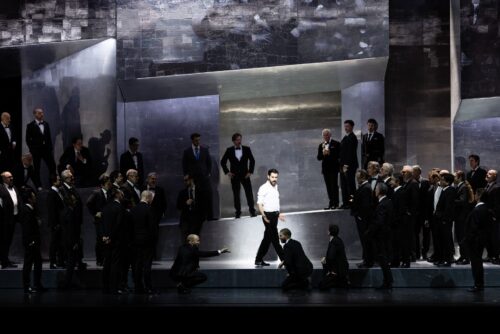
Even the finest opera houses are not equally at home in every repertoire. Bavarian State Opera reigns supreme in Richard Strauss and Wagner = as the worldwide reference for both – acquits itself superbly in Russian opera and in modern music and is rather less consistent in Mozart. Italian repertoire proves the most variable of all. A recent Aida (review here) problematic in staging yet largely rescued by Daniele Rustoni’s conducting, was one illustration of this. This new Rigoletto provides another.
Maurizio Benini’s conducting is, in certain respects, surprising. The ensemble was impeccable, the entries of singers and players precise in a way that speaks to thorough preparation. Yet the orchestra remained stiff throughout, and neither passion nor what one can only call italianità made itself felt. What was missing was that interior movement that animates Verdi — the suppleness of phrase, the forward impulse that unlocks the drama. The orchestra accompanied; it did not ignite.
Barbara Wysocka’s production suffers from the same absence of vitality. The first act should be a whirlwind; too often the singers came across as static, too frequently consigned to the downstage area, to the detriment of both vocal projection and dramatic illusion. The Personenregie was sparse: the characters coexisted more than they interacted. The final act fared no better. Transposed not to the traditional Mantuan tavern but to a club with sadomasochistic undertones, the atmosphere is murky without being oppressive and the tension Verdi demands never quite takes hold.
Vocally, Bekhzod Davronov’s Duke is of a lightness that does not quite serve the role – closer to tenorino than the part demands – and he struggled to impose himself in the ensemble scenes. Ariunbaatar Ganbaatar as Rigoletto possesses an impressive instrument, dark and well-coloured, and one senses a major artist in the making. But the character never fully emerged: neither passion nor a father’s suffering truly broke the surface. One is left wondering whether this was the singer’s own restraint, or whether conductor and director simply failed to open the right doors.
We are in Munich and the comprimario singing did not disappoint. Shannon Keegan made a mark as Giovanna. Thomas Mole, as Marullo, commanded a projection and stage presence that at moments eclipsed the Duke himself — which is saying something. The standard of the minor roles is one that few houses in the world could match.
The one genuine moment of grace came from Serena Sáenz. Gilda’s scena revealed a top register of real quality and a phrase that carried genuine feeling — an emotional charge the rest of the evening had not led the audience to expect.
That brief moment, isolated in a performance that did not do justice to Verdi, was a reminder of what this opera can offer. A feeling of bewilderedness settled as we left the Nationaltheater: that despite the talent and evident effort deployed, one had been truly moved only once.
Antoine Lévy-Leboyer
Featured Image: Serena Sáenz (Gilda) © Geoffroy Schied
Production:
Director — Barbara Wysocka
Set designer — Barbara Hanicka
Costume designer — Julia Kornacka
Lighting designer — Marc Heinz
Chorus master — Christoph Heil
Dramaturgy — Malte Krasting
Cast:
Rigoletto — Ariunbaatar Ganbaatar
Duke of Mantua — Bekhzod Davronov
Gilda — Serena Sáenz
Sparafucile — Riccardo Fassi
Maddalena — Elmina Hasan
Giovanna — Shannon Keegan
Count Monterone — Martin Snell
Marullo — Thomas Mole
Matteo Borsa — Granit Musliu
Count Ceprano — Roman Chabaranok
Countess Ceprano — Nontobeko Bhengu
Court Usher — Daniel Vening
A Page — Lucy Altus