 United Kingdom BBC Proms 2026 [10] – Knussen, Rachmaninov, Shostakovich: Kirill Gerstein (piano), Royal Scottish National Orchestra / Thomas Søndergård (conductor), Royal Albert Hall, London, 3.8.2026. (AK)
Knussen – Flourish with Fireworks, Op.22
Rachmaninov – Rhapsody on a Theme of Paganini, Op.43
Shostakovich – Symphony No.11 in G minor, Op.103 ‘The Year 1905’
In spite of obvious arguments to the contrary, I am uneasy about the coherence and balance of this concert’s programme. The two substantial Russian works (Rachmaninov, Shostakovich) would have merited a somewhat longer piece at the beginning. With Knussen’s piece lasting slightly under four minutes and the Rachmaninov coming close to twenty-two minutes, the twenty-six minute first half of the programme was no match in length to the grand Shostakovich symphony lasting fifty-five minutes.
Knussen composed his Flourish with Fireworks for the London Symphony Orchestra and their new principal conductor, Michael Tilson Thomas in 1988. As Knussen stated, his composition was also a homage to Stravinsky’s Feu d’artifice (a piece, like Knussen’s, also lasting slightly under four minutes). I would have loved to have the Stravinsky as well as the Knussen piece starting the concert. The length of the two halves would have been better balanced and there would have been tangible connection between the pieces performed.
Knussen explained that his piece was built from the initials of the LSO (A, E-flat, G) and MTT (E, B, B); he said he used sol-fa names for these pitches except for the S=E-flat where the note Es (E-flat) from German names was used. I am at a loss to understand how ‘O’ from LSO is translated into the note G but perhaps there is some explanation. (‘SO’ from LSO could be interpreted as a note G but in such scenario the E-flat needs explanation.)
The piece is what the title says: flourish and firework. It is a perfect vehicle to display the strength of all sections of a very large orchestra. The Royal Scottish National Orchestra sounded impressive although I have no idea if all notes were played as intended and if there is anything a conductor can do apart from acting as a metronome. At any event, we had much flourish and exciting orchestral firework.
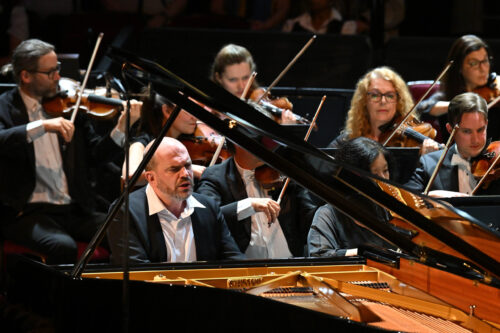
The Rachmaninov Variations brought together symbolically two great virtuoso musician masters (although two hundred years and geographical borders apart): Paganini and Rachmaninov. I now add the virtuoso musician Kirill Gerstein to the mix. The last of Paganini’s 24 Caprices for solo violin consists of a theme and eleven variations. Rachmaninov set his version of the Paganini theme for solo piano and large orchestra, composed twenty-four variations and included the medieval funeral chant Dies irae. By all accounts Rachmaninov was a great pianist, and clearly so is Kirill Gerstein.
Gerstein played from memory, with apparent understanding of the full score. It is possible that conductor and soloist had different ideas about the tempo which started at a relatively moderate one but then was speeded up by Gerstein into the designated Allegro vivace. I am not sure who took charge, but I am confident that I was offered an insight into Gerstein’s view of the piece.
Rachmaninov is mostly regarded as a Romantic composer but what Gerstein presented was a coherent classical masterpiece with sensitive tonal differentiations and strong rhythmic elements. The romantic ingredients were all there but with discipline and without sentimentality. The famous 18th variation – well-known from films like Somewhere in Time (1980), Ronin (1998), and TV shows – never sounded so pure and so heartfelt as under Gerstein’s fingers. Last but not least, Gerstein’s impressive virtuosity on the keyboard is unobtrusive in the service of musical ideas.
The fully packed Royal Albert Hall audience gave a much-deserved standing ovation to Gerstein who rewarded our enthusiasm with the beautifully rendered performance of Rachmaninov’s Melodie, Op.3 No.3.
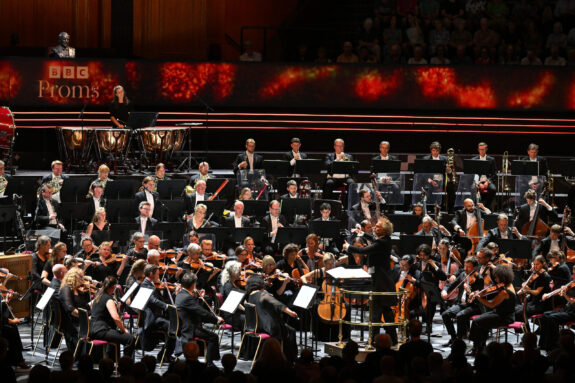
Shostakovich’s 11th Symphony is a big beast, testing all sections of a very large orchestra (including four harps). I hasten to add that the RSNO proved themselves more than capable to meet the challenge. Furthermore, conductor Thomas Søndergård seems to fully identify with this music. He gave full support to the orchestra (by indicating relevant entries of which there are many) as well as an inspiring musical direction. The only blemish (to these pair of ears) is that the pianissimo pizzicato sections of the third movement were truly pianissimo: so much so that nothing could be heard in row H of the stalls and presumably in many other places in the Hall. It felt odd to see the players moving but getting no sound from them.
This symphony is supposed to be telling the story of the January 1905 ‘Bloody Sunday’ massacre (of peaceful Russian protesters) and the subsequent revolution that year. Shostakovich’s music certainly gives a vivid description of the events but it could fit into Russian history later too. The big tune of the slow third movement (Eternal Memory), that is a well-known revolutionary song, moved from period to period of history. In my youth in communist Hungary, we sang this song at our camp fires again and again …in Hungarian. And, I am afraid, I could not help singing along in the Albert Hall although I tried hard to do so in my head rather than with full voice.
Playing the four movements without a break, as specified by the composer, is no mean feat. Yet the RSNO delivered all compositional demands with discipline and gusto. There were too many great solos and orchestral passages to praise separately but credit must go to timpanist Louise Goodwin. There she was, far from her colleagues but not far from the Sir Henry Wood statue, playing what might be the most challenging timpani part in the orchestral repertoire. And she played to perfection.
Agnes Kory
Featured Image: Thomas Søndergård conducts the Royal Scottish National Orchestra © BBC/Mark Allan