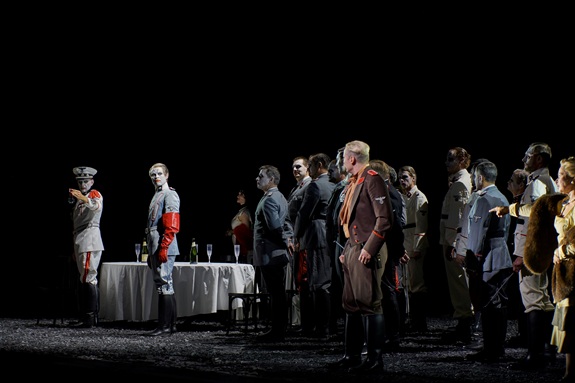
 Germany Berg, Wozzeck: Soloists, Chorus, Children’s Chorus and Extras of the Musiktheater im Revier, Neue Philharmonie Westfalen / John Warner (conductor). Musiktheater im Revier, Gelsenkirchen, 4.10.2026. (DM-D)
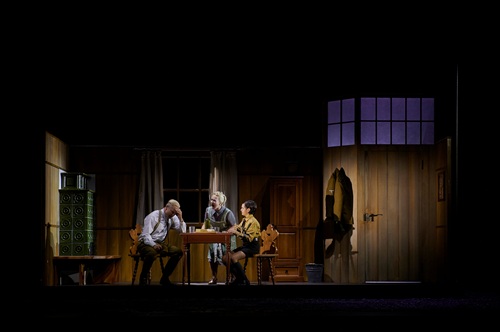
Gelsenkirchen’s Wozzeck is the most recent production by Ilaria Lanzino, who has been making a name for herself over the past few seasons across Germany (see reviews of Die tote Stadt here in Hannover, Fidelio here in Magdeburg and Nabucco here in Düsseldorf). Her work is known for its original interpretations, consistent within themselves and more often than not illuminating the opera’s plot and characters. In addition, she has been working with design teams confident in using the size and technical opportunities of large opera stages in ways that are in line with the directorial concept and not merely visually impressive.
Lanzino foregrounded the issue central to Alban Berg’s Wozzeck, and its source, Büchner’s play of the same title of 1836: whether a specific human being, Wozzeck, is, or indeed can be deemed guilty of his actions, or whether he is driven to them by circumstances beyond his control, in this particular case the context of poverty. Lanzino shifted the plot and its characters to Germany under National Socialist rule. Here Wozzeck was still at the bottom of the hierarchy. However, this was not the hierarchy of social standing and money, but the hierarchy within the Nazi party context: he was at the bottom of a career ladder and wanted to move up. He was subjected to mean and nasty behaviour by his SS superiors; the behaviour of high-ranking members amongst each other was also captured in considerable detail, with everyone keenly aware of their status, both actively keen on keeping those below in place and ingratiating themselves to those perceived to be higher up. Altogether, Lanzino’s approach revealed a historically striking context, with clear implications for today. I was reminded of a notable moment in a recent television broadcast, when the party leaders of the right-wing AfD were asked about the election success of their party’s candidate in one of the federal states; they responded with a very unpleasant, coldly disdainful ‘Let’s see what he achieves with that victory’, immediately making his inferior and their superior position within the party hierarchy unambiguously clear.
Wozzeck marked the first production at Musiktheater im Revier under the baton of new First Kapellmeister John Warner. I wrote about his audition performance for that position, Der fliegende Holländer, in January 2026 (see review here). With his reading of Wozzeck, he more than fulfilled all expectations. The music told the story independently, in line with or in contrast to the singing and events on the stage. Atonal and more conventional passages in the late romantic mode were juxtaposed with ease and moulded into a unified whole, as needed. The singers took delight in switching from Sprechgesang and declamatory passages to more conventional modes of singing. Simon Stricker presented the torn title character with a sonorous, robust baritone. The tenor voices of Martin Homrich (Drum Major), Matthew Peña (Captain) and Adam Temple-Smith (Andres) were well differentiated, with strong, clear and open Helden-material from Homrich, secure extremes from Peña, and more lyrical material from Temple-Smith. Philipp Kranjc brought out the sinister side of the Doctor with an emphasis on creepy calmness. Constanze Jader expressed the nuances of Margret with her rich low mezzo-soprano voice. Susanne Serfling was impressive in her stage presence, revealing Marie as a character similarly involved in the issue of guilt – in Lanzino’s reading of the opera, Marie received boxes with the belongings of arrested Jews. Serfling sang her role with total commitment and passion, achieving a very moving portrayal also vocally, modulating the voice as needed and with ease across a range from bright and forthright to subdued and withdrawn, across volumes.
Altogether, this was a very successful start to the season at Musiktheater im Revier in Gelsenkirchen under the artistic leadership of Frank Hilbrich, Head Of Music Theatre at Theater Bremen until the end of the 2025/26 season.
Daniel Meyer-Dinkgräfe
Featured Image: Musiktheater im Revier’s Wozzeck © Björn Hickmann
Production:
Director – Ilaria Lanzino
Set designs – Martin Hickmann
Costumes – Melchior Silbersack
Lighting – Patrick Fuchs
Chorus director – Alexander Eberle
Children’s chorus director – Veronika Haller
Dramaturgy – Theresa Steinacker
Cast:
Wozzeck – Simon Stricker
Marie – Susanne Serfling
Captain – Matthew Peña
Doctor – Philipp Kranjc
Drum-Major – Martin Homrich
Andres – Adam Temple-Smith
Margret – Constanze Jader
Fool – Julian Mattlinger
First Apprentice – Yevhen Rakhmanin
Second Apprentice – Falk Fink
A Soldier – Johannes Maag