 Germany Korngold, Die Tote Stadt: Lower Saxony State Orchestra Hannover / Mario Hartmuth (conductor). Hannover State Opera, 14.5.2026. (DM-D)
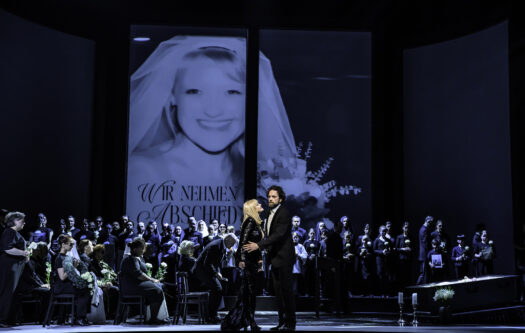
As the audience entered, the curtain was already up; Paul was in the room he had created in memory of his late wife – a predominantly empty space with large walls that served as projection screens. We saw a slideshow of black and white photos of Marie, from childhood to adulthood, many on her own, and some with Paul. Without exception, Marie was shown outright happy or at least happily thoughtful. The contrast to a distraught Paul aimlessly cowering or moving about the space could not have been more pronounced.
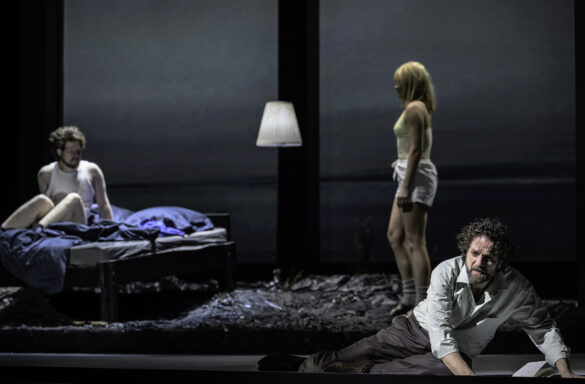
Frank represented the voice of reason, as concerned for his friend Paul as Brigitta, his loyal housekeeper. She was taking care of a young girl, apparently the daughter of Paul and Marie, a silent character added to the production. Paul found Marie’s diary and her depression resulting in her suicide became obvious in flashbacks of Paul’s memories. Some of those recollections were enacted by other performers, with Paul watching. The convex back wall of the set opened to reveal the landscape of Paul’s hallucination. Paul’s problematic state of mental health was abundantly clear from his stumbling gait, confused expression and frequent wringing of hands or ruffling of hair. The events of his hallucination about Marietta and her chaotic artist colleagues were well choreographed, ebbing and flowing in line with the score. If things did not make full sense at all times, if aspects of what we saw seemed out of place, then this was to reflect the Paul’s mental state. The production ended by Paul returning to sanity and making an effort, with the help of Brigitta, Frank and indeed his daughter, to overcome his grief and return to a more conventional life free from the grip of excessive mourning.
With the integrated support of the abstract set and with emotionally charged lighting, director Ilaria Lanzino told a visually powerful story. Intriguing videos underlined Paul’s mental imbalance by suggesting a black-and-white foggy lake with trees, but upside down, as if reflected in a mirror. Lanzino’s tightly controlled Personenregie brought together the outer and inner layers cogently.
Mario Hartmuth was in admirable control of the orchestra, bringing out the score’s rich texture and the wide range of nuances in what can easily become too dense a tapestry of rather unspecified emotion heaped upon emotion. There were moments of memory untinged by the melancholy of the awareness of loss. There were ever so many shades of mourning, grief, loss, incomprehension of what has happened, disbelief, anger, despair and frustration, all the way to suicidal thoughts. There were moments of hope, overshadowed simultaneously by the conviction that hope is futile.
With such attention to detail, without losing sight of the overarching structures, Hartmuth became a very sensitive supporter of his singers. This production marked a role debut for Mirko Roschkowsi. He rose valiantly to the challenges of this most demanding role. The way Hartmuth conducted his music was such that Roschkowski’s voice became one of the components of the music. Just as instrument groups shift their positions in the overall soundscape from foreground to background, he was fully at ease with his singing since there was never any need to strain and cut through the orchestra — instead, he sang with it. This approach allowed him to use his voice to best advantage throughout, gentle and melodiously lyrical as well as ardently gleaming, or emotionally volatile, full of ups and downs in very quick succession. Roschkowski was able to sustain long arcs just as much as he impressed with robust climactic outbursts without resorting to shouting. His voice sounded elegant and lean, rather than heavy and beefy, and he was able to reach and maintain the highest range, for which there is much need in the role of Paul, with considerable ease, comfort and indeed, so it felt, with particular personal relish.
Kiandra Howarth did more than full justice to her similarly demanding role of Marietta/Marie. The top of her voice was clear and free from strain or any tendency towards shrill sounds. In addition, it was based on a profound and particularly well-rounded, sonorous lower register. Given her conductor’s approach, Howarth was able to modulate the volume of her singing to suit her characterization. Peter Schöne gave Frank suitably sane authority both through his acting and vocally. Anthea Barać sang Brigitta with a very powerful and well-placed alto. Julia Sturzlbaum, Cassandra Doyle, Michal Prószyński and Uwe Gottswinter sang their smaller roles as Marietta’s artist colleagues on a par with the main soloists. Max Dollinger was particularly impressive in his aria ‘Mein Sehnen, mein Wähnen‘.
Daniel Meyer-Dinkgräfe
Featured Image: Paul (front r: Mirko Roschkowski), reading Marie’s diary with (background) events described acted out © Bettina Stöss
Production:
Director – Ilaria Lanzino
Set design – Martin Hickmann
Costume design – Vanessa Rust
Lighting design – Johannes Paul Volk
Video – Max Schweder
Chorus director – Lorenzo Da Rio
Children’s chorus director – Tatiana Bergh
Dramaturgy – Christian Förnzler
Cast:
Paul – Mirko Roschkowski
Marietta / Marie – Kiandra Howarth
Frank – Peter Schöne
Brigitta – Anthea Barać
Juliette – Julia Sturzlbaum
Lucienne – Cassandra Doyle
Victorin – Michal Prószyński
Fritz – Max Dollinger
Count Albert – Uwe Gottswinter