
 Ireland Wexford Festival Opera 2025 [1] – Verdi, Le trouvère: Soloists, Chorus and Orchestra of Wexford Festival Opera / Marcus Bosch (conductor). O’Reilly Theatre, Wexford, 24.10.2025. (RB)
The Wexford Opera Festival has built an enviable reputation for staging operas which are no longer performed or completely new works. So, I was surprised to see Verdi’s Il trovatore on the list for this year’s Festival. However, rather than sticking with Il trovatore, Wexford have chosen to stage Le trouvère, the French adaptation of the original work which Verdi presented to the Paris Opéra in 1857. Paris remained a crucial platform for Verdi, given its standing as the most famous and generously funded opera house in the world at that time. The composer made several key revisions to Il trovatore to satisfy the Paris Opera. The main revision was the inclusion of a ballet at the beginning of Act III, a 25-minute divertissement which draws in part on existing music. Verdi also revised the orchestral accompaniment at various points to make the textures more complex and instrumentally refined. The opera was sung in French but for the sake of convenience in this review I will use the Italian titles of arias on the basis that people will more readily recognise those.
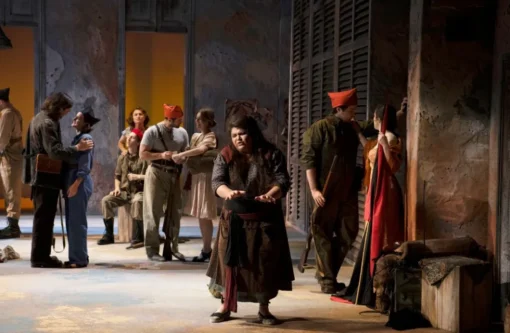
Ben Barnes’s production transfers the action from fifteenth-century Spain to the Spanish Civil War between 1936-39. This period provided the perfect backdrop for the actions of the opera. The swaggering Comte de Luna was portrayed as an unbending, entitled fascist general while Manrique was transformed into an idealistic partisan. Liam Doona’s set consisted of a painted back wall with partitions at the side. Clever use of lighting and assorted props helped to transform this into a bombed derelict building, a room in a castle, a gypsy camp and a convent. While the set was effective, I felt it was a little static and limited. A greater variety of visual backdrops and a more inventive set would have helped to illuminate more the shifting tableau which are so integral to this opera.
While the ballet music was playing at the beginning of Act III, Arnim Freiss projected visual images relating to the Spanish Civil War on to a screen at the back of the stage. This helped to cement the wider social and political context for the opera in the minds of the audience. The ballet itself consisted of dancers performing stretching movements and it seemed very uninspired. It was a shame Wexford did not go for a more ambitious dance routine, especially given this rare outing for Verdi’s upbeat and inspired ballet music.
The performers were excellent and there were no weak links among the cast. Lydia Grindatto portrayed the devoted Leonore to perfection, and she was particularly good in the first act, when her two male rivals came face to face, and in the final act when she was pleading for Manrique’s life. The Act I cavatina, ‘Tacea la notte placida’ was exquisitely beautiful with Grindatto wringing every ounce of longing and rapture from the music. She showed enormous vulnerability while laying bare the sadness of the music in Act IV’s ‘D’amor sull’ali rosee’. Eduardo Niave was impressive in the role of Manrique. His dashing troubadour proved a gallant lover while standing ready to go toe to toe with the fascist Comte de Luna. He sang Act III’s ‘Di quella pira’ with great vibrancy and urgency ending the aria on a powerful climax. He was very impressive in the ensemble numbers particularly in the Act I confrontation with Luna. The role of Manrique is particularly demanding and occasionally I would have liked Niave to sustain the tone more. Overall, however, this was a first-rate performance.
Kseniia Nikolaieva was also extremely impressive in the role of Azucena, and this could well prove to be a signature role for her. In both of her Act II arias she proved to be a consummate storyteller. She conjured up the scene of her mother’s fiery death brilliantly in Act II’s ‘Strida la vampa’ while ‘Condotta ell’era in ceppi’ was vivid and compelling. Nikolaieva was particularly impressive at the bottom of the vocal register injecting the lowest notes with power and gorgeous musical colours. Giorgi Lomiseli was effective as the fascistic, inflexible Comte de Luna. He brought dark colours and musical heft to the vocal line, and his ensemble work was first rate.
The rest of the cast and the Wexford Chorus acquitted themselves well. The Wexford Festival Chorus were hugely impressive taking on the roles of soldiers, gypsies and partisans at various points. The ‘Anvil Chorus’ at the beginning of Act II was a rousing success and we saw the gypsies pointing their rifles first at a giant freedom bell and then at the front of the stage over the heads of the audience. Later in the opera, male members of the chorus dressed as soldiers appeared at the sides of the auditorium and in the balcony and sang with great vigour.
Marcus Bosch and the Wexford Festival Orchestra acquitted themselves brilliantly. Bosch maintained a high level of dramatic energy and momentum during the production. The WFO’s strings and woodwind provided a flexible sympathetic accompaniment to the singers. The brass and timpani underscored the martial qualities in the music and provided propulsive momentum. The ballet section at the beginning of Act III was performed with a high degree of technical finish and Bosch and the WFO captured the distinctive character of the four dances which make up this section.
Overall, this was a stirring first-rate production of Verdi’s Le trouvère. Wexford have made a strong case for this version of the opera to be performed more widely and more frequently.
Robert Beattie
Featured Image: Eduardo Niave (Manrique) and Lydia Grindatto (Leonore) © Pádraig Grant
Production:
Stage Director – Ben Barnes
Set designer – Liam Doona
Movement director – Libby Seward
Costume designer – Mattie Ullrich
Projection designer – Arnim Friess
Co-Lighting designers – Daniele Naldi, Paolo Bonapace
Chorus master – Andrew Synnott
Cast:
Manrique – Eduardo Niave
Leonore – Lydia Grindatto
Le Comte de Luna – Giorgi Lomiseli
Azucena – Kseniia Nikolaieva
Fernand – Luca Gallo
Ruiz – Conor Prendiville
Inés – Jade Phoenix
Un vieux Bohémien – Philip Kalmanovitch
Un Messager – Vladimir Sima
Un Geolier – Conor Cooper
Dancers – Luisa Baldinetti, Miryam Tomè, Andrea Carlotta Pelaia