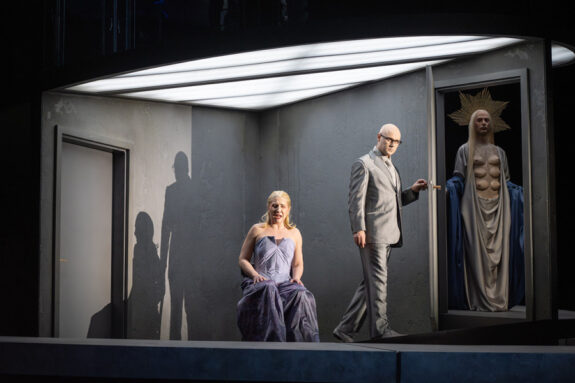
 Germany Korngold, Violanta: Soloists, Chorus and Orchestra of the Deutsche Oper Berlin / Sir Donald Runnicles (conductor). Deutsche Oper Berlin, 25.1.2026. (AB)

There are evenings at the opera when one senses, almost physically, a repertoire correcting itself. The Deutsche Oper Berlin’s premiere of Erich Wolfgang Korngold’s Violanta on 25 January suggested precisely that: not the polite revival of a curiosity, but the recovery of a work whose absence from the mainstream has long been hard to justify.
Part of the immediate fascination is biographical, and it is more than anecdotal. Korngold was eighteen when he composed Violanta, and this was already his second opera. In his case, the much-abused label ‘Wunderkind’ is not a marketing gesture but an accurate description of the musical facts on the page. The score does not sound like an apprentice effort. It projects an almost disconcerting command of large-scale pacing, orchestral architecture, and theatrical timing – an assurance that most composers spend decades acquiring.
Stylistically, the influences are clearly audible. Korngold knows Richard Strauss, and Elektra in particular seems close. Puccini’s presence, too, is felt – not in quotation, but in Korngold’s instinct for vocal line and for the moment when sensual impulse tips into confession. Yet what ultimately dominates is not reference but voice: a distinctively Korngoldian idiom, saturated, richly harmonic, and – crucially – irresistibly seductive. If this soundworld reaches its most refined form in Die tote Stadt, Violanta already makes clear why one can become almost ‘addicted’ to it.
The story, by Hans Müller-Einigen, is set in Renaissance Venice and unfolds against the carnival’s atmosphere of sanctioned licence. In wonderfully direct, poetic language, it tells of Violanta, who seeks revenge on Alfonso, the son of the King of Naples, who seduced her sister Nerina after which she committed suicide by drowning herself. Violanta’s husband, Simone, captain of the Venetian Republic, is to kill Alfonso once Violanta gives a prearranged signal through a particular song during what is presented as a planned rendezvous between herself and Alfonso. The first part of this taut seventy-five-minute one-acter is devoted to the preparation of the trap: Violanta’s grief, the household’s activity, and the surrounding carnival festivities that provide both cover and pressure. The second part concentrates almost entirely on the encounter between Violanta and Alfonso, in which Alfonso’s innocence becomes apparent and suppressed feelings – above all erotic desire – break through Violanta’s revenge script and declare themselves, abruptly, as love.
David Hermann’s production offers a convincing solution to the challenge of staging such concentrated, psychologically driven material. The first part plays on an inclined circular disc, part of Jo Schramm’s striking stage conception, above which hovers a ring that suggests both ornament and constraint. With Alfonso’s entrance, the set begins to transform like a turning screw, the centre of the stage rises step by step, stepwise revealing rotating rooms, leading downward into a progressively more private space. The effect is not merely scenic ingenuity; it externalises the opera’s central mechanism – descent, exposure, self-recognition.
Within these rooms, Hermann populates Violanta’s inner world with images that function as emotional evidence rather than narrative illustration. She encounters her drowned sister; a Marian figure that, in its many-breasted form, evokes the Artemis of Ephesus; and a vision of herself as an old woman. In this conception, Alfonso is not an actual character but acts as a kind of inner ‘therapist’ who guides Violanta on a journey into her own subconsciousness, assisting in a process of self-discovery for which the score itself seems to provide the irresistible propulsion. Korngold’s music, with its suggestive pull and orchestral saturation, draws the listener into this journey almost against one’s will, and Hermann’s staging – despite its conceptual ambition – remains largely coherent because it follows the music’s psychological logic.
Hermann also reshapes the ending in a way that is both bold and, in its own terms, logical. In the libretto, after Violanta’s ‘songs of recognition’, she places herself before Alfonso and is stabbed by the rushing-in Simone. Here, Simone fires blindly into the first ‘subconscious’ room – standing, as it were, on the ‘head’ of the screw – hitting Violanta. She catches the bullet with disarming ease and returns into the rooms of desire. The change is significant: rather than a sacrificial death, the conclusion becomes an image of continued, chosen descent – Violanta not redeemed, but returned to her own newly acknowledged self.
The singing was consistently strong, and given the density of Korngold’s orchestration, that is not a small achievement. Laura Wilde’s Violanta combined intensity with control, shaping the role’s arc from grief-driven rigidity to erotic self-exposure with vocal authority and clarity of intent. Ólafur Sigurdarson gave Simone weight and grain, presenting him as more than an executioner: a man whose sense of honour is inseparable from possession. Mihails Cuļpajevs, as Alfonso, sang with brightness and stamina, supporting the production’s idea of Alfonso not as seducer but as the guide to Violanta’s subconsciousness. The collective standard of the smaller roles was also very high – which is not always the case in the Deutsche Oper – with Kangyoon Shine Lee (Giovanni Bracca), Lilit Davtyan (Bice), Stephanie Wake-Edwards (Barbara), and Andrei Danilov (Matteo) each giving good performances as members of the captain’s household. As usual the chorus of the Deutsche Oper – mimicking the Venetian carnival crowds and placed invisibly in the background of the stage – was in excellent form for its director Jeremy Bines.
In the pit, Sir Donald Runnicles and the orchestra of the Deutsche Oper Berlin brought the score’s colours to a genuine glow. Korngold’s orchestration is both lavish and controlled; it can easily turn opaque or merely loud. Under Runnicles, it retained shape and direction. The music’s saturated string writing, its gleaming brass, and its constantly shifting harmonic structures emerged with clarity, and the score’s climaxes felt inevitable rather than inflated.
The performance’s only real objection lay outside Korngold. Hermann inserts a prologue: first a lutenist playing Dowland’s ‘A Fancy’, presumably as a gesture toward Renaissance atmosphere, followed by the Prelude from Berg’s Three Orchestral Pieces Op.6. Both are finely played; neither is dramaturgically necessary, and neither clarifies what follows. One suspects an anxious impulse to ‘extend’ a work some fear may be too short. Yet Violanta is short only in the sense that it ends before one wishes it to after seventy-five minutes; the listener is not satisfied but hungry – precisely because Korngold’s soundworld is so intoxicating.
That hunger also has a historical undertow. Korngold, forced to leave Germany by the Nazi terror, remade himself in America; alongside instrumental and chamber music works, he composed film music and shaped that genre like almost no other. To hear Violanta in Berlin, and to hear it performed at this level, is therefore not merely to encounter an early operatic masterstroke, but to sense what cultural violence interrupted. The Deutsche Oper Berlin, having already earned serious Korngold credentials with Das Wunder der Heliane, continues here to be instrumental in the modern rediscovery of his work. Violanta is, indeed, a fabulous discovery – less a novelty than a restoration.
Andreas Bücker
Featured Image: Laura Wilde (Violanta) and Mihails Culpajevs (Alfonso) © Marcus Lieberenz
Production:
Direction – David Hermann
Set designs, Video – Jo Schramm
Costumes – Sybille Wallum
Lighting – Ulrich Niepel
Dramaturgy – Jörg Königsdorf
Chorus director – Jeremy Bines
Cast:
Simone Trovai – Ólafur Sigurdarson
Violanta – Laura Wilde
Alfonso – Mihails Culpajevs
Giovanni Braccia – Kangyoon Shine Lee
Bice – Lilit Davtyan
Barbara – Stephanie Wake-Edwards
Matteo – Andrei Danilov
First maidservant – Hye-Young Moon
Second maidservant – Lucy Baker
First soldier – Michael Dimovski
Second soldier – Paul Minhyoung Roh