 United States Mozart, Così fan tutte: Soloists, Chorus and Orchestra of Lyric Opera of Chicago / Enrique Mazzola (conductor). Civic Opera House, Chicago, 13.2.2026. (JLZ)
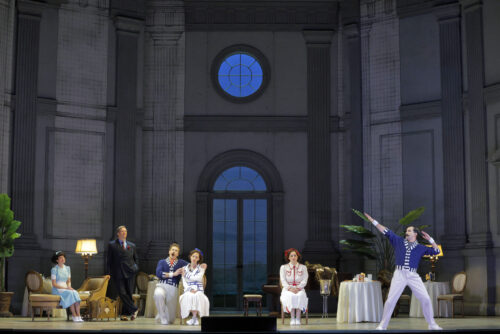
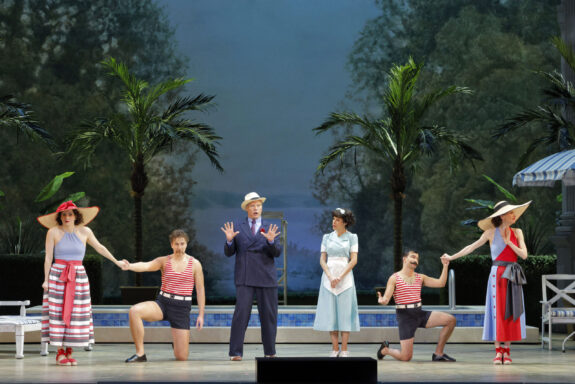
Mozart’s Così fan tutte (1790) has a sufficiently strong score to endure adaptions and updated settings because of the exquisite music that fits Da Ponte’s libretto. Lyric Opera’s current run, which brings San Francisco Opera’s staging to Chicago, places the drama in a 1930s American country club. The blocking stands out for the way in which the positioning of singers underscores the ensembles by allowing them to work with each other in proximity and give visual cues for the duets, trios and other ensembles. The action moves between various places in the club, and this revival makes good use of the stage to have the chorus enter or exit through logical openings in the country-club set. It is by no means the only way to stage the opera, but it is efficient in ways where other productions sometimes fail.
Lyric’s cast was remarkably suited to the opera and worked well with each other in the ensembles that require the finesse that characterizes the work. Among the principals, Ian Rucker was outstanding as Guglielmo and used his rich, textured baritone to good effect. His voice blended with Rod Gilfry’s in the opening scene, and with other cast members in various ensembles. His aria ‘Non siate ritrosi’ gave the audience the opportunity to hear this talented baritone in a sustained number. Rucker’s sense of style was present from the start, and in this aria he gave full voice to the melodic lines with particular attention to phrasing. His voice never seemed to tire or strain, and it has a richly textured quality that fits the character.
As Ferrando, tenor Anthony Leó gave a fine performance. While his voice sounded a little strained in the first scene, the subsequent scenes showed his supple tenor’s nuanced approach to the role. Leó’s cavatina ‘Tradito, schernito’ stood out for the expressiveness in his execution and left a strong impression. Soprano Jacquelyn Stucker brought her talent to the role of Fiordiligi in a performance that offered subtleties which enhanced her character, though at times the orchestra’s volume overbalanced her voice. Stucker had a resolute approach to the aria ‘Come scoglio immoto resta’ that showed her intention to remain faithful – or at least try to! As Dorabella, Fiordiligi’s sister, Cecilia Molinari worked well with Stucker in the ensembles. More importantly, Molinari brought out details in the second-act aria ‘È amore un ladroncello’ that captured the audience’s attention. Molinari brought a welcome presence to this production, and it will be good to see her return to the Lyric for other roles.
Likewise, Rod Gilfry gave a solid performance as Don Alfonso, with acting that brought charm to the character’s penchant for scheming. Gilfry’s voice enhanced the ensembles, particularly ‘Soave sia il vento’ with Stucker and Molinari. The trio showed the three voices nicely, and Gilfry anchored the piece with his warm, resonant sound. It was a timeless moment and deserved the audience’s enthusiastic response.
Ana María Martínez was extraordinary as Despina. She made the character come to life with style and grace, and her vocal beauty added much to the evening. Her deft reading of ‘Una donna a quindici anni’ in Act II set the tone for the events that followed, and her ability to capture the dance rhythms added to the delivery. It was a pleasure to hear Martínez bring her remarkable talent to the role, and her engaging singing made the role of Despina central to the production.
Enrique Mazzola led the Lyric Opera Orchestra skillfully as he shaped the sounds while also attending to the action on the stage. He seemed at times modest with the tempos, which allowed the text to be heard clearly. The only thing that raised questions was the pacing of the various sections of the second-act finale, where the pauses elicited some audience members to applaud prematurely. Nonetheless, Mazzola brought the work to its conclusion, and with it delivered a fine performance of this enduring opera.
James L. Zychowicz
Featured Image: Lyric Opera of Chicago’s Così fan tutte © Cory Weaver
Cast:
Ferrando – Anthony Leó
Guglielmo – Ian Rucker
Don Alfonso – Rod Gilfry
Fiordiligi – Jacquelyn Stucker
Dorabella – Cecilia Molinari
Despina – Ana María Martínez
Production:
Original director – Michael Cavanagh
Revival director – Roy Rallo
Sets and Projection – Erhard Rom
Costumes – Constance Hoffman
Lighting – Jane Cox
Revival lighting – Chris Maravich
Chorus director – Michael Black