
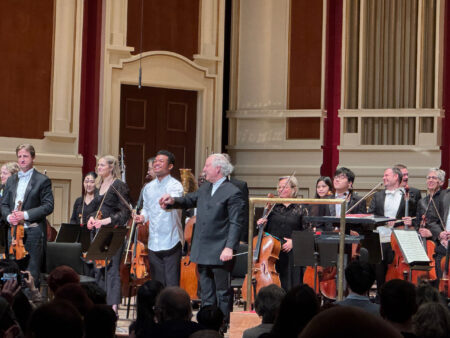
 United States Various: Randall Goosby (violin), Pittsburgh Symphony Orchestra / Manfred Honeck (conductor). Heinz Hall, Pittsburgh, 13.2.2026. (SJ)
Arturs Maskats – Tango
Mozart – Violin Concerto No.5 in A major, K219, ‘Turkish’
Encore: Coleridge-Taylor Perkinson – ‘Louisiana Blues Strut’
Barber – Adagio for Strings
Bernstein – Symphonic Dances from West Side Story
Post-concert performance:
Elgar – Salut d’amour
Bernstein – ‘One Hand, One Heart’
Over the Valentine’s Day weekend, Manfred Honeck offered a Pittsburgh Symphony program that visited four appealing works. Though lighter in scale and without a major symphony to anchor it, the program proved an enjoyable listen from start to finish. Opening the evening was Latvian composer Arturs Maskats’s Tango, a piece that dates from 2002.
The work begins with vigorous, rhythmically-driven material and boasts a distinctive orchestration that includes scoring for bandoneon which authentically captures the spirit of Argentine tango. Dense scoring was given with clarity and, in due course, distilled to a beautiful passage from concertmaster David McCarroll and the sultry clarinet of Michael Rusinek. Maskats writes in a language that’s individual yet approachable, and this performance made me keen to discover more of his work.
Even for someone as industrious as Mozart, the violin concertos are a standout, with all five written in rapid succession while the composer was still a teenager. The masterful No.5 brought violinist Randall Goosby back to the Heinz Hall stage. Textures were light and breathable in the orchestral exposition, and Goosby made an elegant entrance with a clear and pure tone. His playing was energetic and pointedly articulate, in congenial conversation with the PSO musicians. The genteel Adagio was graceful and refined, capped off by the good-natured Rondeau. Interspersed were the fiery ‘Turkish’ themes that give the concerto its nickname, during which Goosby’s limber technique generated foot-tapping excitement. As an encore, the violinist selected the delightful ‘Louisiana Blues Strut’ by Coleridge-Taylor Perkinson, a piece written for Sanford Allen – the first Black violinist of the New York Philharmonic and someone whom Goosby counts as a mentor.
Barber’s Adagio for Strings made a poignant opening to the second half. Beginning in fragile wisps, it steadily grew in intensity, cresting to pained heights. The somber sumptuousness of the Pittsburgh strings left a strong impression. Few figures are more closely associated with the Adagio than Leonard Bernstein, making it fitting for a Bernstein work to follow: Symphonic Dances from West Side Story.
More than just a suite of greatest hits, Dances brings to life much of the musical with clever cohesion in its nine interconnected segments. Tensions between the two rival factions were apparent from the opening ‘Prologue’. Brilliant scoring made extensive use of percussion and piano and even invited the musicians to snap their fingers. A touching viola solo by Zhenwei Shi marked the iconic ‘Somewhere’, with the full orchestra burgeoning to soaring melodies that surely took a cue from Rachmaninoff.
There was driving intensity and percussive resplendence in ‘Mambo’, and the blues-inflected ‘Cool’ had sophisticated contrapuntal intricacies, urbane and chic without taking itself too seriously. A forlorn, lonely flute solo (newly appointed principal Nikolai Song) marked the ‘Finale’ in which the once-boisterous street scene retreated to tragedy.
Select PSO performances include a brief post-concert chamber recital. This evening’s offering included Elgar’s lush Salut d’amour as transcribed for string quartet, and another selection from West Side Story: ‘One Hand, One Heart’, cast in the unusual but effective combination of string quartet with flute and trumpet.
Sam Jacobson