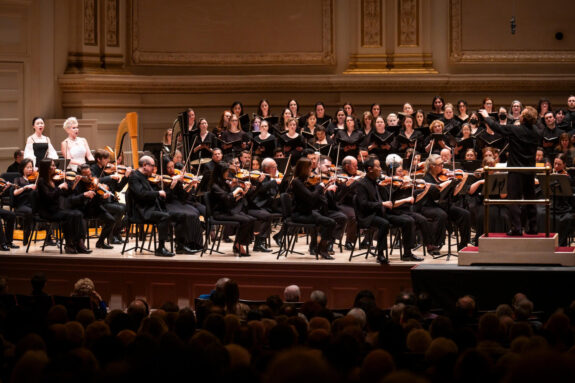
 United States Mahler: Ying Fang (soprano), Joyce DiDonato (mezzo-soprano), Philadelphia Symphonic Choir (director: Joe Miller), Philadelphia Orchestra / Yannick Nézet-Séguin (conductor). Stern Auditorium, Carnegie Hall, New York, 10.3.2026. (ES-S)
Mahler – Symphony No.2 in C minor, ‘Resurrection’
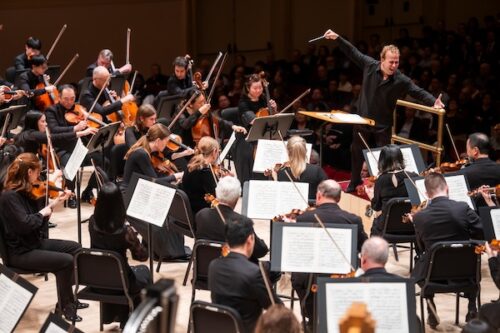
At Carnegie Hall, the Philadelphia Orchestra and Yannick Nézet-Séguin turned to Mahler’s Symphony No.2, the ‘Resurrection’, a work whose immense scale often tempts conductors toward spectacle. Nézet-Séguin instead emphasized balance and internal clarity, shaping the symphony through carefully calibrated contrasts of texture and color while maintaining a strong sense of long-range direction. By giving as much attention to Mahler’s subtle orchestral dialogues as to the work’s overwhelming scale, the performance revealed the richness of a score that can feel as intimate as it is monumental while suggesting how this orchestra continues to shape its own Mahler sound.
From the opening bars of the first movement, Nézet-Séguin made clear his emphasis on balance and structural clarity. The cellos and double basses attacked their opening figures with sharpness and precision, giving the music an immediate sense of tension and definition. Rather than pressing the music forward, he allowed the movement’s contrasting episodes to unfold with a measured sense of proportion. The Philadelphia Orchestra responded with playing of remarkable focus, the brass projecting authority without overwhelming the texture and the woodwinds adding warmth to Mahler’s darker sonorities. The strings’ famously polished sound was unmistakable.
Mahler’s score frequently reduces the massive orchestral forces to smaller, almost chamber-like groupings, and these moments were among the performance’s most revealing. In the first movement, exchanges among the woodwinds emerged with conversational clarity as the funeral march dissolved into more reflective episodes. The Andante offered another kind of transparency, with pizzicato strings supporting delicate wind writing while two harps quietly colored the texture. Later, in the Scherzo – based on Mahler’s Wunderhorn song ‘Des Antonius von Padua Fischpredigt’ – individual woodwinds stepped forward with sharply etched character, their lines twisting through the orchestral fabric with sardonic clarity. Nézet-Séguin shaped these passages with particular care, allowing Mahler’s immense ensemble to contract into something unexpectedly intimate before expanding again to symphonic scale.
After the turbulent opening movement and the longer pause Mahler prescribes, the Andante unfolded with graceful restraint. Within an overall performance characterized by brisk pacing, Nézet-Séguin maintained a flowing tempo that preserved the movement’s Ländler character, avoiding the temptation to linger excessively over its nostalgic atmosphere. The Philadelphia strings produced a luminous sound, their phrasing supple and transparent.
The scherzo introduced a more unsettled world. Mahler’s circling figures and ironic gestures can easily tip into caricature, but Nézet-Séguin favored a more restrained approach, emphasizing rhythmic motion rather than exaggerating the music’s grotesque edge. Woodwind lines were vividly characterized, and the orchestra maintained impressive precision as the movement’s restless energy gathered toward its explosive climax.
Seated behind the violins beside soprano Ying Fang, Joyce DiDonato rose to sing ‘Urlicht’, Mahler’s setting of a poem from Des Knaben Wunderhorn, bringing warmth and directness to the vocal line. Her phrasing remained grounded and expressive, supported by delicately balanced orchestral writing in which the oboe often echoed the mezzo-soprano line. The surrounding strings and harp sustained a soft halo of sound, allowing the voice to remain central without forcing the tone. The movement’s quiet close created a moment of stillness before the vast canvas of the finale.
Mahler’s concluding movement unfolds through a succession of striking instrumental and spatial contrasts. It begins with a violent orchestral shock, after which distant offstage brass calls seem to answer the orchestra from afar, creating a sense of vast perspective. In quieter passages the texture again narrowed, with winds and strings trading brief motifs. From within this orchestral buildup, the brass chorales emerged not as shattering gestures but imbued with a sense of unwavering conviction. When the Philadelphia Symphonic Choir, prepared by Joe Miller, began their hushed ‘Aufersteh’n’, still seated, their sound seemed to emerge almost imperceptibly from the orchestra. Ying Fang’s radiant soprano came through the chorus with equal ease, and Joyce DiDonato followed with ‘O glaube, mein Herz, o glaube’ as the music moved toward its final affirmation. Nézet-Séguin drew a remarkable dynamic range from the combined forces, from near-whispered choral lines to massive orchestral climaxes, allowing the symphony’s final pages to unfold with a sense of cumulative inevitability.
Next season, under the auspices of Carnegie Hall, Yannick Nézet-Séguin will undertake a complete cycle of Mahler’s symphonies with three orchestras: the two ensembles he leads, the Philadelphia Orchestra and the Met Orchestra, together with the Vienna Philharmonic. If this performance offered any indication of the musical thinking behind that project, it is a cycle audiences will await with keen interest.
Edward Sava-Segal
Featured Image: Yannick Nézet-Séguin conducts Ying Fang (soprano), Joyce DiDonato (mezzo-soprano), Philadelphia Symphonic Choir and the Philadelphia Orchestra © Chris Lee