 Germany Wagner, Das Rheingold: Soloists, Meininger Hofkapelle / Killian Farrell (conductor), Staatstheater Meiningen, 27.3.2026. (AB)
The beautiful Hoftheater and famous Hofkapelle in the small provincial town of Meiningen in Thuringia have a rich and long tradition of musical excellence. Previous conductors included Hans von Bülow, Richard Strauss and Max Reger; Johannes Brahms chose the orchestra for the premiere of his last symphony, and Richard Wagner ensured that the largest contingent of musicians for the first Ring in 1876 came from the Hofkappele.
Twenty-five years ago, Meiningen caused a sensation with one of the most remarkable German Ring undertakings of its time. Austrian visual artist Alfred Hrdlicka directed, the young Kirill Petrenko conducted, and the cycle was performed on four consecutive days for the first time ever.
Against this background, the new Das Rheingold stands under a very different sign. Directed and designed by Markus Lüpertz, it is not the start of a new cycle but a self-contained solitaire — and that helps explain, perhaps, both its coherence and its modesty of interpretative scope.
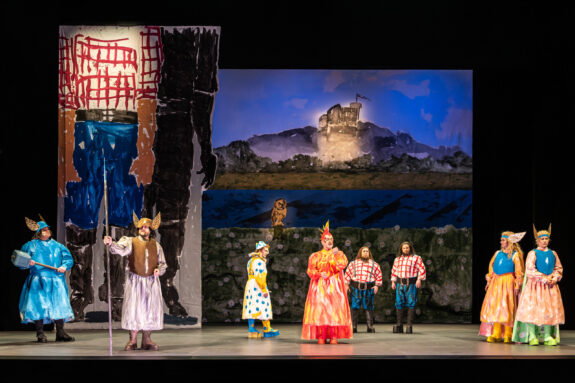
Lüpertz, one of Germany’s best-known contemporary visual artists, makes this Rheingold very much about Lüpertz, the artistic personality. As the Hofkapelle unfolds the famous E-flat major prelude with striking transparency, the eye meets a painted curtain: at the left edge stands a figure with its back to the audience, looking out over the River Rhine, wooded hills and a castle high above. With a self-portrait of Lüpertz turning his back on the onlooker on the left-hand side, the allusion to Caspar David Friedrich’s iconic painting is unmistakable: the artist contemplating his own imagined Rhine world. It is a self-regarding image, certainly, but also a witty and revealing one.
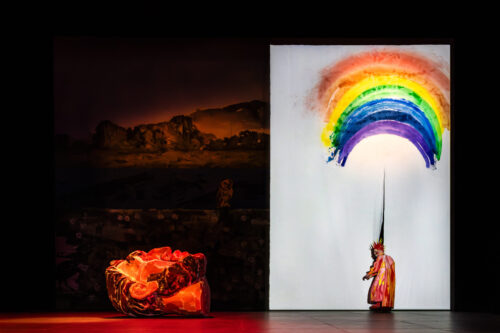
A self-confessed sceptic of Regietheater, Lüpertz does not attempt to force Wagner’s myth into a contemporary political or psychological framework. Instead, he turns the work into a sequence of unmistakably Lüpertz canvases: brightly coloured, deliberately artificial, often humorous, and content to illustrate rather than reinterpret. The costumes follow the same logic. The gods appear in glaring outfits with gold-winged helmets, Froh wears a yellow-and-blue Pierrot costume, Loge sports a red mohawk, and the Rhinemaidens appear as colourful mermaids. Alberich arrives in a camouflage uniform, and the giants look like lumberjacks. The effect is often amusing, sometimes surreal, and always visually distinct.
The production’s main weakness, though, lies in its limited stage direction. Again and again, characters are left simply to stand and wait for their next intervention, particularly in the extended negotiation scenes. Lüpertz thinks primarily in images, not in dramatic interaction. Yet because the stage remains otherwise bare, some visual ideas land all the more strongly — above all the huge head of Fasolt, rolling on after his offstage murder with grotesque force. This is, in the end, a beautifully illustrated rather than deeply developed theatrical reading, but as a self-contained Rheingold it has genuine charm.
Musically the evening is consistently impressive. The text intelligibility of the entire cast is exemplary. Killian Farrell conducts the Meininger Hofkapelle with freshness, clarity and complete control, allowing inner lines and secondary details to emerge without weakening the score’s dramatic pulse. His approach is often filigree, always singer-friendly, and strongly theatrical rather than symphonically inflated.
The cast responds at a high level. John Heuzenroeder’s Loge, if not conventionally beautiful in timbre, proved one of the evening’s most distinctive performances: dry, biting, and underpinned by a serious, fiery energy as well as a sharply shaded irony. David Steffens offered a large-framed Wotan, more lyrical than overtly dramatic and not overwhelmingly charismatic, perhaps, but consistently solid and musically intelligent. Marianne Schechtel’s Fricka impressed with tonal beauty and a freshness that gave the role an almost girlish quality. Boaz Daniel brought directness and weight to Alberich, making him at once forceful, present, and unexpectedly touching rather than merely demonic, while Tobias Glagau, as Mime, was vocally and scenically agile throughout.
Among the two giants, Keith Klein lent Fafner an almost songful, melancholic colouring, while Selcuk Hakan Tıraşoğlu gave Fasolt the necessary power and self-assurance, together forming a highly effective pair. The trio of Rhinemaidens (Monika Reinhard, Hannah Gries and Julia Rutigliano) blended most attractively, and Tamta Tarielashvili’s Erda contributed a dark and mysterious tone.
In the end, the strongest applause rightly belonged to the singers and musicians. That should not diminish Lüpertz’s achievement, which gave the evening a clear visual identity and an unmistakable signature. This is not a radical reinterpretation, nor an attempt to rival Meiningen’s legendary Ring past, but a bright, self-contained, often witty Rheingold carried by excellent forces under a remarkable young conductor.
Andreas Bücker
Featured Image: Staatstheater Meiningen’s Das Rheingold © Christina Iberl
Production:
Direction, Set designs and Costumes – Markus Lüpertz
Assistant director – Ulduz Ashraf Gandomi
Costume implementation and Set design assistance – Almut Echtler
Dramaturgy – Matthias Heilmann
Cast:
Wotan – David Steffens
Donner – Mark Hightower
Froh – Garrett Evers
Loge – John Heuzenroeder
Fricka – Marianne Schechtel
Freia – Lubov Karetnikova
Erda – Tamta Tarielashvili
Alberich – Boaz Daniel
Mime – Tobias Glagau
Fasolt – Keith Klein
Fafner – Selcuk Hakan Tirasoglu
Woglinde – Monika Reinhard
Wellgunde – Hannah Gries
Flosshilde – Julia Rutigliano
Thank you very much for this positive feedback!