
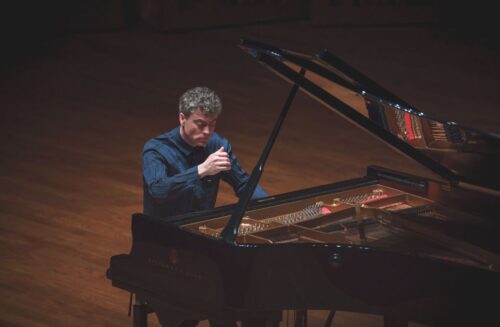
 United Kingdom Beethoven: Paul Lewis (piano), Tim Gibbs (double bass), Vertavo String Quartet (Øyvor Volle [violin], Annabelle Meare [violin], Berit Cardas [viola], Bjørg Lewis [cello]). Wigmore Hall, London, 29.3.2026. (CSa)
Beethoven – Piano Concerto No.2 in B-flat, Op.19; Piano Concerto No.3 in C minor, Op.37
Despite well-established historical tradition, the reduction of Beethoven’s large scale symphonic works such as his five piano concertos for performance by small chamber ensembles, is not to every concertgoer’s taste. Those who expect to hear heroic exchanges between piano and full-blooded orchestral strings, resonant brass and nuanced winds might feel somewhat shortchanged by the paired down, play-at-home arrangements made for piano and string quintet by the nineteenth-century Bavarian composer and pianist Vinzenz Lachner. Yet, what might be lacking in instrumental heft, is more than compensated by structural clarity and tonal transparency. The result is less a public utterance and more an intimate conversation. Such was this finely balanced and emotionally attuned collaboration between pianist Paul Lewis, the Vertavo String Quartet and the Philarmonia’s Principal double bassist Tim Gibbs, all of whom joined together to play two Beethoven Piano Concertos: No.2 in in B-flat and No.3 in C minor.
The Vertavo Quartet, formed in Norway in the 1980’s, has recently celebrated its 40th anniversary. Its recuring partnership with Lewis also has a marital connection. The quartet’s cellist Bjørg Lewis is Paul’s wife. Lewis himself hardly requires an introduction to Wigmore Hall regulars. A former pupil of the late, great Alfred Brendel, he is world-renowned concert pianist who enjoys a close relationship with the hall and has established himself as one of his generation’s leading interpreters of late-eighteenth and early-nineteenth century Viennese repertoire. His affinity with Beethoven in particular, can be attributed to Brendel and through him to an artistic lineage which connects directly to the great composer. A little musical detective work reveals that Brendel studied for some time with the highly influential Swiss pianist and interpreter Edwin Fischer. Fischer was a pupil of Martin Krause who was taught by Franz Liszt. One of Liszt’s teachers was Carl Czerny who was a student of Beethoven himself.
The recital began with Piano Concerto No.2 in B-flat. This work, written shortly after the 22-year-old composer had arrived in Vienna, was in fact the first of the concertos to be completed but the second to be published. Mozartian in sound and texture, Lewis and his colleagues introduced just enough Beethovenian edginess into their intimate dialogue to give this performance a sense of true authenticity. One was struck by the undemonstrative calmness and simplicity of Lewis’s playing, even in those dazzling, virtuosic cadenzas. Classical flourishes and graceful skimming keyboard arpeggios brought the opening Allegro con brio to life but never dominated the partnership. A sense of peace and stillness pervaded the second movement Adagio, the last notes of which dissolved into prayerful silence, while the final Rondo brimmed with vibrancy and jocund good humour.
The sole work after the interval was a magisterial rendition Piano Concerto No.3 in C minor, ‘a key’, according to musicologist Charles Rosen ‘full of Mozartian reminiscences; in particular K491, a concerto in the same key which Beethoven is known to have admired.’ In a wonderfully modulated account of the first movement Allegro, Lewis brought gravity and psychological intensity to the opening bars, and a dark urgency to the main theme softened only by a series of exquisite trills. This was followed by a deeply introspective and heartrending Adagio which captured the ‘holy, celestial harmony’ Carl Czerny contended. Quicksilver interplay characterised the final Rondo, with scales and playful leaps crisply articulated before breaking into a vibrant, almost exuberant coda.
Across the two works, Lewis and his colleagues communicated with each other naturally, generously and unobtrusively, in an offering in which individual voices blended into a single expressive whole. An evening of economically scaled-down music-making to be sure, but one where less was unquestionably more.
Chris Sallon