 United States Puccini, Madama Butterfly: Soloists, Metropolitan Opera Chorus & Orchestra / Carlo Rizzi (conductor). Metropolitan Opera, New York, 28.3.2026. (RP)
The Metropolitan Opera rang down the curtain on the season’s final performance of Anthony Minghella’s 2006 production of Madama Butterfly on Saturday evening. Over the past two decades, the late film director’s minimalist, timeless concept, with its brilliant colors and subtle imagery, has become one of the company’s truly legendary productions. Minghella’s Madama Butterfly does not contain the spectacle and opulence of Franco Zeffirelli’s longer-running productions of La bohème and Turandot, but it is far more potent.
The Met Chorus celebrated the anniversary with a backstage party in which they were joined by Carolyn Choa, Minghella’s wife and co-creator, as well as the original costume designer, Hang Feng. Choa’s continual involvement with the production has kept it precise, taut and fresh. At the party, Cio-Cio-San and Pinkerton’s son, Trouble, a Bunraku-style puppet rather than a child in Minghella’s production, blew out the candles on the cake. It is all available for viewing on the Met Chorus’s Facebook page.
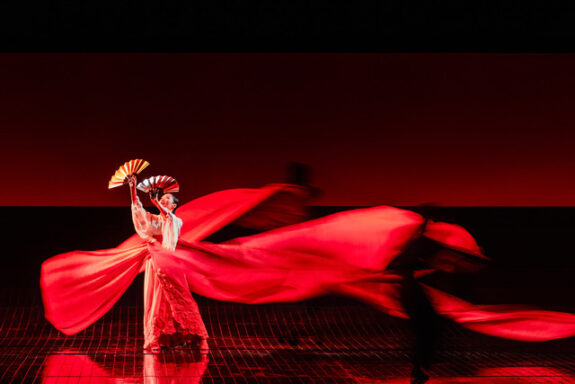
Another consistent element has been Hsin-Ping Chang as the solo geisha dancer. When she appears on a bare stage at the start of the performance in a dazzling white kimono with four red banners streaming from her waist, the audience instantly falls silent. Chang’s movements and the striking imagery electrify the atmosphere. With the mood silent and efficiently set, the fast, fugue-like introduction to Act I has even more impact, especially under Carlo Rizzi’s baton.
An artist’s path to singing a leading role at the Met is of little matter as the performance is all that counts. Toni Marie Palmertree, who made her house debut as Cio-Cio-San with this performance, isn’t the exception to the rule, but her story is exceptional.
Ten years ago, after some career detours and challenging personal times, Palmertree was an Adler Fellow with San Francisco Opera. At her audition, soprano Sheri Greenawald, then director of the San Francisco Opera Center, told Palmertree that she would be the next great Butterfly. She made her San Francisco stage debut as Butterfly when the original artist singing Cio-Cio-San fell ill. Shortly after, she was diagnosed with stage IV uterine cancer.
Palmertree has been cancer-free since 2017, but COVID brought her burgeoning career in Europe and the US to a halt. She made her Met debut in the 2022–2023 season as the Voice from Heaven in Verdi’s Don Carlo. Since then, she has covered roles at the Met and performed with various regional companies across the US. This season, the Met gave her a single chance to stake her claim as Butterfly, and she smashed it.
Cio-Cio-San is 15 years old at the start of the opera. While Palmertree didn’t capture the girl’s innocence, few have been more joyous and triumphant in love. Certainly, none could have had a smile that beamed so brightly. A mother’s love was expressed with pride and warmth, but with all of Butterfly’s dreams dashed, Palmertree’s anger flamed. Yet her Butterfly was benevolent in accepting the inevitable and noble in death.
Palmertree’s voice is big and luscious with a free, radiant upper range, fully capable of expressing the same emotional warmth she physically manifests. Her voice seethed with emotion in the Act I love duet with Matthew Polenzani’s Pinkerton. The tenor shook off the American lieutenant’s arrogance and brusqueness, singing with a compelling combination of passion and tenderness. Pure delight rained down as Hyona Kim’s riveting, detailed Suzuki joined Palmertree in exulting over Pinkerton’s return in the Flower Duet.
Palmertree began Butterfly’s great aria, ‘Un bel di’, in soft, shimmering tones that blossomed into a glowing yet poignant expression of love, longing and hope. Cio-Cio-San’s farewell to her son, ‘Tu? Tu? Piccolo iddio!’, is one of the most dramatic scenes in all of opera. Palmertree began the aria with unfathomable affection and tenderness for the ‘little god’ whom Cio-Cio-San adores. In its concluding measures, Palmertree’s voice blazed as she overcame despair to renounce a life without honor.
Polenzani’s Pinkerton is first-rate, his voice growing ever richer and stronger over the years. The warmth and expressiveness of Andrzej Filończyk’s baritone, coupled with his youth, made for an exceptionally compassionate Sharpless. Joining with Hyona Kim, the men made the Act III trio, ‘Lo so che alle sue pene’, in which Pinkerton, Sharpless and Suzuki confront the consequences of Pinkerton’s actions, one of the most intensely emotional scenes of the entire performance.
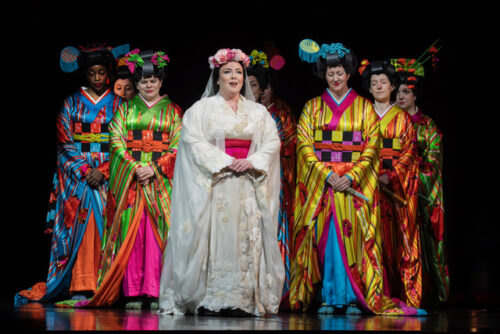
Richly detailed characterizations and imposing costumes were the hallmark of Scott Sully’s Goro, Peixin Chen’s Bonze and Yeongtaek Yang’s Prince Yamadori. All of them were reprising their roles in this performance, as was Jasmin Ward as a sympathetic Kate Pinkerton. Ward and Yang are participants in the Met’s Lindemann Young Artist Development Program and show exceptional promise.
This marked Rizzi’s tenth time conducting Madama Butterfly in March. He brought a master’s touch to dynamics, balance and pacing. The Met Chorus and Orchestra performed with their usual incomparable artistry.
Rick Perdian
Featured Image: Hsin-Ping Chang (ballet soloist) © Evan Zimmerman/Met Opera
Production:
Production – Anthony Minghella
Director/Choreographer – Carolyn Choa
Sets – Michael Levine
Costumes – Han Feng
Lighting – Peter Mumford
Puppetry – Blind Summit Theatre
Chorus director – Tilman Michael
Cast:
Cio-Cio-San – Toni Marie Palmertree
Pinkerton – Matthew Polenzani
Suzuki – Hyona Kim
Sharpless – Andrzej Filończyk
Goro – Scott Scully
Bonze – Peixin Chen
Prince Yamadori – Yeongtaek Yang
Kate Pinkerton – Jasmin Ward
Solo Dancer – Hsin-Ping Chang