
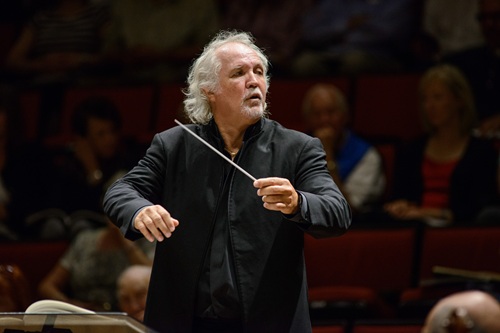
 New Zealand R. Strauss, Brahms: Madeleine Pierard (soprano), New Zealand Symphony Orchestra / Sir Donald Runnicles (conductor). Michael Fowler Centre, Wellington. 2.10.2026. (PM)
Richard Strauss – Der Rosenkavalier Suite, Op.59; Four Last Songs, Op.posth.
Brahms – Symphony No.3 in F major, Op.90
What a glorious concert! – in the first half across the span of two otherwise unconnected compositions, we were caught up in the music’s enchantment, thanks to composer Richard Strauss and his characteristic life and love depictions, both theatrical and personal. First was an orchestral suite from his opera Der Rosenkavalier, one drawing candid and sympathetic references to youth and age in the work’s key moments – and then, with the composer’s final composition, his Four Last Songs, came the tranquil inevitability of both nature and human life taking their full interactive courses.
The Rosenkavalier music exuded youthful passion at the beginning, before adroitly sending its characters on journeyings of changing courses and outcomes. Conductor Sir Donald Runnicles vigorously and viscerally encouraged the orchestral depictions of extra-marital congress between the story’s illicit lovers at the outset (wonderful, orgasmically-whooping horns!), whose ‘afterglow’ ironically took us abruptly to the story’s famous ‘Presentation of the Rose’, irrevocably re-aligning the opera’s relationships, via some of the most exquisite writing (winds, harp, celesta and muted violins) ever crafted for opera – the playing of the New Zealand Symphony Orchestra here was as exquisite and heart-rending in its beauty as any performance I’ve previously heard, those famous ‘rose chords’ variants of the theme first heard played by the strings at the opera’s beginning after the opening horn call!
Love’s more salacious side had its delightful moments here as well, with the opera’s equally famous lascivious waltz tune, here outrageously distended with its character’s self-satisfaction, and spared no indulgence by Runnicles, to our great delight. The music moved to the story’s final scenes with the remaining principal characters expressing their conflicted states in a sublime vocal trio, here with tender solo violin, oboe and horn lines gradually subsumed by the full orchestral panoply at the climax. And just as moist-eyed was the final duet music of the re-aligned lovers, punctuated by those same haunting ‘rose chordings’ from the winds – after which the composer allowed the story’s concluding chronology to invert its order, finishing with the exuberant exit music of the lascivious character, unrepentant to the end!
We were then taken on a life-journey, a perspective reaching fulfilment in the ageing composer’s Four Last Songs, a product of his final, reflective years, and the result of two of his passions, intertwined in his love for his wife, Pauline, and for the soprano voice (as Pauline de Ahna, she was herself an accomplished operatic soprano).
With so many previously admired performances sounding in my ears I was obviously interested in how I would react to Madeleine Pierard’s singing of such an iconic work (with any much-recorded ‘classic’, always a fascinating experience!). Suffice it to say that I didn’t wish at any time for a single note or phrase of hers to be delivered otherwise, so much did I ‘grow into’ her voice’s ambient presence, generating colour and tonal responses which for me ‘went with’ each of the songs’ structures and emotions. As observed on previous occasions I had seen and heard Pierard, she ‘owns’ so profoundly the text of anything she sings, the voice here confidently bestriding the emotional gamut of these ‘same-but-different’ settings.
Both singer and conductor moulded the energies of the words of ‘Fruhling’ (Spring) with a freshness and clarity that grew with the song’s blossoming, while in the yearning melancholy of the next song ‘September’ one felt the sadness of the singer’s ‘Der Garten trauert’ (‘The garden mourns’) and, just before the beautiful horn solo at the song’s end, with ‘müdgewordnen Augen zu’ (‘tired eyes closed’). As well I relished the gentle, ‘out of the ether’ opening of ‘Beim Schlafenhegen’ (‘While going to sleep’), leading to NZSO leader Vesa-Matti Leppanen’s gorgeous violin solo, and the singer’s rapturous response.
As for the final song ‘Im Abendrot’ (At Dusk) this was a glorious, spaciously-delivered ‘passage into eternity’, the music transcendent as the voice proclaimed ‘O weiter, stille Friede’ (‘O vast and silent peace!’) before both vocal and instrumental tones were magically transmogrified into a timeless state ‘as yesterday’s sev’n thousand years’ with the words ‘Ist dies etwa der Tod?’ (‘Could this perhaps be death?’) – everything rapturously calm and still as sleep overtakes, and life ebbs away.
Strauss’s unequivocal celebration of life and acceptance of death made the concert’s second half work sound more than usually enigmatic – Brahms’s Third Symphony. Here, Runnicles’s vitally-urgent performance of the opening movement brought out the piece’s drama more than usually for me, and especially with the first-movement repeat observed for good measure (not always!). I especially enjoyed the dramatic and deep-toned swirling central section, led by the horns, whose heroic tones repeatedly put one in mind of Robert Schumann’s ‘Rhenish’ Symphony (also a ‘No.3!’).
The work’s two middle movements emphasised the lyricism, the Andante swiftly dancing its way through a pastoral setting, with delicious exchanges between winds and lower strings at the beginning, and moments of full-throated song vying with circumspectly ‘signalling’ notes, as if the music was giving itself directions! – the Poco Allegretto movement which followed was more serious, a long-breathed theme soulfully intoned firstly by the ‘cellos, and then the rest of the strings, and taken up also by a ‘wind choir of oboe, flute and horn.
The finale was a mini-drama in its own right, its sotto-voce opening resembling undercover preparations for an oncoming conflict! – Runnicles and his players were intrepid, but flexible, sharp-edged and syncopated in the music’s minor-key aspect and warmly heroic in the major, alternating the moods and energies before quietly drifting back to the symphony’s beginning, with its distinctive F-A-F chord progressions, Brahms’s signature motto frei aber froh (free but happy) rounding off both the work and the entire programme with glowing resolve.
Peter Mechen