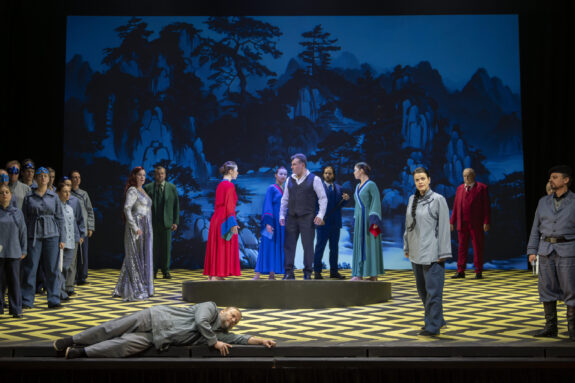
 Czech Republic Puccini, Turandot: Soloists, Ballet, Chorus and Orchestra of Narodni Divadlo Moravskoslezské Opera and Ballet / Marek Šedivý (conductor). Antonín Dvořák Theatre, Ostrava, 29.11.2025. (GT)

The magnificence of this theatre’s staging of one of the most popular Puccini operas impressed me enormously on my last visit to Ostrava. This 2024 production of Turandot captivates with its sheer beauty and almost fairy-tale scenery, all of which is embellished by wonderful singing. This evening presented a quite different Turandot in the guest singer Bulgarian soprano Iordanka Derilova, who has greatly impressed me in Germany and in her native country in recent years.
Among the highlights of the Slovenian producer Rocc’s staging at the Antonín Dvořák Theatre are the unexpected entrances by the performers. This innovation occurred at the very beginning with the Mandarin and Calaf coming on the stage from the hall, while the Three Enigmas peeped from behind the stage curtain. The Three Enigmas made their presence known by looking into the faces of the characters, as if asking them questions, while often comically posing with their arms aloft.
The major performance, both in character and voice, was Derilova whom I last heard as Brϋnnhilde last summer at the Wagner Festival in Sofia. A frequent visitor to Ostrava, she has appeared here in several operas. Derilova sang Liu in the 2002 staging, when Iwona Noszczyk was the Princess Turandot. She impressively balances strength in both her high notes and middle range, never showing vocal strain. She effortlessly reached the highest notes in ‘In questa reggia’ and ‘Diecimila anni al nostro’, while her response to her suitor was notably sensitive. Derilova’s stage presence commands attention through her nuanced characterisation. She seemed to menace those around her, but in the final moments, her iciness melted as her tormented soul turned to love.
The acting and singing of Veronica Rovná as Liù characterised every nuance of the servant girl’s tragic fate; her ‘Signore, ascolta!’ was stunning in its beauty and sensitivity, and especially her ‘Tu che de gel sei cinta’. I have heard this singer in several roles, in quite different characters from her role as one of The Two Widows in Smetana’s opera of the same name, to her Elena in Nino Rota’s Il cappello di paglia di Firenze, all of which were clear evidence of her great talent.
The tenor, Jan Vacik’s Emperor Altoum, was superb – his singing was limited to just one arioso – he displayed a fine lyrical voice, and his unspoken facial movements were a source of amusement – he often gave the impression of someone who didn’t know where or what he was doing on the stage – his relatively small part was a highlight.
The Calaf of Luciano Mastro was exceptional, on this night performing as if this role belonged to him – he has a beautifully toned tenor and masterfully controlled vocal power. His singing of ‘Non piangere, Liu’ and finally, the ‘Nessun Dorma’ were magnificent.
The characterisation of Ping, Pang and Pong in their coloured suits was delightful; sometimes singing from the auditorium, ‘Ola Pang!’, sometimes in front of the curtains, ‘Ho una casa nell’ Honan!’ They linked the entire show with their quite different characters, one serious, another comical, and the other pompous. The movement of the three ministers – on and around the auditorium was masterly in bringing the audience into the narrative. On one occasion, they were hitting imaginary golf balls into the auditorium for fun.
The choruses prepared and directed by Jurij Galatenko were excellent – at one point, the children’s choir sang from the rear of the hall above the audience in heavenly voices, ‘Cosa comanda Turandot’- and another great moving scene on stage in the final act by the mixed choruses in beautiful golden costumes and masks, ’O sole! Vita! Eternita’.
The costumes prepared by Belinda Radulović were magnificent, both for soloists and choruses, lending a spectacular beauty to the whole show. The unassuming dress of Calaf, perhaps drawing more attention to his singing, while the stunning beauty of Turandot in her silvery, brilliant dress emphasised her stature of greatness. The choruses were at first attired in everyday Chinese clothes, while in Act III, they were stunning in their golden dresses and masks, producing a startling vision.
The choreography was masterful in enhancing the drama, and the role of the Mandarin was an innovative element in heightening the tension between the characters by walking around the protagonists – in a dramatic switch from the normal scenario – his role changed to being the executioner by shooting Liù rather than her committing suicide.
The projection of a beautiful scene of Chinese mountains and a lakeside with animated birds flying through the landscape was astonishing to behold. The oriental setting was evident by the descending huge gong, and a great mask presented a spectacular vision against the drama of the three questions set for Calaf by Turandot. The stage sets were limited to a simple, large dais upon which Calaf sings his dedication of love, and where he and Turandot embrace. The dramaturgy by Juraj Bajus was another outstanding contribution in guaranteeing success for this production.
The orchestra were magnificent in producing every nuance of colour and harmony from Puccini’s final score, masterly directed by Marek Šedivý. This Turandot is another triumph for Ostrava with its innovative staging and world-class singing.
Gregor Tassie
Featured Image: The National Moravian-Silesian Theatre’s Turandot (previous cast) © Martin Popelář
Production:
Stage Direction and Set designer – Rocc
Costumes – Belinda Radulović
Choreography – Nataša Novotná
Head of the NDM Opera studio – Lenka Živocká
Dramaturgy – Juraj Bajús
Chorus director – Jurij Galatenko
Cast:
Princess Turandot – Iordanka Derilova
Emperor Altoum – Jan Vacik
Timur – Jozef Benci
Calaf – Luciano Mastro
Liù – Veronika Rovná
Ping – Pavel Divin
Pang – Vit Šantora
Pong – Martin Javorský
The Mandarin / The Executioner – Tomasz Suchanek
The Persian Prince – Jiří Dvořák
The Three Enigmas – Barbora Cejková, Petra Sejkorová, Hana Wimmerová