 Czech Republic Dvořák, Rusalka: Soloists, Ballet, Chorus and Orchestra of Národni Divadlo Moravskoslezské Opera and Ballet / Marek Šedivý (conductor). Antonín Dvořák Theatre, Ostrava, 30.11.2025. (GT)

Dvořák’s Rusalka is one of the two most popular Czech operas in the composer’s homeland, shared with Smetana’s The Bartered Bride. Rusalka has been a success ever since the premiere in 1901. The fantastical character of the libretto, the warmth of the orchestration, and the vocal writing make it ever popular. The first staging in Ostrava, soon after the theatre’s opening in March 1920 was directed by Rudolf Lanhaus (who was also the Vodník) and conducted by Emanuel Bastl with Linda Šmídová in the title role. There have been ten productions since then, and this outstanding production by Jakub Klecker was first seen in 2019.
The staging by Klecker presents four scenes with a moon in the first background against the earth, plus the lake scene, while he effectively uses a stage lift, alternately raising or descending Vodník, Rusalka and Ježibaba at key moments. Overall, the sets were colourful, with pictures of the lake, and imagery of the sea, and an underwater vision. The costumes were in the present day, apart from the fantastic costumes of the water nymphs, Ježibaba and her witches.
The finest singing of the evening was that of Veronika Rovná in the title role; on every occasion I have seen this immensely gifted soprano – she has stolen the show – most notably in Smetana’s Two Widows and at Prague’s Estates Theatre last season when she was Elena in Il capello di paglia di Firenze, and most recently as Liù in Turandot. She has an immensely vibrant soprano able to reach the highest notes with ease; in intense emotional scenes, she can sing with a lighter voice without any strain, while retaining colour and sensitivity. Initially, I thought Rovná was a mezzo-soprano, but it is clear she has a wide range. She also has the stage presence for every scene to be dominated by her.
In another powerful performance, Rusalka’s father – the water goblin Vodník – was sung by Martin Gurbaľ, who again was excellent with his beautifully resonant bass and stage presence. The Prince of Martin Šrejma was also outstanding with his beautifully lyrical tenor and masterful acting, yet another fine performance. The hunter of Jiří Hájek, with his booming baritone, was outstanding in this performance, singing at first from the balcony above the orchestra. The Ježibaba of Katerina Jalovcová was suitably bewitching with her fine contralto and superb as the almost satanic character, savouring every incident of wickedness against Rusalka’s desire for love.
The Foreign Princess of Livia Obručnik Vénosová was excellent with her fine mezzo-soprano voice and skilful characterisation. Of the secondary characters, the Gamekeeper of Petr Urbánek was impressive, and a special note should be made for the alter ego character by Heda Dufková, as the young Rusalka in her magical appearance on the stage. Ježibaba’s witches dancing frenetically in their black and red costumes emphasised the nature of the fate awaiting Rusalka.
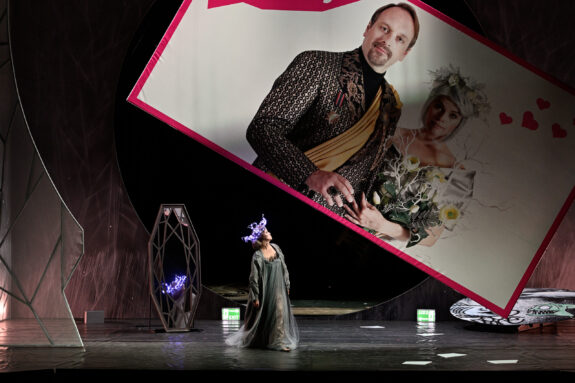
The opening of Act II was dominated by a huge poster above the stage depicting the prince and Rusalka announcing their marriage, while below, the gamekeeper and the kitchen boy discuss the forthcoming event, which they judge as being concocted by Ježibaba. The entry of the prince’s entourage in Italian-style costumes and sunglasses had a kinship to Italian mobsters. The hint of some kind of crime world was maintained in the polonaise, which was hardly a celebration but more a dirge for the tragedy of the rejection of Rusalka by the prince. This denouement was very effective in Klecker’s staging as we see the great banner of the marriage falling, and Rusalka’s hopes destroyed as she witnesses the betrayal of the prince. Yet now the Foreign Princess sees that the prince cannot be trusted and dismisses him. Ježibaba appears to celebrate her victory over the failed marriage. In Act III, at last, the prince returns to Rusalka, now a will-o’-the-wisp, and they embrace in death.
This was a memorable production of this ever-popular opera, making full use of the theatre and the auditorium in the movement and staging. The fast-moving plot allows the audience to be engaged by the quickly transforming scenes, the singing, and often, the spellbinding visual imagery. Jakub Klecker’s production is masterful, and he is joined by an outstanding group of young Czech collaborators.
The scenery designed by Radovan Lipus and the sets by David Bazika, throughout were colourful and portrayed the half fantasy and unreal fairytale of Rusalka powerfully; the deep blues and greens were dominant with symbolism depicted by the great moon in Act I replaced by a huge timepiece with its internal workings taking centre stage in Act II, all of which create an almost surreal effect enhanced by the video projections by Otakar Mlčoch. The costumes by the Vietnamese-born Ha Thanh Špetliková were marvellously complemented by the choreography of Jana Hanusová, especially in the wild satanic dancing in Act I, and the dances at the beginning and end of the opera reminding one of Das Rheingold.
The orchestra and chorus were excellent in bringing out all the glory of Dvořák’s most memorable opera score. Rusalka contains some of his most rhapsodic and beautiful writing and was directed with great skill by Marek Šedivý. This was a triumph for the theatre and more evidence that this company is among the finest in the Czech Republic.
Gregor Tassie
Featured Image: The National Moravian-Silesian Theatre’s Rusalka: Veronika Rovná (Rusalka) © Martin Popelář
Production:
Director – Jakub Klecker
Staging – Radovan Lipus
Scenery – David Bazika
Video projection – Otakar Mlčoch
Costumes – Ha Thanh Špetliková
Choreography – Jana Hanusová
Dramaturgy – Eva Frantisáková
Chorus director – Jurij Galatenko
Cast:
Rusalka – Veronika Rovná
Vodník – Martin Gurbaľ
Prince – Martin Šrejma
Ježibaba – Katerina Jalovcová
The Foreign Princess – Livia Obručnik Vénosová
First Forest nymph – Veronika Kaiserová
Second Forest nymph – Magdeléna Rovenská
Third Forest nymph – Anna Nitrová
Gamekeeper – Jiří Hájek
Kitchen boy – Ivana Ambrusová
The Hunter – Petr Urbánek
Little Rusalka – Heda Dufková
Forest nymphs – Eva Marie Korená, Nikola Pavlicová Novotná, Bohdana Šindlerová