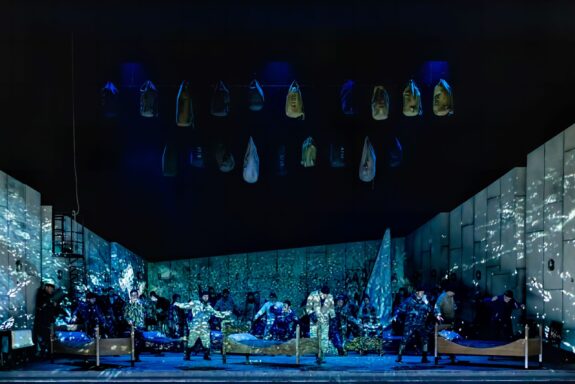
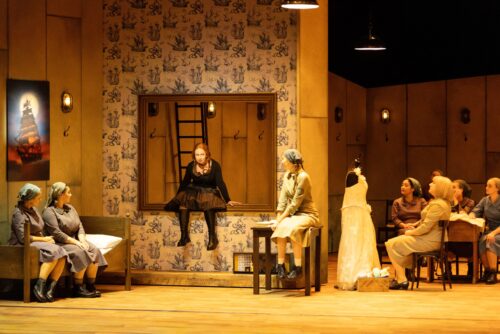
 Germany Wagner, Der fliegende Holländer: Soloists and Chorus of Musiktheater im Revier, Neue Philharmonie Westfalen / John Warner (conductor). Musiktheater im Revier, Gelsenkirchen, 18.1.2026. (DM-D)
Production:
Director – Igor Pison
Overall concept – Gabriele Rech
Sets and Costumes – Nicola Reichert
Lighting – Patrick Fuchs
Video – Gregor Eisenmann
Choreography – Tenald Zace
Dramaturgy – Sophie Gustorff
Chorus director – Alexander Eberle
Cast:
Daland – Tobias Schabel
Steersman – Khanyiso Gwenxane
Dutchman – Benedict Nelson
Mary – Julie-Marie Sundal
Senta – Susanne Serfling
Erik – Martin Homrich
Early on during the Overture, we saw a bed in the left-hand corner of the stage, a table with chairs nearby. On the wall next to the bed was a painting of the Dutchman’s ship. Young Senta was jumping up and down impatiently on the bed until young Mary started reading to her from the large book, presumably the story of the Flying Dutchman. Videos showed images from young Senta’s imagination, projected on the large-scale scrim near the ramp: a swirl of the raging ocean, water, surf, clouds, with fire-red blurbs taking on the shape of the Dutchman’s vessel as in the painting above the bed.
Gabriele Rech had come up with this original idea of the events of the opera reflecting Senta’s early and ongoing engagement with the myth of the Flying Dutchman. As she was unable to direct the production due to illness, Igor Pison used her concept for his production. It made sense and made Senta the central character of the production. The casting of Susanne Serfling was essential to making this idea work. She was excellent in presenting Senta as a strong-willed, independent woman who has known her own mind ever since she was a child. Her singing also reflected that strength. The voice was powerful across a range of nuanced volume, well-focused, clear, ringing and with a particularly secure and beautiful top range. The chorus too made a strong contribution.
The production enabled a striking comparison of Daland with Rocco from Beethoven’s Fidelio, both as simple, naïve, benevolent men who like money. John Warner conducted Daland’s music in such a way that it supported such an association. Tobias Schabel sang Daland with suitable lightness and ease of the sonorous voice. Benedict Nelson sang a noble, sad Dutchman, a man marked by his fate and his genuine remorse, hardly able to hope but equally doomed never to give up trying. Nelson’s voice was firm and flexible, mellifluous and rich in nuance. Martin Homrich combined elements of the lyrical, the heroic and the character tenor cleverly in his well thought-through rendering of Erik. Julie-Marie Sundal contributed a warm mezzo-soprano voice as Mary, providing a good contrast to Serfling’s Senta. The chorus also made a strong contribution.
In the recruitment process for permanent positions for conductors, candidates who have made it to the final stages of interviews and performing will be asked to conduct a full, scheduled performance. This was the context for John Warner conducting the Neue Philharmonie Westfalen, the resident orchestra for Musiktheater im Revier, for this performance. Warner studied music at Oxford, receiving a First Class Honours for his undergraduate degree and distinction for his Masters, in 2016 and 2017, respectively. He has written and published about music, i.e. on Wagner for The Wagner Journal. He was particularly clear and consistent in signalling cues to his orchestra and singers, ensuring the orchestra’s volume was organically aligned to the strength of the voices. He brought out the light, playful moments of the score, relating mainly to the women’s chorus at the beginning of Act II, and Daland. For the Dutchman, in line with the production, the emphasis was on the mood of sadness and struggling against an overpowering fate. For Senta, the music was particularly emotional, and for the choral passages, as well as the orchestral interludes, the music blossomed under Warner’s baton. During the applause, which was delivered as a standing ovation right from curtain down, the musicians in the pit stamped their feet to acknowledge Warner’s achievement at his first solo curtain call.
Daniel Meyer-Dinkgräfe
Featured Image: Musiktheater im Revier’s Der fliegende Holländer © Pedro Malinowski