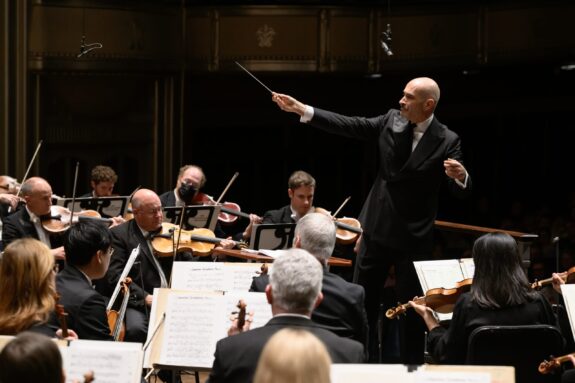
 United States Mendelssohn, Schoenberg, Schubert: Augustin Hadelich (violin), Cleveland Orchestra / Antonello Manacorda (conductor). Mandel Concert Hall at Severance Music Center, Cleveland, 5.2.2026. (MSJ)
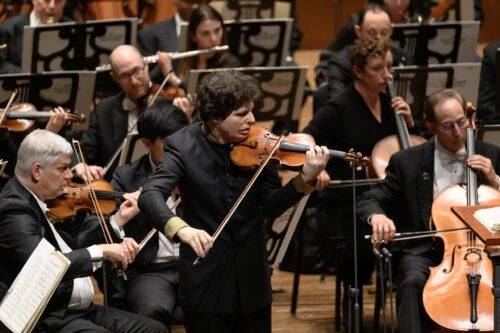
Mendelssohn – Violin Concerto in E minor, Op.64
Schoenberg – Chamber Symphony No.2, Op.38
Schubert – Symphony No.8 in B minor, D.759, ‘Unfinished’
‘I kind of like this guy. He’s not so full of himself’.
That is how an anonymous audience member summed up why many are finding conductor Antonello Manacorda so appealing on his visits to the Cleveland Orchestra. He knows his material, displays genuine ability and doesn’t waste any effort trying to appear flashy or grand. Those are core Cleveland values right there. He is not one of the most famous names among the guest conductors who have visited Cleveland in recent years, but he is one of the best. This concert confirmed that he must be considered at least a dark-horse candidate for the ensemble’s music directorship which will open starting with the 2027/28 season.
Manacorda’s reputation is centered around the outstanding recordings he has made of Beethoven and Schubert symphonies (highly recommended, incidentally), but the key triumph of this concert was his presentation of Schoenberg’s Chamber Symphony No.2. Frankly, I have always considered the work a weak echo of the composer’s vivid Chamber Symphony No.1, a piece that signaled Schoenberg’s move away from traditional late-Romantic lush harmonies by emphasizing intervals of fourths, instead of the sweeter (and more predictable) thirds. He began writing the Symphony No.2 in 1906 on the heels of that first one, but he stalled out as his thoughts propelled him right past tonality and into experimental atonality, which eventually led to the invention of serialism.
Schoenberg never felt like he could dispose of the sketches, though, and after a couple of abortive attempts to finish it, he finally pulled it together in 1939 for the commission of a new work. I was an immediate fan of the First Chamber Symphony when I heard it in my youth, but years of occasional encounters with the Second have never sold me on it. There seemed something insincere about Schoenberg’s seemingly halfhearted return to the rejected framework of tonality after he had done so much work establishing serialism, and I largely regarded the piece as a failure.
It turns out that all I needed was to hear it in Antonello Manacorda’s hands. Manacorda made sure that the music both ‘spoke’ coherently and ‘sang’ expressively in its first movement, the convoluted E-flat minor home key of the Adagio shredding toward dissolution. He caught the sense that the music was trying to forcibly hold together traditional tonality as it danced perilously close to the edge of the cliff. The Cleveland Orchestra players followed his lead and made this gnarly music come to life with rich string textures and vibrant winds. The composer’s touch for unusual colors was heightened with one sinister moment of soft bassoons and muted trumpets glinting against Wesley Collins’s stark solo viola.
The second movement introduced the unexpected concept of ‘fun Schoenberg’ as gestures were tossed through the winds and on to the strings with a brilliant sense of play. But as the movement progressed, one could hear the balkanization of the musical motifs, until the piece ran aground on the rocks of dark, expressionistic chords in the low strings, ending the movement with unanswered agony. This was, to my knowledge, only the third performance of the piece by the Cleveland Orchestra. I reviewed the one from nine years ago, under composer/conductor Matthias Pintscher (here), a Pierre Boulez protégé, but this performance was on an entirely different level and proved the piece worthy of standing beside the First.
Manacorda is far from being just a conductor of difficult obscurities. He led a poised and restrained Schubert ‘Unfinished’ Symphony to close the concert, pacing the first movement moderately and the slow movement flowingly so that they unfolded at essentially the same pulse, two sides of one expressive coin. He made sure that some passages sang but was equally adept at turning a phrase crisply clipped with a flick of his wrist. Conducting the work without a score (which he used for the other pieces), Manacorda showed that he had absorbed the details deeply, remembering for instance that the second theme of the first movement is marked pianissimo in Schubert’s score, whereas many performances juice up the lovely melody. Manacorda refused to let the orchestra even rise to a full roar until the final crisis of the movement. He found a range of dynamics along the way, including numerous varieties of soft levels. The second movement sang sweetly, with gleaming solos from Afendi Yusuf (clarinet) and Frank Rosenwein (oboe). Rosenwein had also shone in the rhapsodic first movement solo. Manacorda was breathtaking in the Andante’s transition points, achieving a fine, accomplished performance.
But one must not forget the evening’s guest soloist, the great Augustin Hadelich, in a poised performance of Mendelssohn’s Violin Concerto. For a time after his death, Mendelssohn was treated as a proto-romantic composer who never quite got there, while the mid-twentieth century turn toward objectivity equally shortchanged the composer as if he were just a classicist forced to put up with an uncomfortable aesthetic of the age in which he lived. It is only in recent decades that a core of insightful interpreters – including previous Cleveland music director Christoph von Dohnányi – came to realize that the key to unlocking Mendelssohn’s genius was the constant presence of an uneasy tension between classicism and romanticism. It is not either/or. It is both.
Hadelich and Manacorda understand this duality and worked hand-in-glove to bring new life to the familiar concerto. Hadelich refused to overcharge the solo part, favoring fast and fleet tempos, and Manacorda refused to just ‘phone it in’ on autopilot, instead actively engaging with detailed phrasing and tempo adjustments. With such dedicated and committed attention, the concerto bloomed anew and brought a strong ovation from the audience, which Hadelich honored with a delightfully jazzy encore, Coleridge-Taylor Perkinson’s ‘Louisiana Blues Strut: A Cakewalk’.
Mark Sebastian Jordan
Featured Image: Antonello Manacorda conducts the Cleveland Orchestra © Yevhen Gulenko/TCO