 Netherlands Netherlands Violin Competition – Oskar Back Concerto Finals: Luna van Leeuwen, Rebecca Roozeman, Yente Lottman (violin), Residentie Orkest / Otto Tausk (conductor). Grote Zaal, Tivoli/Vredenburg; Davina van Wely Concerto Finals: Eline van Dijk, Wendel de Bruijne, Katja Naegele (violin), Britten Youth String Orchestra / Loes Visser (conductor). Hertz Hall, Tivoli/Vredenburg, Utrecht. 31.1.2026. (LV)
Glazunov – Violin Concerto in A minor, Op.82
Saint-Saëns – Violin Concerto No.3 in B minor, Op.61
Haydn – Violin Concerto No. 4 in G major, Hob.VIIa/4
Ernest Bloch – ‘Nigun’ from ‘Baal Shem’
Hawar Tawfiq – ‘Dialogos’
The concerto finals of the Netherlands Violin Competition 2026 came down to three women in their mid-twenties, each of whom played with such authority that it was easy, at moments, to forget this was a competition at all. The Oskar Back Prize and the Audience Award both went to Rebecca Roozeman for her Saint-Saens’s Concerto No.3, while Luna van Leeuwen and Yente Lottman shared second prize after their performances of Alexander Glazunov’s Violin Concerto. In the afternoon, Katja Naegele won the Davina van Wely Prize, open to violinists aged 14 to 17.
Across both finals, one sensed a generation of Dutch violinists shaped not only by the country’s famously strong early training and traditions, but by an unusually early exposure to international stages, standards and expectations. At the Davina van Wely level, this internationalism appears less as formal study abroad than as circulation: competitions, masterclasses, festivals, tours and appearances in major halls at an age when many young players are still working primarily within a local frame. By the time these musicians reach the Oskar Back stage, international mobility and study feel less like a leap than a continuation of a path already well underway.
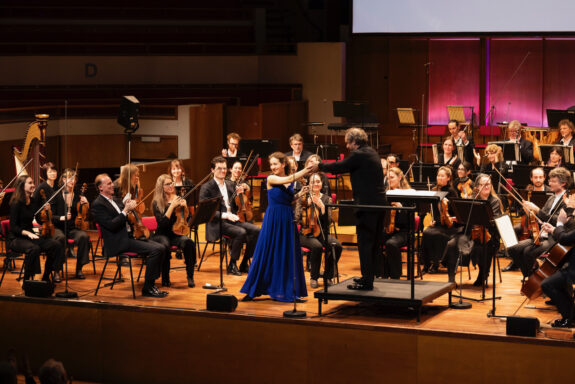
The Oskar Back Prize – The finale in Tivoli/Vredenburg’s Grote Zaal was notable not only for the level of the soloists, but for the way the Residentie Orkest under Otto Tausk played throughout the evening. The orchestra was richly present – sonorous, alert and finely balanced – and unfailingly sympathetic, able to fill the hall with sound without ever crowding the violinists. Tausk’s podium manner was lithe and self-effacing, shaping the music from within rather than from above. The atmosphere that resulted was unusually relaxed: these felt like true concerto performances, not competitive encounters, and the audience sensed the difference.
1) Luna van Leeuwen: Glazunov on a tightrope – From the opening bars of Glazunov’s Violin Concerto, Luna van Leeuwen established a warm, grounded presence, her low-register slurred lines rich and secure. The strings answered with a broad, generous statement of the opening idea, and the relationship between soloist and orchestra felt immediately sympathetic. Its single-span design, dense textures and sudden accelerations can be difficult to synchronize convincingly in real time. Van Leeuwen leaned into that volatility rather than smoothing it away. In the most brilliant writing, that commitment occasionally brought a sense of pressure and moments where ensemble alignment felt hard-won. Still, the musical intention was clear, and the risks were musically worth taking.
2) Rebecca Roozeman: Saint-Saëns and authority rewarded – Rebecca Roozeman (who won the award) chose Saint-Saëns’s Third Violin Concerto, and her connection with the audience was unmistakable. Her playing projected calm assurance and clarity. She let the concerto unfold in broad, elegant paragraphs, trusted the music’s natural flow and avoided exaggerated contrasts. The orchestra responded attentively, the woodwinds seeming to lean in toward her with their phrasing and subtle colors rather than competing.
Roozeman’s radiant solo passages near the end glowed warmly and an oboe glowed back. Her Saint-Saëns persuaded neither through display nor mere familiarity, but through freedom held within clarity: the line could breathe, yet the music’s pulse and direction were always unmistakable. That balance – playing freely while letting everyone see exactly where the next beat lives – is what audiences and jurors respond to. .
3) Yente Lottman: Glazunov as narrative – Yente Lottman’s Glazunov suggested a violinist already thinking beyond the competitive frame. From the first bar, the concerto unfolded with a passionate flow, the orchestra responding instantly to her phrasing. Nothing felt routine; each phrase carried its own inflection, and even the orchestral surges seemed shaped in response to her lead. Lottman’s technical command was evident without ever becoming the point. Runs spoke clearly, double-stops lay comfortably under the hand, and the concerto’s bravura was absorbed into a broader narrative. In quieter moments, her lyrical shaping drew the listener in, and the cadenza emerged as a natural continuation of the musical argument.
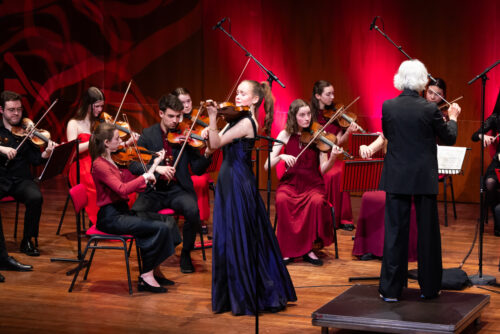
The Davina van Wely Prize: three beginnings – The Davina van Wely Prize finals in the 400-seat Hertz Hall offered a striking contrast of personalities, shaped within a remarkably outward-looking Dutch training culture and backed by the alert, responsive Britten Youth String Orchestra under Loes Visser. Each finalist – Eline van Dijk, Wendel de Bruijne and Katja Naegele – performed the complete Haydn Violin Concerto No.4 and Bloch’s ‘Nigun’, a pairing that proved quietly revealing.
Eline van Dijk entered to enthusiastic calls from young supporters in the balcony. The orchestra played with the affection and quick responsiveness so characteristic of youth ensembles in the Netherlands. As the Haydn unfolded, van Dijk’s playing gained snap and charm, a brief portamento hinting at its kittenish charms. In ‘Nigun’, her focus deepened, the line darkening as she leaned into its inward intensity.
Wendel de Bruijne played with pronounced physical engagement, shaping phrases through varied bowings and dynamics and entering into lively dialogue with the orchestra. Her first-movement cadenza was very long. In ‘Nigun’, that same commitment translated into urgency.
Katja Naegele (who won the award) was the most virtuosic of the three, shaping the cadenza in the Haydn with instinctive proportion, and drawing a pure, singing line in the slow movement. Her eye contact with the orchestra – especially the leader – created an immediate sense of shared intent, and the Finale sparkled with rhythmic lift. In ‘Nigun’, soloist, conductor and orchestra aligned in what felt like a genuine cry from the heart, intensity and control held in finely judged balance.
While the jury and audience deliberated over the Oskar Back Prize, violinist Martine Velthuis and pianist Kanako Inoue performed ‘Dialogos’, commissioned by the Competition. The piece, which lasts about eight minutes, unfolds as a continuous dialogue: scratches, buzzes, sudden lyricism and restless motion interweaving with the piano. A long, searching line emerged, dissolved into frenetic energy, then found consolation on the G string. The violinist reached directly into the piano to pluck its strings, and flashes of color led to a quiet, unexpected pizzicato ending.
Laurence Vittes
Featured Image: Oskar Back 2026 Winner Rebecca Rozeman © Marieke Wijntjes